
The sun could be getting dimmer. Is another Little Ice Age on the way?
I received an interesting question by way of an email from a reader: “Do you believe that a grand solar minimum will have a significant effect on future global temperatures?”
To start with the basics, a solar minimum is the period of least solar or sunspot activity in the 11-year solar cycle of the sun. In contrast, a grand solar minimum is hypothesized to last for decades.
To look further into the cycles of the sun and their impact on global warming, I decided to forward this question to Ray Weymann, who lives in Atascadero. Weymann is a retired director and chair of the Astronomy Department at the University of Arizona and director and staff member emeritus of Carnegie Observatories in Pasadena.
Here is his thoughtful response.
Visualize Moscow in winter, and you may think of people in fur hats making their way through bone-chilling temperatures in the mid-teens.
Yet visit Glasgow, Scotland in mid-winter, and the average low temperature is several degrees above freezing, despite the two cities having the same latitude.
A significant reason for this difference is the warm ocean water carried up to Scotland by the Gulf Stream.
But England and Scotland have not always enjoyed such mild winter weather.
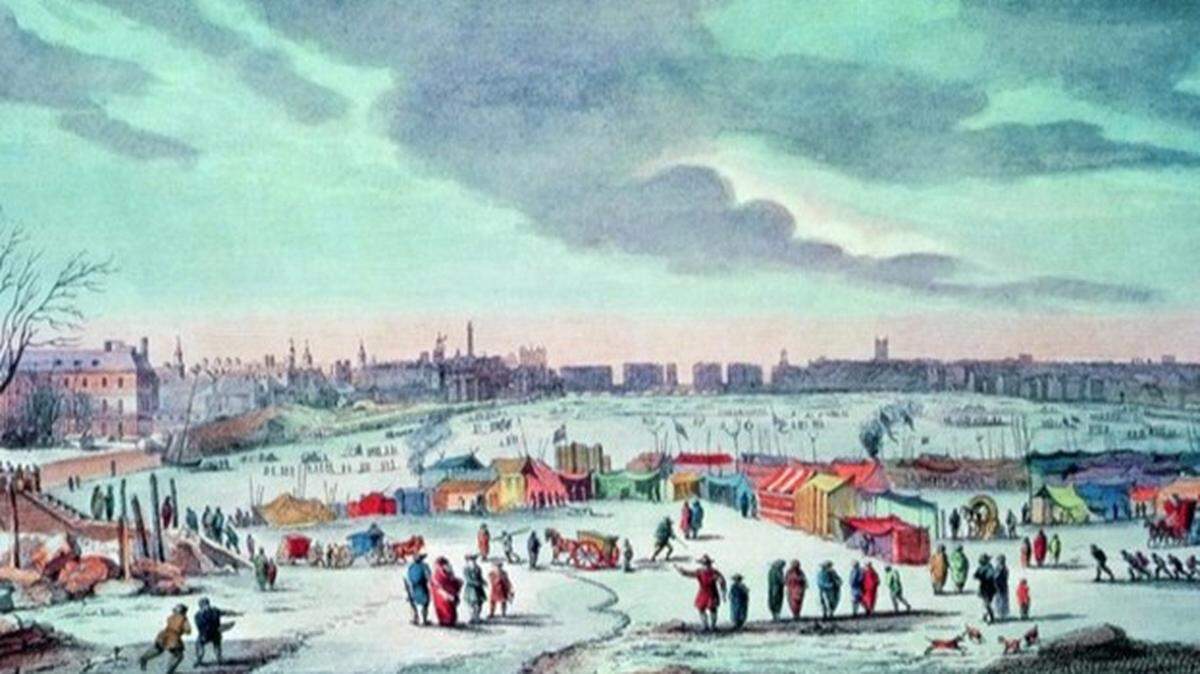
Look at London in the winter of 1683 and 1684, when so-called “frost fairs” were held on the frozen Thames Rivers and people endured bitter cold and crop failures.
This winter fell during a period of a few centuries with long cold snaps primarily felt in Europe. This period is known as the Little Ice Age, as distinguished from more severe cycles of many thousands of years of vast glaciers.
There is no scientific consensus on the leading cause of the Little Ice Age. Shifts in atmospheric pressure patterns and ocean currents such as the gulf stream may have contributed.
So too may have been periods of volcanic activity more vigorous than usual, since ash spewed into the sky prevents some sunlight from reaching the earth’s surface.
A third possible contributor may have been a slight dimming of the sun itself.
Shortly after the invention of the telescope, astronomers daily projected images of the sun to record the number of sunspots. (Warning: Never look directly at the sun through a telescope!)
Records show that the sun was virtually spotless during a period from about 1640 to 1700. Modern observations from space have established a strong relationship between periods when there are lots of sunspots and a very slightly brighter-than-average sun, and a marginally fainter sun with periods with few spots.
Typically, the sun goes through an 11-year cycle with lots of spots to one with few spots.
But one group of solar astronomers think we may head for another prolonged period of few spots and solar dimming, while others disagree.
Upwelling currents of the electrically conducting gases in the sun generate the sun’s magnetic fields, which give rise to the sunspots.
Complete understanding of even the 11-year cycle, let alone longer-term changes, is still in the future, however.
Nevertheless, suppose the first group is right. Should we then worry about another Little Ice Age? Almost certainly not. Here is why.
While fluctuating changes in ocean and atmospheric circulation cause regional climate changes, long-term global changes are caused by changes in the overall energy flow in the earth’s climate system.
All our warmth comes from 70% of the sun’s energy that is not reflected back to space.
The Earth maintains energy balance by radiating an equal amount of heat energy back into space. It is considered “self-adjusting” since the amount of this radiated energy depends upon the Earth’s surface temperature; a higher surface temperature radiates more heat.
But only about 60% of this energy can escape to space, while 40% is re-directed by greenhouse gases, such as carbon dioxide, back to the Earth’s surface.
Change any of these energy factors, and you will warm or cool the earth as it tries to restore energy balance. We are currently changing one of these factors by rapidly increasing greenhouse gases in the earth’s atmosphere, warming our world.
But would the amount of solar dimming that we may experience overcome this? Only for a short period of time.
We can now calibrate the amount of reduced solar energy experienced during the Little Ice Age. Due to the increased heat-trapping at our present rate of increased greenhouse gas levels, in just six years or so, the effects of a dimming sun would be overcome, and further warming will continue.
The message is clear: We must reduce our dependence on fossil fuels as our primary source and switch to sources that do not produce greenhouse gases.
A period of a spotless sun will not spare us from further warming.
For a detailed discussion of this subject and other aspects of climate change, please visit centralcoastclimatescience.org.
Diablo Canyon Power Plant microclimates
We are so fortunate to live on the Central Coast.
You can view a beautiful video describing the microclimates surrounding the Diablo Canyon Power Plant along the Pecho Coast, with scenic views of the hills, canyons, trails and ocean, at https://youtu.be/SjPY_8zapdg.