
California has been in a drought since 2000. What’s in store for the future?
In 2002, now retired climatologist Bill Patzert predicted a decades-long drought for California due to changes in the Pacific Decadal Oscillation (PDO) and global warming, which he now calls global heating.
“Rainfall in California is controlled by natural forces like the decadal PDO signal and the shorter-term phases of the El Niño-Southern Oscillation (ENSO),” said Patzert, who made the prediction while he was at NASA’s Jet Propulsion Laboratory. “The (global) heating of our state is an important new element in rain patterns. The rain season has become compressed, starting later and ending earlier. Finally, how we manage our water can impact droughts, for example, over drafting of aquifers and groundwater basins cause self-inflicted water shortages.”
“So, our water supply is impacted by natural climate variability, global heating creating new trends in rainfall and human behavior in how we manage our precious water resources,” Patzert explained.
The PDO is found primarily in the northern Pacific Ocean. The phases of the PDO are called warm or cool phases.
El Niño, La Niña or the infamous neutral condition known as El Nada or El Nothing focus on sea surface temperature in the central equatorial region of the Pacific Oceano. The PDO is classified by seawater temperatures throughout the northern Pacific.
Overall, the cool phase of the PDO often brings lower amounts of rain and snow to the Golden State, while the warm phase can enhance the impacts of El Niño and produce a greater amount of precipitation.
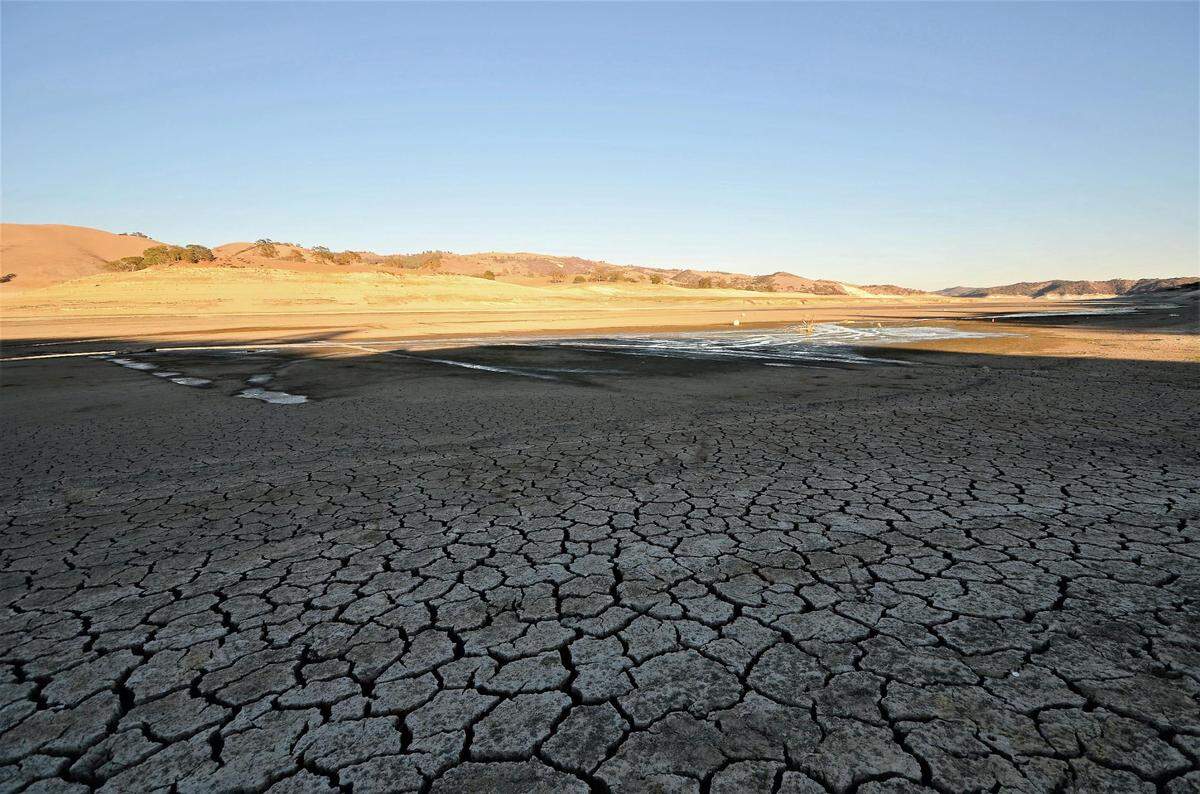
The hypothesis Patzert made more than two decades ago for the Western United States was verified, and he predicts that this condition will continue for much of California in the future. That is not very reassuring since we live in a semi-arid area.
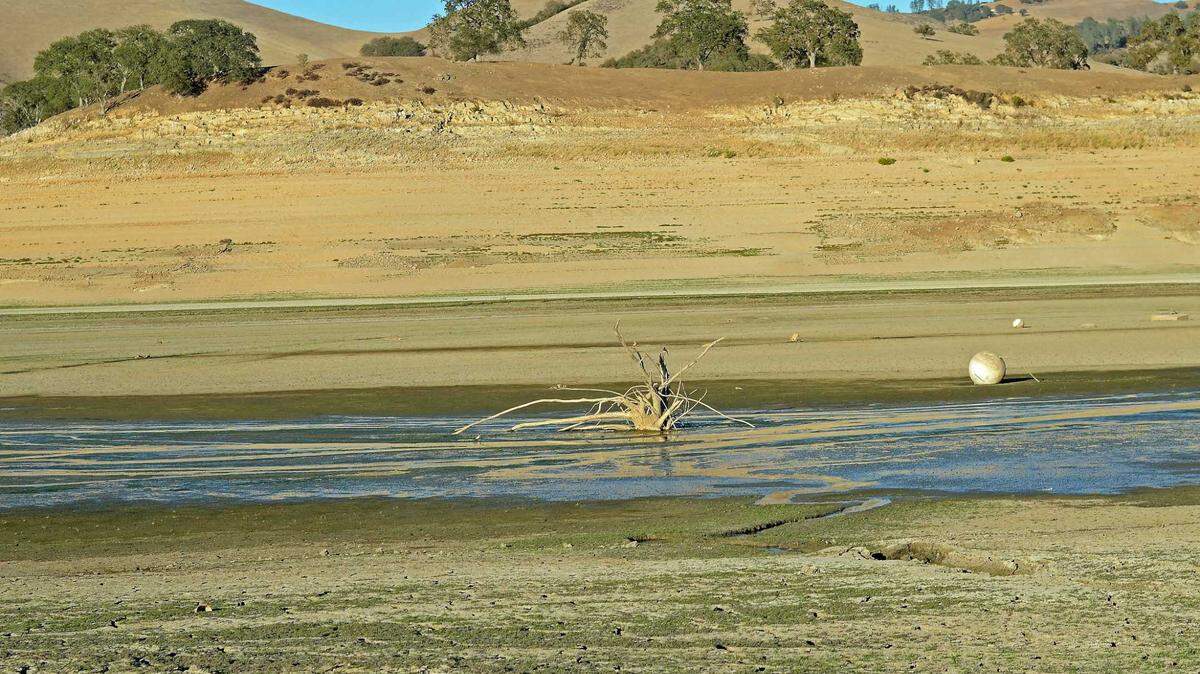
“We’ve really been in a drought since 2000, with some wet years (2005, 2010, 2011 and 2017) in Central California,” Patzert told me. “Since the beginning of this century, Lake Mead, the largest reservoir in the Western U.S., has dropped precipitously on and off. It is now only at about a third of its full capacity.”
“The wax and wane of wet years have given many a false sense of security,” he went on to say. “However, California has entered ‘a new normal’ of significantly more dry years resulting in lower lake levels, less groundwater, depleted aquifers, and skimpier Sierra Nevada snowpack.”
The short-lived relief of a wet year is followed by the constant worry of the dry years. As Michael Corleone says in “The Godfather: Part III,” Just when I thought I was out, they pull me back in.”
Unfortunately, with the wettest part of this rain season — which runs July 1, 2020, through June 30, 2021 — well past us, the below-normal amounts of rainfall for most of the winter months pulled many of us back into a state of worry.
Much of the Central Coast has only received about a third to a half of its average rainfall.
Even though a few Central Coast locations recorded some measurable precipitation in April, many did not. Diablo Canyon Power Plant near Avila Beach reported its first dry April since 1976, when weather data was first collected.
If not for the late January atmospheric river event that stalled over Cambria and retrograded northward toward Big Sur, before moving southward into southern San Luis Obispo and northern Santa Barbara counties, this would have been one of the driest years on record since 1869 at Cal Poly.
Cal Poly’s Irrigation Training and Research Center maintains the longest continuous rainfall observations that I could find for the Central Coast; they’re available online at www.itrc.org.
Meteorologists simply referred to atmospheric rivers as “the hose,” and for a good reason.
The time-lapse radar presentation from the atmospheric river that hit the Central Coast in January looked like somebody holding a water hose somewhere far out over the Pacific Ocean washing down Central California with a stream of fluid.
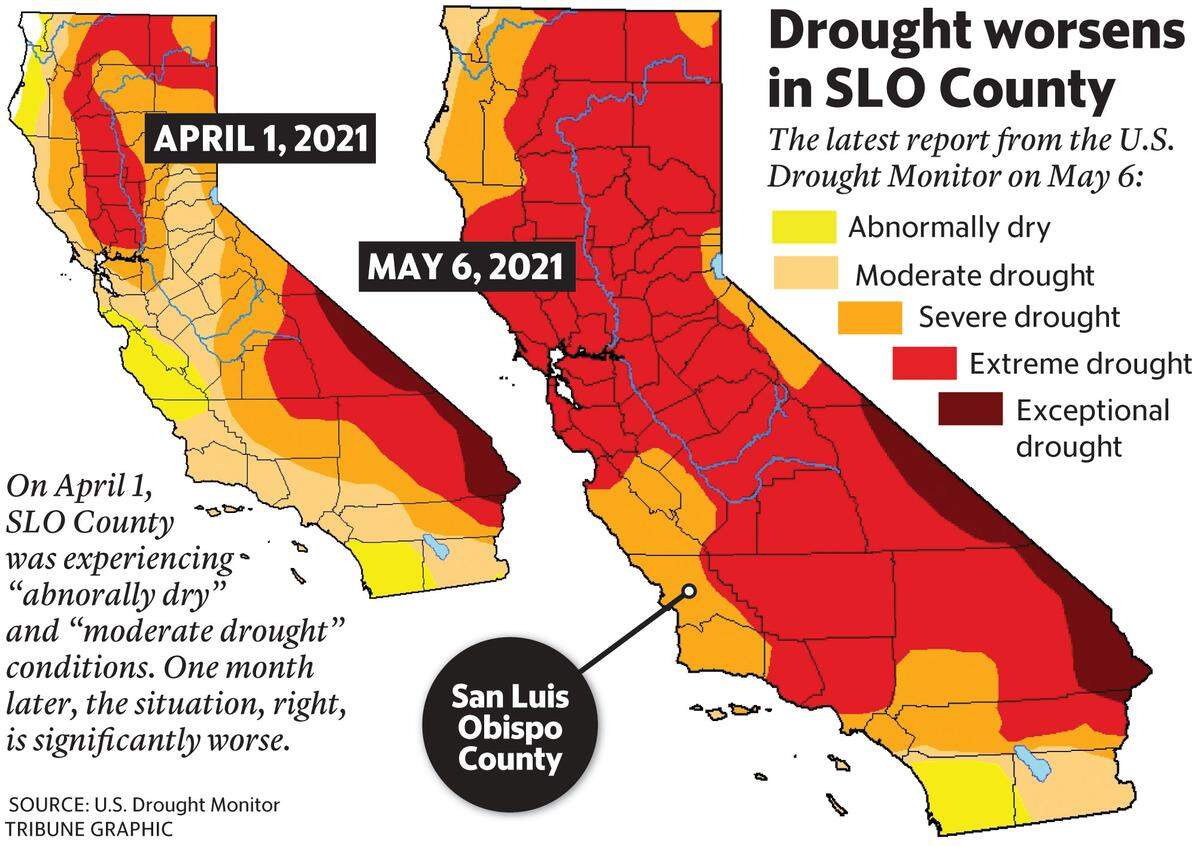
Despite January’s atmospheric river, last week’s U.S. Drought Monitor shows the entire Central Coast in a “Severe Drought (D2)” classification. Much of the Bay Area increased to “Extreme Drought (D3).”
The Drought Monitor map is updated weekly and is a joint effort by the NOAA, the U.S. Department of Agriculture and the National Drought Mitigation Center (NDMC) at the University of Nebraska-Lincoln.
So, what will next year’s rain season bring? Last year I predicted below-average rainfall due to the La Nina.
“The presence of a La Nina, the notorious ‘Diva of Drought’ present at the equator, doesn’t bode well for winter rainfall,” said Patzert at the time.
Historically, La Niña conditions typically produce lower-than-average winter rainfall. However, there have been La Niña years that have seen well above average rainfall amounts.
The Climate Prediction Center is advertising neutral conditions developing this spring and continuing through summer. It is interesting to note that several of the numerical model runs indicate a moderate El Niño developing next winter while others are showing a La Nina condition.
At this time of the year, these predictions often change. Here is why.
We’re in the so-called “spring predictability barrier,” when predictions are difficult because the El Niño Southern Oscillation (ENSO) is often in transition from one phase to another in spring.
For example, a La Niña phase could be decaying and passing through a neutral condition to an El Niño condition, or vice versa.
Of course, as you get closer to winter, the models become more accurate because there is less time for inaccurate oceanographic and atmospheric data to be amplified at model initialization. Many climate scientists think the most reliable strategy is “wait and see” at this time of the year.
PG&E Safety Action Center
Given the exceptionally dry conditions all over California, all the experts are anxious about an
early and long fire season. To mitigate the damage from fires, simple tasks such as trimming back trees, shrubs and bushes and creating defensible space around a home or business can help make neighborhoods and communities safer.
PG&E’s Safety Action Center website offers easy-to-use educational videos and visual guides with tips on how to create defensible space, which is the buffer area between a home and any vegetation or material that could fuel a wildfire.
Find out more at www.safetyactioncenter.pge.com.
This story was originally published May 11, 2021 at 5:05 AM.