‘Extreme’ drought is edging into SLO County from the Valley, latest map shows
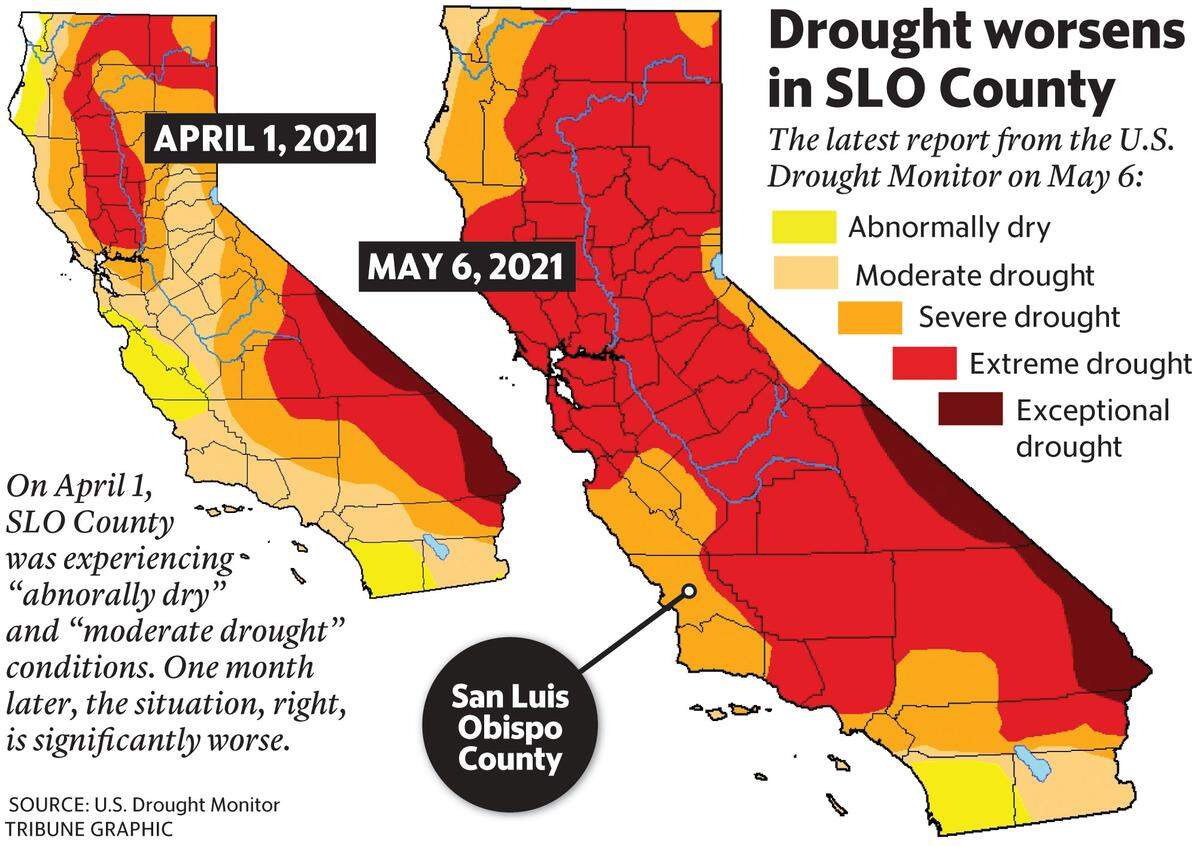
All of San Luis Obispo County is now experiencing “severe” or “extreme” drought conditions, the latest map from the U.S. Drought Monitor shows.
The map, released Thursday, shows how dramatically conditions have changed from just one month ago, when most of SLO County was “abnormally dry” or in “moderate drought.”
As of Thursday, all of the county is living under at least “severe drought” conditions, and roughly 18.5% of the population — about 49,800 people — are living in “extreme drought” conditions, according to the monitor.
“I was startled by the rapid increase in drought severity at the end of our rain season,” PG&E meteorologist John Lindsey told The Tribune on Friday.
This far into the rain year, when there’s not a lot of chance of future precipitation to help mediate some of those drought impacts, that’s pretty worrying, Lindsey said.
Lindsey said on average, San Luis Obispo receives about 0.43 of an inch of rain in May and only 0.12 of an inch in June.
It’s likely SLO County won’t get any rain through the middle of May this year, but there is “a slight chance of precipitation toward the end of this month,” Lindsey said.
“However, it would not be enough to help much,” he added.
Most of California in ‘extreme’ drought conditions or worse
Thursday’s troubling update also shows that nearly three-quarters of California by land area is in “extreme” drought conditions or worse, including the entire Sacramento Valley and Bay Area.
The monitor shows 98% of California is in at least “moderate” drought, 93% in “severe” drought, 73% in “extreme” drought and 5% in “exceptional” drought conditions. The entirety of the state is at least “abnormally dry.”
The extreme category is up from 53% just a week earlier, and from just 4% this time last year.
The quickly worsening conditions follow another winter of below-average rainfall, with a dire water situation reflected in well-below average snowpack totals in the Sierra Nevada, and reservoirs much below their normal levels.
Only Gov. Gavin Newsom has the power to official declare California to be in a drought. Newsom did declare a drought emergency last month, but only for Sonoma and Mendocino counties.
Fire risk grows across California
Across the state, weather officials and fire personnel are bracing for another weekend of high fire risk, with gusty winds again forecast to coincide with hot and dry conditions.
The National Weather Service has issued a fire weather watch for the Sacramento Valley and northern San Joaquin Valley, in effect Saturday morning through Monday evening. A fire weather watch is one step below a red flag warning, but red flag warnings often start as a watch and are then upgraded.
The region will see sustained winds from 10 mph to 20 mph, with gusts up to 35 mph possible in some areas. Near the capital, gusts are expected to reach about 30 mph Saturday and 25 mph on Sunday.
“Strongest wind expected along the west side of the Sacramento Valley and through favorably oriented gaps and canyons in the surrounding foothills,” the fire watch bulletin from NWS advises.
Fire and weather officials have warned for months that conditions are prime for another devastating wildfire season this year.
“Not all aspects of coming fire season are predictable. Last year’s dry lightning event was not foreseeable months in advance,” UCLA climate scientist Daniel Swain tweeted Thursday. “But severe and still-worsening drought and extremely dry vegetation — plus strong expectation of hotter-than-average summer — are deeply concerning.”
With summer still weeks away, Cal Fire shared an infographic Wednesday showing that 13,604 acres have already burned on state and federal land this year, compared to 1,726 by the same point last year. The 2020 wildfire season was by far the worst in modern California history in terms of acres burned, with over 4.2 million acres scorched.
This story was originally published May 8, 2021 at 11:30 AM with the headline "‘Extreme’ drought is edging into SLO County from the Valley, latest map shows."