
Sequoia trees have witnessed centuries of climate change. What has happened in 50 years?
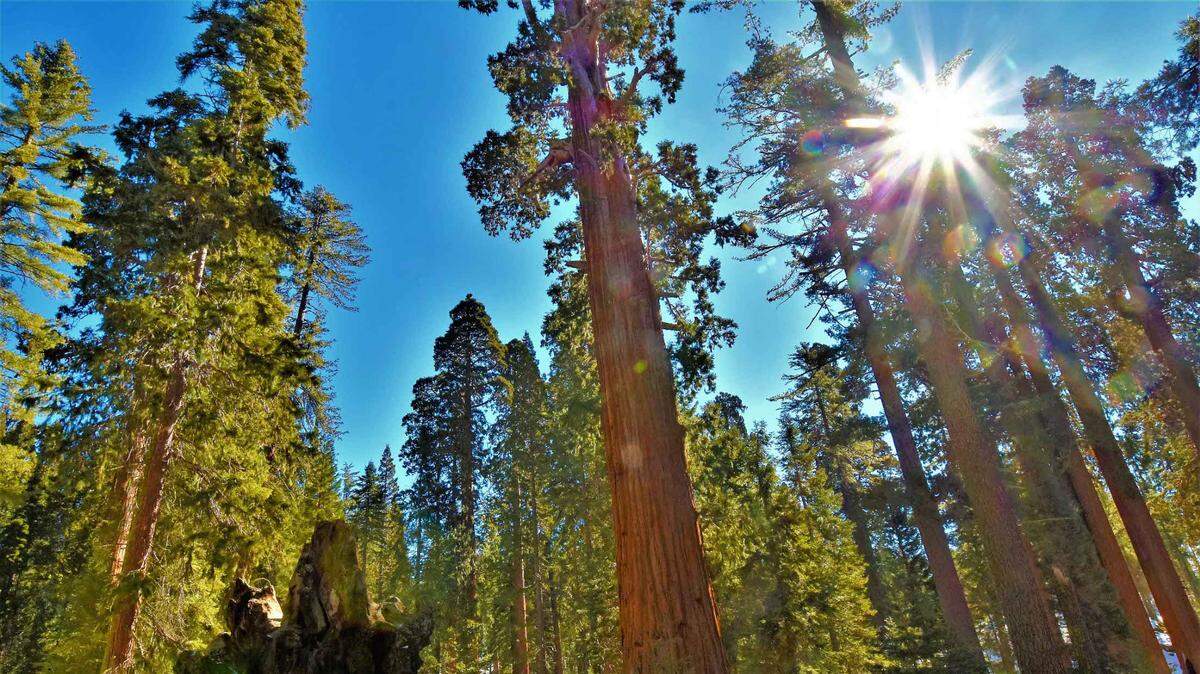
I recently spoke with Rick London, CEO of United Way of San Luis Obispo County, about Earth Day and the subject of giant sequoia trees in Sequoia National Park came up.
Sequoias, also known as Sierra redwoods, are the largest trees on Earth and can live for more than 3,500 years. Few life experiences can match standing in one of these redwood groves.
When the trees die, it is often indirectly because of root weakening.
Rick told me about one massive tree that toppled over in the park in 1998. That year, one of the most potent El Niño events ever seen produced near or record amounts of snow and rain throughout California.
The memory of that giant sequoia on the ground left a lifelong impact on him and has increased his desire to preserve the environment.
These redwoods have witnessed a lot of climate history, but never at the same pace as in the past 50 years. Here is why.
The first Earth Day was celebrated on April 22, 1970.
During that time, the carbon dioxide (CO2) level in the planet’s atmosphere was 320 parts per million (ppm).
In April, Earth’s carbon dioxide level was nearly 419 ppm as measured at the Mauna Loa Observatory in Hawaii.
This unprecedented increase in carbon dioxide is mostly from burning fossil fuels.
“Fossil fuels like coal and oil contain carbon that plants pulled out of the atmosphere through photosynthesis over the span of many millions of years,” the American Meteorological Society and National Oceanic and Atmospheric Administration said in 2019 in their State of the Climate statement. “We are returning that carbon to the atmosphere in just a few hundred years.”
According to Pennsylvania State University meteorology professor David Titley, “To compare that to something readers may be familiar with, a blood alcohol level of 0.04%, or 400 ppm, puts a partygoer well on the way to intoxication. If we increase our blood alcohol to 0.08%, or, 800 ppm, we are legally impaired.”
Carbon dioxide is a greenhouse gas. That means it functions like the glass in a greenhouse, allowing the sun’s light to pass through, but trapping the infrared radiation (heat) near the Earth’s surface.
Natural climate change occurs over thousands of years due to variations in Earth’s orbital cycles around the sun.
Eccentricity, the deviation of our planet’s orbit from a perfect circle, is a 100,000-year cycle. Earth’s axial tilt varies over a 41,000-year process, and Earth’s precession (wobble) on its axis occurs over a 26,000-year progression.
Unlike natural climate change that happens over millennia, human-induced global warming is occurring over mere decades.
Since 1970, the average U.S. temperature has warmed by 2.4 degrees Fahrenheit, according to Climate Central, an independent group of scientists and communicators who research and report the facts about our changing climate.
Temperature data from its website, ClimateCentral.org, indicates that Santa Maria Airport has seen a 3-degree increase in average temperatures since 1970.
South of the Central Coast, Los Angeles has warmed by 0.5 degrees Fahrenheit, while San Francisco is 2.8 degrees hotter.
Reno, Nevada, saw the most significant increase in the United States at 7.6 degrees, followed by Las Vegas at 5.8 degrees.
Rising air temperatures is a problem, but the world’s oceans may pose even a greater challenge.
The oceans are absorbing 93.4% of this heat, said Josh Willis of the Jet Propulsion Laboratory (JPL).
Willis and the NASA Oceans Melting Greenland (OMG) team have flown out of Greenland’s airfields for years. They have deployed numerous bathythermograph (BT) buoys that measure seawater temperatures from a recently refurbished Douglas DC-3 cargo plane around Greenland’s glaciers.
They have recorded a warming of Atlantic Ocean seawater in contact with these glaciers, resulting in more significant melting.
On average, the Greenland ice sheet is now losing about 281 billion tons of ice per year. But in 2019, a record for ice loss at 532 billion tons was reported.
So far, the loss of ice has resulted in nearly half an inch of sea-level increase worldwide.
If all the ice were to melt from Greenland, it would produce a 25-foot rise in sea level.
Willis told me that about 40% of the recent sea-level increase is due to thermal expansion of the ocean, 30% from land glaciers, and 30% from the melting of the ice sheets in Greenland and Antarctica.
In the future, the rate of sea-level rise will increase, with the main contributor being the melting of the ice sheets.
By 2100, most climate scientists are expecting about a 47-inch increase in sea level.
PG&E offers renewable energy
PG&E exceeded California’s Renewables Portfolio Standard (RPS) goal requiring energy providers to deliver 33% renewable energy by the end of 2020.
PG&E estimates that it delivered more than 35% from specified eligible renewable resources to its customers in 2020.
Overall, more than 88% of the electricity PG&;E delivered to its customers last year came from greenhouse gas (GHG)-free resources, including eligible-renewable, nuclear, and large hydroelectric energy. To learn more, please visit www.pgecurrents.com.
This story was originally published April 27, 2021 at 5:05 AM.