
Record heat on the Central Coast indicates a troubling trend, meteorologist says
I am often asked what is the difference between weather and climate? Weather is the short-term atmospheric condition, essentially the day-to-day winds, temperatures, humidity levels, cloud cover, visibility, and precipitation (drizzle, rain, hail or snow).
In other words, “What will it be like tomorrow?”
On the other hand, the climate is long-term state of the atmosphere and ocean, often measured over a 30-year average. For example, “Will it be foggy along the beaches next July?”
Basically, the weather is one play in a baseball game. Climate is the history of Major League Baseball.
Natural climate change occurs over thousands of years due to variations in Earth’s orbital cycles around the sun.
Eccentricity, the deviation of our planet’s orbit from a perfect circle, is a 100,000-year cycle. Earth’s axial tilt varies over a 41,000-year process, and Earth’s precession (wobble) on its axis occurs over a 26,000-year progression. (If you’re curious about that, read the article “Milankovitch (Orbital) Cycles and Their Role in Earth’s Climate” by Alan Buis of NASA’s Jet Propulsion Laboratory at https://climate.nasa.gov.)
Unlike natural climate change that happens over the millennia, human-induced global warming is occurring over mere decades.
A straightforward way to measure a critical aspect of global warming is to review longer-term temperature records.
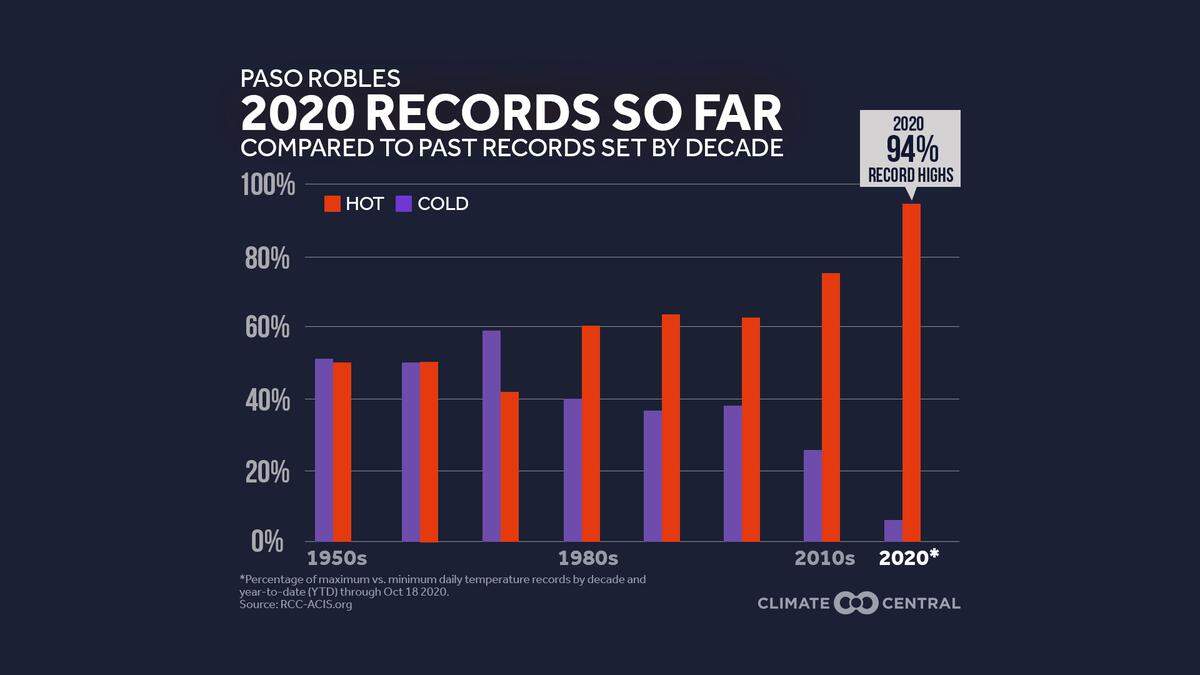
In this case, a picture or a graph is worth a thousand words. This adage certainly gives an uncluttered image of air temperature change along the Central Coast.
.jpg "image001 (9).jpg")
The temperature data for these informative graphs come from Climate Central, an independent group of scientists and communicators who research and report the facts about our changing climate.
If our climate was in equilibrium, you would expect an equal number of high-temperature records and low-temperature records on the Central Coast.
This condition occurred throughout most of the 1900s at the Paso Robles and Santa Maria airports. The number of high-temperature records started to outpace low-temperature records later in the 20th century and accelerated into the early part of the 21st century.
The Paso Robles Municipal Airport during the 2010s reported about 75% of the daily record temperatures were highs and only 25% were lows. At the Santa Maria Airport, it was even worse; 95% of the all-time daily records were highs and only 5% were lows.
.jpg "Santa Maria (1).jpg")
It is troubling to see the record high and low temperature data trending in this direction. In fact, average yearly temperatures are forecast to rise by six degrees Fahrenheit by the end of this century.
“By adding heat energy to the atmosphere, climate change makes naturally occurring extreme events, such as wildfires and heat waves, worse and more frequent,” Climate Central meteorologist Sean Sublette told me.
Overall, warmer air temperatures, stronger winds and abundant fuel have fed into a dreadful feedback loop.
According to Cal Fire, a 300% increase in wildfire risk in California’s non-urban areas is predicted by 2050 due to climate change.
A warming atmosphere may also lead to a significant impact on our health.
Dr. Bruce Bekkar of Delmar wrote, “The current human cost of climate change in America is not limited to the death tolls of headline-grabbing superstorms, floods and heatwaves. Although extreme weather events are increasing, evidence now clearly connects our global warming to additional, more prevalent dangers, including warmer average temperatures, worsening air pollution, new infectious agents, and acute and chronic stress.”
When Bekker attended medical school back in the 1980s, he said, he only spent two hours over four years on tropical infectious diseases because students were told they would never see them unless they moved to the lower latitudes toward the Earth’s equator.
Since the time he attended medical school, tropical infectious diseases have spread northward. Today, many of those tropical diseases are now occurring in the United States.
Even though it will worsen before it gets better, by reducing the amount of fossil fuels we burn, for example, in automobiles, we will see a rapid increase in air quality, which will improve everyone’s health.
PG&E remains committed to helping California meet its bold clean energy and greenhouse gas reduction goals. To learn more, please visit www.pge.com.
This story was originally published October 27, 2020 at 5:00 AM.