
What’s in store for SLO County weather? Forecast calls for late sunrises, chilly mornings
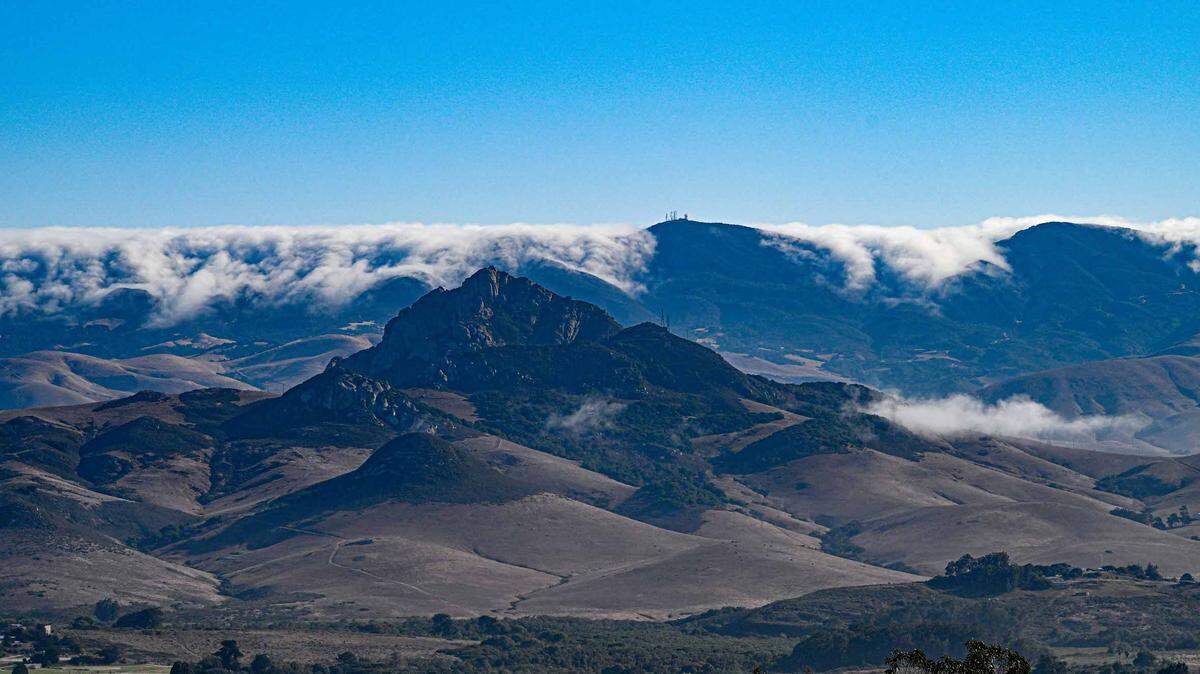
This week, and possibly into the next, Santa Lucia (northeasterly) winds will dominate, bringing mostly clear skies, low relative humidity, chilly mornings and mild afternoons.
Although the winter solstice on Dec. 21 marked the shortest day of the year, the coming days this week will feature the latest sunrises of the year, occurring at 7:12 a.m.
Fresh to strong (19 to 31 mph with gusts up to 40 mph) Santa Lucia (northeasterly) winds are expected from today through Monday morning. Gusts could peak at 55 mph in specific areas, including Highway 41 between Morro Bay High School and Atascadero (midway up the hills), coastal canyons like Diablo Canyon, and parts of eastern San Luis Obispo such as Cal Poly, San Luis Obispo High School and the French Hospital Medical Center.
On Monday afternoon, the forecast calls for fresh to strong (19 to 31 mph) northwesterly winds, decreasing by the evening. These onshore winds will bring areas of marine low clouds to the coastal regions.
Starting Tuesday and continuing through Saturday, a pattern of moderate to fresh (13 to 24 mph with gusts up to 35 mph) Santa Lucia winds are expected to develop overnight and morning, decreasing and shifting out of the northwest winds during the afternoon.
This pattern will maintain mostly clear skies and low relative humidity, with occasional mid to high-level clouds streaming over the Central Coast. Additionally, overnight low clouds and fog will likely move into the inland valleys.
As far as temperatures are concerned, overnight temperatures will dip into the mid-30s in inland valleys like Paso Robles and the mid-40s in coastal valleys such as San Luis Obispo and along the beaches.
During this time of year, coastal areas tend to be warmer than inland regions. Coastal valleys and beaches are expected to gradually warm, reaching the mid-60s early in the week and climbing to the mid-70s by the latter half.
Meanwhile, inland valleys will see temperatures rise from the low 60s Sunday through Tuesday to the high 60s from Wednesday through Saturday.
For the upcoming week, some models previously suggested that a cut-off, low-pressure system might bring rain. However, the latest runs of the American and European numerical models indicate dry conditions persisting through the end of January.
Surf report
The wave event of Dec. 23, 2024, will be remembered as a record-breaking phenomenon.
Extensive analysis has confirmed it as the most powerful swell ever recorded by the Diablo Canyon Waverider Buoy, which has been in operation since June 1983.
While the wave height wasn’t the highest ever measured, the period and wavelength were the longest observed. This combination led to unprecedented wave energy, calculated as the product of the wavelength and the square of the wave height.
This Saturday, a 7- to 9-foot northwesterly (295-degree deep water) swell (with a 14- to 17-second period) will gradually decrease to 6 to 8 feet (with a 13- to 15-second period by Sunday).
On Monday morning, a 5- to 7-foot northwesterly (290-degree deep water) swell (with a 12- to 22-second period) will develop along the coastline.
Strengthening northwesterly winds on Monday afternoon will generate a 7- to 9-foot northwesterly (305-degree deep water) sea and swell (with a 5- to 20-second period).
These conditions will persist into Tuesday, maintaining the same height but with a period of 7 to 17 seconds.
From Wednesday through next Saturday, a 5- to 7-foot northwesterly (300-degree deep water) swell (with an 8- to 16-second period) is forecast along the coastline.
Surface seawater temperatures will range between 53 and 55 degrees through next Saturday and Sunday.
On this date in weather history (Jan. 5)
1904: Bitterly cold air gripped the northeastern United States, with morning lows of -42 degrees at Smethport, Pennsylvania, and -34 degrees at River Vale, New Jersey, which established state records. (The Weather Channel)
1913: The temperature at the east portal to Strawberry Tunnel, Utah, reached -50 degrees to tie the record established at Woodruff on Feb. 6, 1899. (David Ludlum)
1982: A three-day rainstorm in the San Francisco area finally came to an end. Marin County and Santa Cruz County were drenched with up to 25 inches of rain, and the Sierra Nevada Range was buried under 4 feet of snow.
2017: Persistent southerly winds interacting with relatively low-level and abundant moisture over the Pacific Ocean combined with plenty of orthographic enhancement produced heavy rainfall along the coast and in the coastal valleys, but only light amounts of rain in the inland areas. The 3.25 inches of rain at Diablo Canyon was the most precipitation received during a 24-hour period since Dec. 18, 2010, when 3.32 inches were recorded. The greatest 24-hour rainfall total at Diablo Canyon was 8.54 inches reported on March 10, 1995.
2021: A weak cold front moved through our area with light rain. The Walter Ranch above Cambria in the Santa Lucia Mountains reported the most rain at 0.26 of an inch.
This week’s temperatures
LOWS AND HIGHS, PASO ROBLES
SUN | MON | TUE | WED | THU | FRI | SAT | SUN |
37, 63 | 35, 64 | 38, 64 | 36, 66 | 33, 68 | 32, 68 | 33, 69 | 34, 68 |
LOWS AND HIGHS, SAN LUIS OBISPO AND COASTAL VALLEYS
SUN | MON | TUE | WED | THU | FRI | SAT | SUN |
45, 67 | 45, 66 | 46, 64 | 45, 72 | 42, 73 | 41, 74 | 42, 73 | 44, 71 |
John Lindsey is a retired PG&E marine meteorologist. Email him at JohnLindseyLosOsos@gmail.com or follow him on Twitter @PGE_John.