
Weather flags can signal storms and save lives. Here’s how they work
Over the years, the number of ways to communicate have skyrocketed, with smartphones and social media combined with traditional mass media such as newspapers, broadcast radio and TV.
Despite this, there is still a place for older methods of messaging.
A long-standing communications technique is U.S. Navy signal flags. Each unique one represents a letter in our alphabet, meaning that people can talk by spelling out words ith flags.
This method is still used today at sea and onshore. If you are operating during radio silence at sea, it is a stealthy way to communicate between ships in convoy.
Other types of signal flags often seen at U.S. Coast Guard stations, harbor offices, and yacht clubs throughout the country are the Coastal Warning Display (CWD) signals, or, weather flags.
In 1989, the National Weather Service (NWS) retired its CWD network nationwide in favor of the National Oceanographic and Atmospheric Administration (NOAA) weather radio.
The NOAA radio can be heard by sailors already out at sea and broadcasts real- time wave and wind observations from the marine buoys, such as the waverider buoy at Diablo Canyon Power Plant, along with the current weather forecast 24 hours a day.
By popular demand, the U.S. Coast Guard formally re-established the CWD program in 2007. It is an exceptionally reliable and simplistic communication method that can save lives, especially at hazardous harbor mouths.
These weather flags can indicate small craft advisory, gale, storm or hurricane warnings. Others can indicate fair weather, rain or a temperature change, and even the winds’ direction. Some CWD stations use colored lights.
The CWD signals are as follows:
One red triangle-shaped flag is hoisted on the flagpole when the NWS issues a small-craft advisory. Along the West Coast, a small-craft advisory occurs when sustained winds reach 21 to 33 knots.
Two red triangle-shaped flags are raised during gale warnings. Gale warnings are issued when winds are forecast to range between 34 and 47 knots.
During a storm warning, one square red flag with a smaller black square inside is hoisted. This indicates winds between 48 and 63 knots.
Along the East and Gulf coasts of the United States, two red square flags with smaller black squares inside are shown for hurricanes.
Locally, George Brown, a retired emergency service coordinator for San Luis Obispo County, has always believed in a service culture for others.
As a young man, he recorded weather observations for the NWS on his family’s farm in Santa Clara County.
These weather observations warned others downstream of possible floods. He worked as a ski patrolman in the Sierra Nevada mountains, looking for signs of potential avalanches.
He served in the U.S. Navy and worked as a firefighter before going to work for the county.
He told me that one of his most important tools as an emergency coordinator was a coffee mug. He made a point of meeting other first responders for coffee, which allowed them to share information and get to know one another before an emergency occurred.
Most mornings, Brown checks the weather forecast for hazardous oceanographic conditions along the Central Coast.
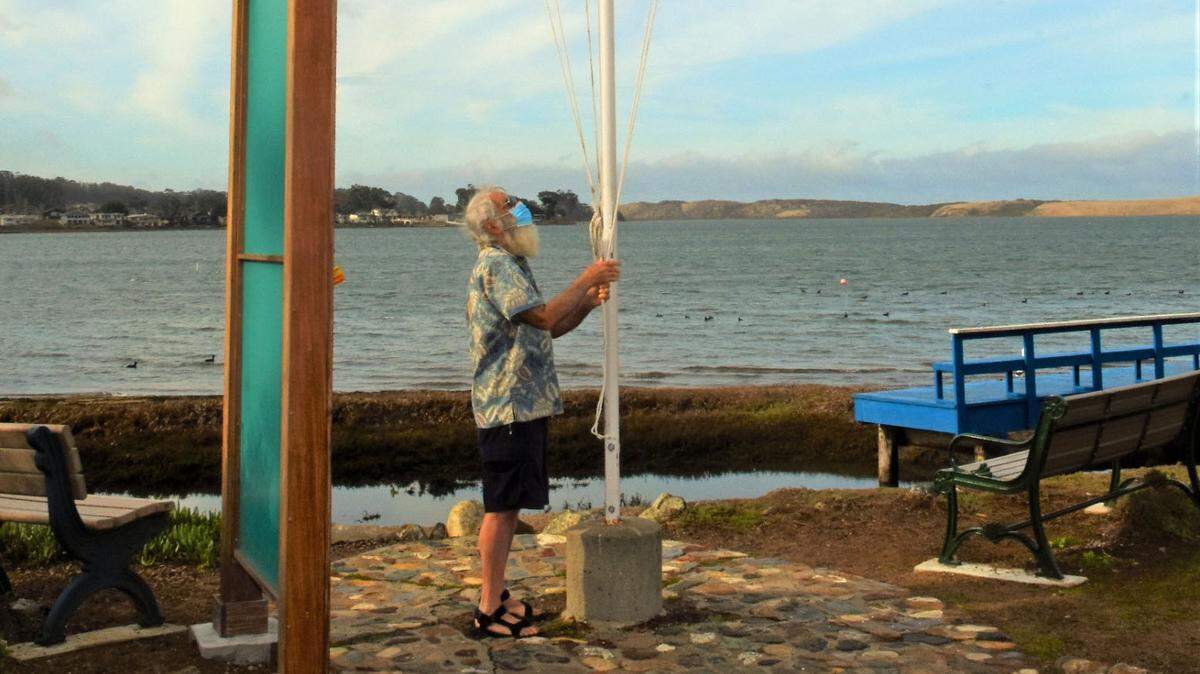
If the NWS issues a small-craft advisory gale, or storm warning, he will quickly hoist the display flags that correspond to the advisory or warning on the flagpole next to the Baywood Park Pier in Los Osos.
These signal flags are closely watched by members of the Baywood Navy, founded by Tim Frein in 2004. Their motto is, “We don’t sail in water deeper than we can stand in or when the wind is calm,” and used by many others in the beautiful, eclectic community on Morro Bay.
“We are just a bunch of volunteers who love the area and the water and keeping the local and maritime history and tradition alive for the next generation,” Brown said.
His son Andrew, who is a competitive sailboat racer, and his wife Marrie sewed the latest batch of weather flags that the Baywood Navy can post.
The Morro Bay harbor entrance is one of the roughest on the West Coast.
When boaters see the signal flags at the U.S. Coast Guard station in Morro Bay flapping in the wind, they usually turn around.
The Morro Bay Fishermen’s Association uses lights to warn mariners of hazardous conditions at the harbor entrance. Also, special weather broadcasts are announced on Marine Channel 16 on the marine radio and given on Channel 22A.
PG&E seeks applicants for Diablo Canyon panel
In keeping with PG&E commitment to involving the community in the decommissioning of Diablo Canyon Power Plant, the utility and the Diablo Canyon Decommissioning Engagement Panel announced jointly that applications are now being accepted to join the panel.
There are up to three positions open for appointment or reappointment and the 30-day application period runs through March 13.
Members of the community who are interested in participating on the panel can obtain more information on how to apply at diablocanyonpanel.org or pge.com/engagementpanel.