SLO County is predicting $1 million budget deficit — but it could grow quickly
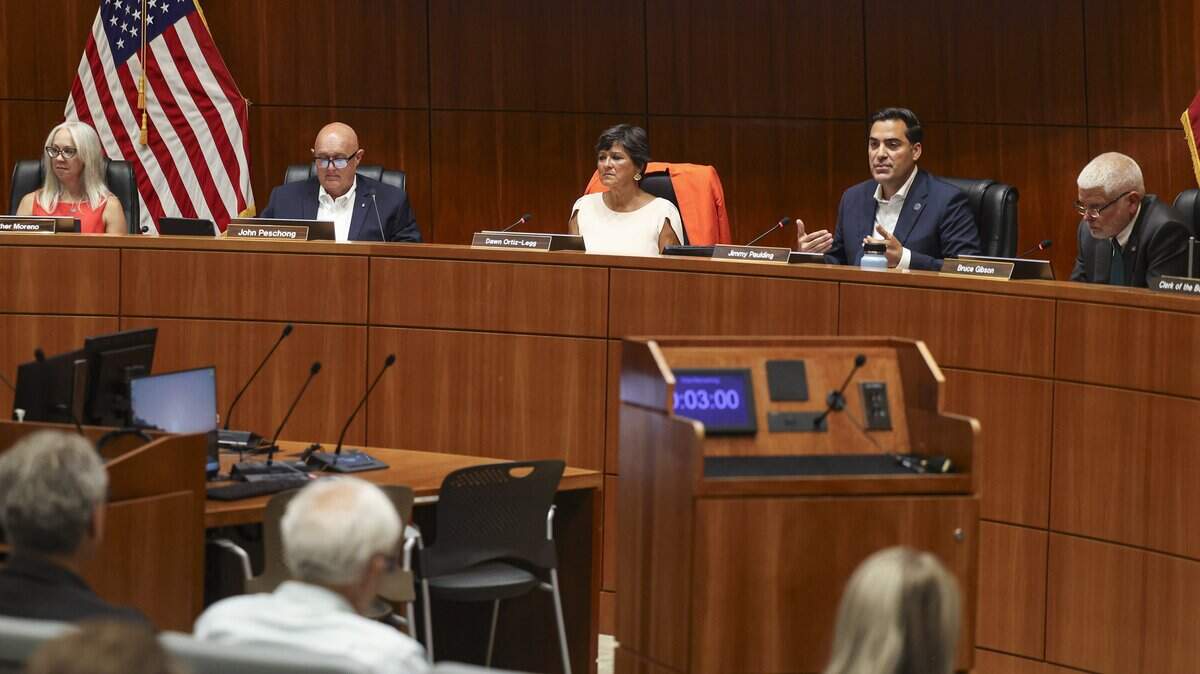
San Luis Obispo County is on track to have a nearly $1 million budget deficit this year, but the financial forecast remains deeply uncertain due to volatile state and federal forces.
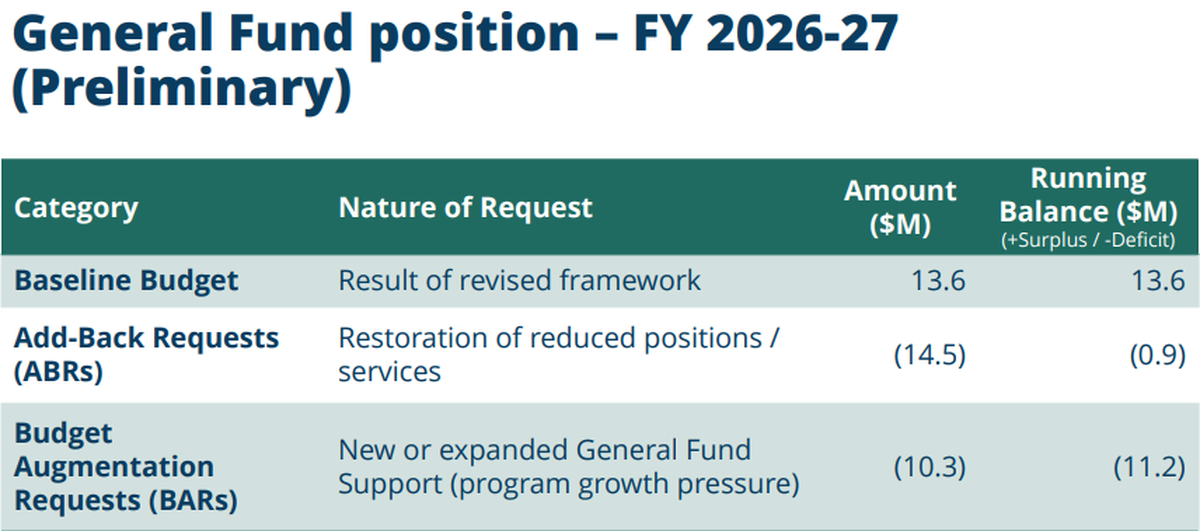
The county is currently projected to have a $13.6 million baseline budget surplus for the fiscal year 2026-27, but that preliminary number is expected to shrink considerably and likely shift into a minor deficit as some jobs and services are restored over the new few months of the budgeting process, according to Lisa Howe, SLO County’s assistant chief executive officer.
The county’s financial outlook reflects an improvement compared to a November prediction based on historical status-quo spending habits that estimated a funding gap ranging from $4 million to $11 million. But the county expects little relief in the face of “constrained long-term revenue growth and structural cost pressures,” according to the staff report.
The government funding gap could grow up to $11.2 million, one estimate showed, or the county could retain a surplus of more than $13 million — but that would result in dozens of layoffs, according to a county PowerPoint presentation. This range of possibilities represents a more optimistic outlook compared to the 2025-26 fiscal year when the county faced a $38 million deficit and had to cut nearly 155 jobs, though many were already vacant, The Tribune previously reported.
During the Board of Supervisor’s meeting Tuesday, Howe said the county’s fiscal outlook was in a “slightly more positive position” but still “subject to significant concerns.”
SLO County enacts ‘more disciplined’ budget approach
Compared to the previous fiscal year, the county’s discretionary revenue is predicted to grow by about $10.7 million due to higher interest revenue, sales and use tax revenue and property tax revenue, according to the staff report.
The county also recently switched to a baseline budget framework — “a more disciplined approach,” the report said — which requires departments to craft budgets within an established target, as well as internally rebalance funds if over budget.
The new framework includes a vacancy management policy, allowing larger departments to defund positions that have gone unfilled for long stretches of time and no longer serve a purpose.
It also lets departments submit “add-back requests” to restore existing services and jobs that go over the recommended baseline budget. Similarly, departments can turn in “budget augmentation requests” to add resources or positions.
The county’s prediction of a baseline $13.6 million surplus for the 2026-27 fiscal year does not currently factor in any add-back or budget augmentation requests.
If no requests are approved for the next few years, the county estimated a $3.2 million surplus in fiscal year 2027-28, a $1.9 million surplus in 2028-29 and a nearly $500,000 surplus in 2029-30.
So far, 11 departments have submitted 66 add-back requests, totaling $14.5 million worth of general fund support and approximately 39 positions for fiscal year 2026-27. The county has also received 65 budget augmentation requests, adding up to $10.3 million and 44 new positions.
Howe said it’s too early in the budget process to determine whether any job cuts will be recommended to the Board.
If the county were to fund every add-back request, it would prompt a $900,000 deficit for the 2026-27 fiscal year, and if it were to fund all budget augmentation requests as well, the funding gap would reach $11.2 million, according to the staff report.
In future years, if every add-back request is accepted, the county’s deficit will quickly balloon, reaching $12 million in 2027-28, $13.8 in 2028-29 and $15.7 million by the end of the decade.
The County Executive Office intends to review all requests and make recommendations to the Board of Supervisors in alignment with budget goals and priorities, Howe told The Tribune.
“Knowing that next year may be a more constrained year, we also want to be careful we’re not adding structurally ongoing expenditures to turn around and have to reduce,” Howe said during the meeting.
Currently, the county’s public protection and health and human services departments are seeking the largest add-back requests, totaling $6.3 million and $4.1 million, respectively, according to the staff report.
Supervisor Bruce Gibson voiced concerns that most of the discretionary revenue would continue to be handed to large departments, like the Sheriff’s Office, in a “rich, get richer” approach instead of funding a full array of county departments that “are all part of the overall mission,” he said.
But Supervisor Heather Moreno argued that the Sheriff’s Office largely relies on general fund support and has had a hard time bringing on new recruits, leading to more overtime hours and strain on the department.
“It’s really a struggle, and we need to be able to support our public safety department,” she said.
County faces fiscal uncertainty due to Big Beautiful Bill repercussions
HR 1, or the One Big Beautiful Bill Act, could also be financially burdensome to enact at the county level — but it’s still up in the air what the exact costs will amount to, according to the staff report.
The bill shakes up social safety net programs by enforcing tighter eligibility rules and expanded work requirements. Once implemented, HR 1 is expected to trigger an abundance of administrative burdens that will increase costs at the county level, The Tribune previously reported.
The Big Beautiful Bill also reduces contributions to federal programs, such as Medi-Cal and CalFresh, that may require states, and in turn counties, to take on more of the costs.
“For Medi-Cal in particular, increased non-federal cost-sharing requirements could create significant operating pressures for counties, including expanded indigent care obligations for individuals losing health coverage,” the staff report said.
As the state continues its own budget negotiations for the 2026-27 fiscal year, a variety of unknowns remain during “ongoing state-federal fiscal tensions and revenue volatility” that could trickle down to the county, according to the report.
However, Howe highlighted one potential bright spot amid a wave of uncertainty — a multi-million dollar boost from a one-time financing source.
A recent review identified $25.9 million in Medi-Cal reimbursement revenue that could be transferred to the Tax Reduction Reserve, one of the county’s reserve accounts maintained to achieve long-term fiscal resilience.
“The intent there is to really strengthen the county’s ability to respond to unanticipated state and federal cost shifts that are going to occur,” Howe said.
Supervisors Gibson, Moreno and Jimmy Paulding said they would support the revenue transfer.
“I think sending that into the tax reduction reserve gives us the flexibility to work,” Gibson said.
The county and the Board of Supervisors will continue to carry out its budgeting process over the next few weeks, with the recommended budget to be introduced at the May 19 board meeting. Budget hearings will take place June 8 through 10, and the recommended budget will be adopted on June 16.
This story was originally published March 16, 2026 at 5:00 AM.
CORRECTION: An earlier version of the story emphasized the temporary budget surplus. The SLO County budget is expected to face a nearly $1 million deficit for the 2026-27 fiscal year. The error has been corrected.