
SLO County candidate was convicted of election fraud. Why has case been behind closed doors?
Michelle Marie Morrow — the former Board of Supervisors candidate found guilty of multiple counts of felony voter and election fraud — was scheduled for sentencing in the San Luis Obispo County Superior Court at 8:30 a.m. on Monday morning.
Her friends, other court-goers and the media all gathered at the courthouse early, eager to hear the highly awaited details of her unique case that has seemed largely shrouded in secrecy.
Morrow was convicted of election fraud after entering a plea agreement in November — but no one knows exactly why.
Few details have been released apart from the original charges filed against her, and despite being public court proceedings, Morrow’s case has been held almost entirely behind closed doors. Of her three court appearances, two have gone into off-record chambers sessions.
Monday was no exception.
As the minutes turned into hours of waiting, the judge finally opened her case — in private. A conversation between the judge, Morrow, her defense attorney Jim Murphy and district prosecutor Ben Blumenthal took place inside a chambers session, locking attendees out of any discussion of her case.
The crowd waited. The group came out of closed session. The judge asked the attorneys for an on-record disclosure of what happened in the locked room, which underwhelmingly amounted to an approved request to delay Morrow’s sentencing by another month. No reason was given.
After nearly three hours and no further details, court was adjourned on Morrow’s case, and attendees shuffled out of the room.
Morrow’s sentencing was rescheduled for Feb. 13 at 8:30 a.m. in Department 3 of the SLO County Superior Court.
At that time, sentencing documents will be released that could potentially provide more information about the details and context of the crime, what probation considered when figuring out a recommended sentence and information about the defendant.
Until then, it seems SLO County will be largely in the dark about this high-profile case.
Open court is a constitutional right. When public cases are held in private, it leaves room for public speculation and could even undermine trust in the justice system, one lawyer told The Tribune. It makes people wonder: What could be possibly be happening behind those closed doors?
However, others said that closed chambers discussions serve an important role the criminal justice system by protecting the privacy of involved parties and may just be the reason this case — and others like it — could be settled quickly and without a trial, bringing answers and peace-of-mind sooner.
As part of its Reality Check series, The Tribune spoke to multiple lawyers and members of the criminal justice system about the role chambers sessions play in open courts and in Morrow’s unique case.
Morrow did not respond to The Tribune’s attempts to contact her for this story.
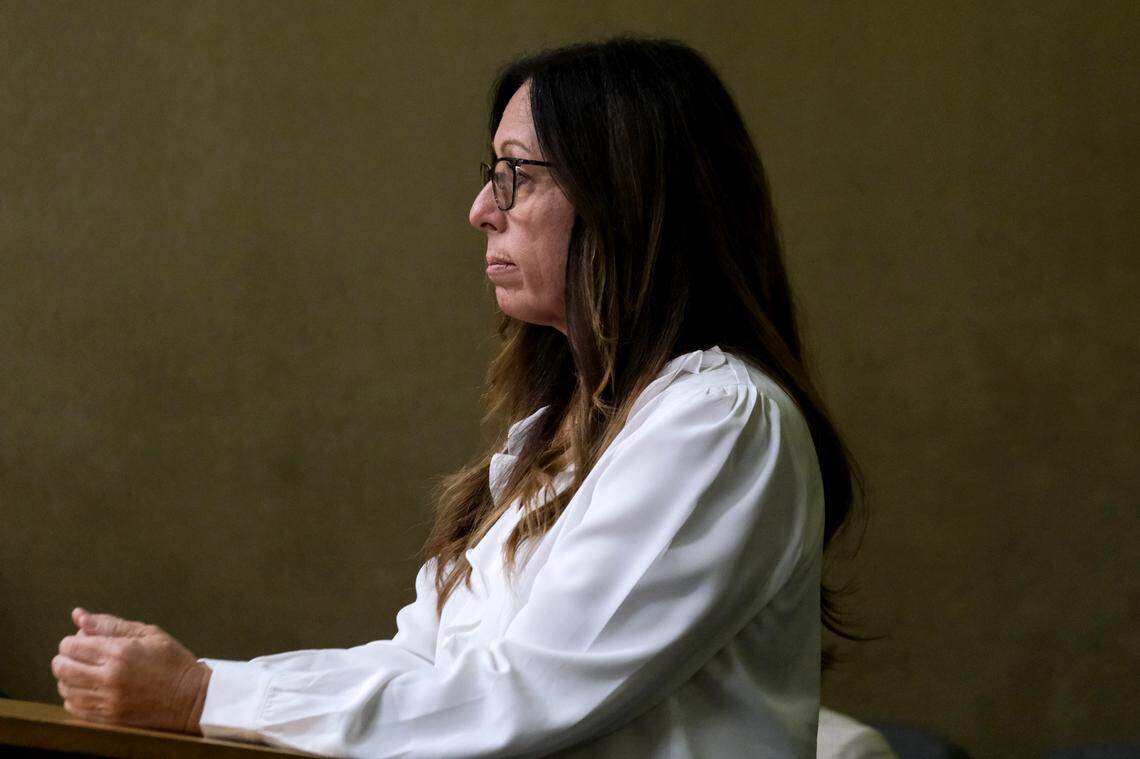
SLO County supervisor candidate convicted of voter, election fraud. What we know
The details of Morrow’s case have been kept largely under wraps, leaving the exact circumstances that led to her convictions unclear.
Here is what we know.
Morrow, 55, of Grover Beach ran as a write-in candidate for the District 3 Board of Supervisors seat in the March 2024 primary, losing in a landslide to incumbent Supervisor Dawn Ortiz-Legg. During her run, one of Morrow’s stated priorities was to “eliminate corruption,” according to one campaign ad.
District 3 includes a chunk of San Luis Obispo, plus the Edna Valley, Avila Beach, Pismo Beach and a portion of Grover Beach.
Later finding that she had actually lived in District 4 during her campaign, the District Attorney’s Office filed four charges against her for election and voter fraud in September.
At her second arraignment in November, Morrow was convicted of filing a false declaration of candidacy and fraudulent attempts to vote — both felonies — after pleading no contest to the charges.
Two other felony charges against her — perjury by declaration and a voter registration violation — were dropped.
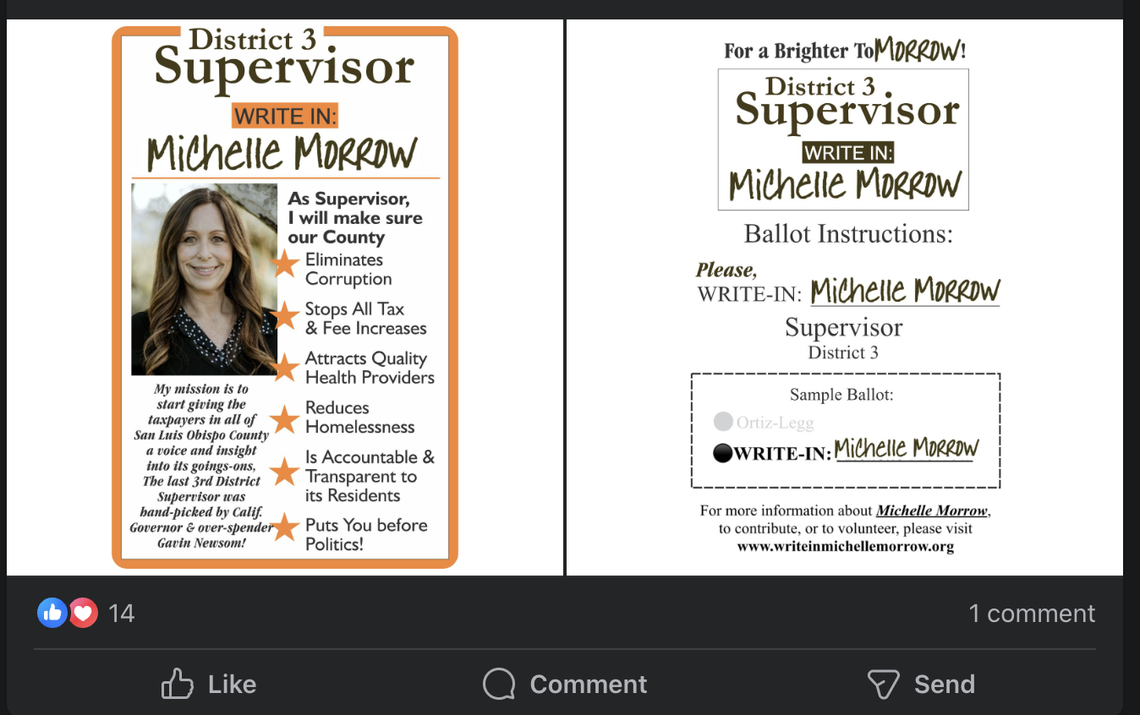
The core of the DA’s case against Morrow was that she registered to vote and run for office — and then did those things — under an address she did not actually live at.
Morrow registered under an address in Grover Beach. According to a Feb. 1 story from New Times, she was initially deemed ineligible to run because she had supposedly not lived at the District 3 address long enough. County election rules require candidates to be a resident of the area they’re running to represent for at least 30 days.
At the time, County Clerk-Recorder Elaina Cano told New Times that Morrow would become eligible to register on Feb. 15 and needed to submit her candidacy paperwork no later than Feb. 19 — which she did on Feb. 16 under the Grover Beach address.
The DA’s charges amount to a finding that Morrow never lived at an address in District 3 at all. She had broken the law by running for office and voting there.
It is unclear when or how the office became aware of the allegations or when the investigation began.
In September, a Tribune reporter visited Morrow’s address in Arroyo Grande in District 4. Morrow was not home, but the person who answered the door said she lived there.
In October, two other candidates for the Nov. 5 election were reported to the DA’s Office on similar allegations of election fraud, but the office has taken no action in those cases, nor has it confirmed or denied whether it is investigating the allegations.
What are chambers sessions, and why have so many been called for Morrow’s case?
In the American criminal justice system, open court allows for public accountability — most of the time.
On occasion during a court case, chambers sessions — or chambers conferences — will be called. These private hearings are held in a judge’s chambers and attended only by the judge, their staff and the parties involved in the case. The public and media are not allowed to observe.
Chambers sessions have now been called in two of Morrow’s three court appearances.
The first took place when Morrow entered a plea. At the federal level, plea agreements are written out, with the exact allegations and crime the person is pleading to recorded in a document. Written pleas are not required at the county level, and no such document was produced for Morrow’s plea.
Morrow’s case is not the first time local courts have withheld open proceedings or records from the public.
During the murder trial of Kristin Smart, The Tribune successfully led a coalition of media outlets in effort to unseal public court records. During oral arguments, The Tribune said the media was being unlawfully locked out of on-record hearings that were outside the presence of the jury. It and other media outlets ultimately gained access the next day.
Assistant District Attorney Eric Dobroth told The Tribune that “chambers conferences in criminal cases are not rare and are generally used to discuss logistics,” such as the rescheduling of hearing dates, which happened during the second chambers session.
But David Loy, the legal director of the First Amendment Coalition, told The Tribune that “chambers conferences should be the exception, not the rule.”
“The public has a right of access to the court precisely to oversee and monitor how judges are processing and deciding cases,” Loy said. “Courts are public by definition and not private.”
Contrary to Dobroth, Loy said it would be “unusual” for the majority of proceedings in a given case to be done in secret.
“There can be, in my view, rare circumstances where that is appropriate, to do something in chambers,” he said.
In regards to the chambers session on Monday to reschedule the sentencing, Loy said, “that’s the kind of thing I would expect to be done in open court.”
“I can’t think of a legitimate reason to do those kinds of conversations in chambers, away from the public,” Loy said.
Jim Murphy, Morrow’s defense attorney, later told The Tribune the Monday’s chambers meeting was called as a matter of privacy.
“There are very rare occasions where a lawyer is not able to disclose information about a case, and that is when it is very sensitive information and might not help the client in any way,” Murphy said. “My client wants to retain her privacy.”
Murphy said the sentencing was delayed to allow him “additional time to provide critical information to the court that it does not yet have.”
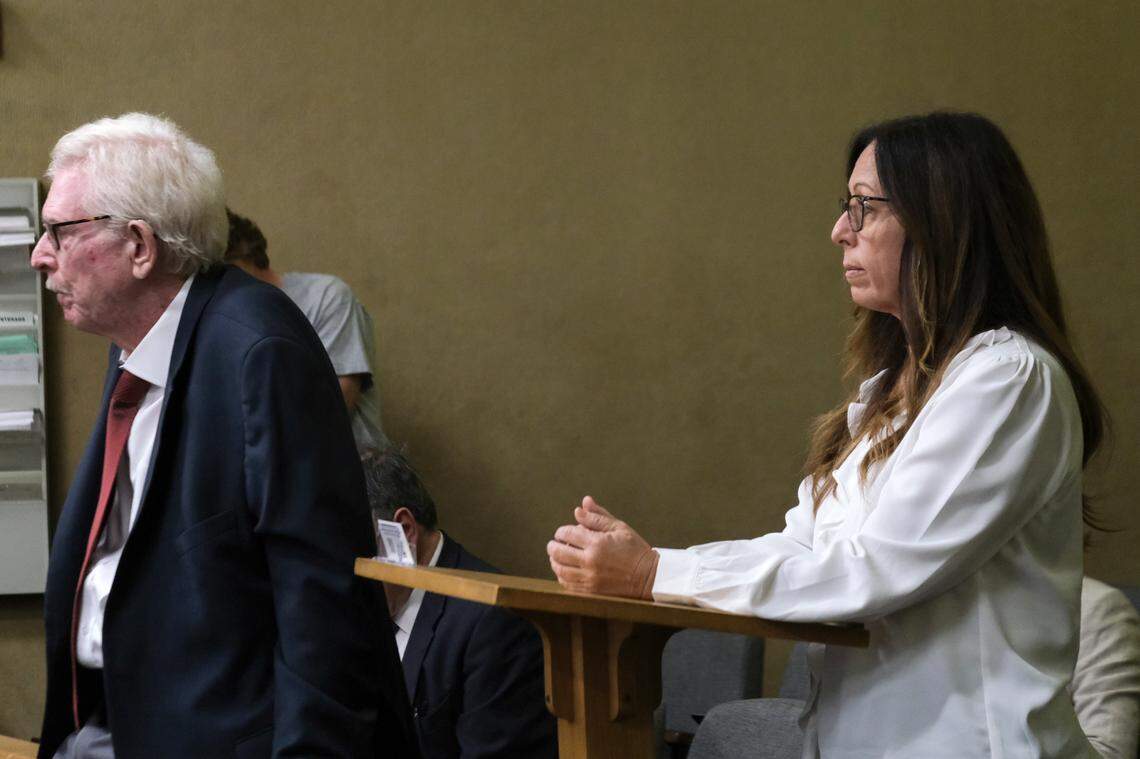
Well-known SLO County defense attorney Ilan Funke-Bilu told The Tribune that privacy concerns are a common and valid reason to call chambers sessions.
“I take Mr. Murphy at his word. There’s some sensitive information that they don’t want to disclose publicly that might embarrass or might invade the privacy of a witness, of a defendant or something else that’s a common ground,” Funke-Bilu said.
Retired SLO County Judge John Trice echoed a similar point.
“A felony conviction alone is a pretty heavy thing to carry around with you for the rest of your life,” Trice said.
He told The Tribune that holding professional licenses, such as a medical license, can sometimes be grounds for calling chambers proceedings so as not to further publicly damage a person’s reputation in court.
Morrow does not appear to have any licenses, but did appear to operate a senior caregiver referral business, Morrow Support. It is unclear if the company is still in business or, if not, when it closed its doors.
But Loy said privacy isn’t a good enough reason.
“Every criminal case is potentially embarrassing to one or more parties,” Loy said. “That’s not generally considered sufficient grounds to close the courtroom or do things in secret.”
Loy more conservatively classified sensitive information as something that is a “genuine threat to someone’s life” rather than information someone would prefer to keep private. To him, anything less is not grounds for closing the court.
For Trice, however, the secrecy of Morrow’s case didn’t strike him as odd “because it’s just such an unusual case.”
“It’s not your standard criminal case,” Trice said. “(It’s) more of a political issue.”
To add to the oddity, it is among the only — and potentially even the first — convictions of election fraud in SLO County, though there have been other instances of allegations and even charges filed by the DA’s Office that were later dropped.
Another reason for the frequent chambers sessions could be the level of public interest in the case, Funke-Bilu said.
“In cases more watched, you’re likely going to see more chambers conferences,” he said.
Even without exceptional circumstances, Funke-Bilu said he did not think chambers conferences are overused in the criminal justice system.
He said closed sessions can allow for more frank and open discussions than could otherwise happen in public court, saving time and energy by allowing the case to reach a quicker settlement while protecting those involved.
“I recognize that we’re dealing with a justice system that’s supposed to be open, but it’s not a perfect system,” Funke-Bilu said. “I think that chambers conference are absolutely necessary for the wheels of our justice system to run smoothly. As long as it’s not that common, then I don’t think there’s a risk the public will feel that the integrity of the system is at risk.”
Loy said nearly the opposite.
“People have the right to know precisely to forestall speculation and conspiracy theories about why this person is prosecuted,” Loy said. “This is why it’s written into our Constitution. The accused has a right to a public trial under the Sixth Amendment and the people have a right of access under the First Amendment for precisely these reasons — precisely because one of the hallmarks of tyranny in a police state are secret courts and secret tribunals.”
This story was originally published January 13, 2025 at 5:00 AM.
