Conservative board majority votes 3-2 to radically redraw SLO County supervisor districts
The San Luis Obispo County Board of Supervisors voted 3-2 on Tuesday evening to adopt a new district map and dramatically redraw representation boundaries for the next 10 years.
Over the adamant objections of liberal board members Dawn Ortiz-Legg and Bruce Gibson, conservative supervisors Lynn Compton, John Peschong and Debbie Arnold joined to reject the five-district map drawn by the San Luis Obispo Chamber of Commerce, which features districts similar to the ones currently in use.
Instead, Peschong, Arnold and Compton picked the map championed by the local Republican Party, which was drawn by Arroyo Grande resident Richard Patten.
“From the very beginning, I was very clear,” Peschong said. “One of my goals has been to try to keep these cities whole, as much as possible. I think the Patten map does a better job of that than the Chamber of Commerce map. That doesn’t make the Chamber of Commerce map a bad map, or they’re bad people. It doesn’t make Mr. Patten a bad person or a bad map. It just means that there are differences here. That’s just the way they worked it out.”
The decision followed a full day of comments, during which the majority of audience members begged the board to respect the current district boundaries and communities of interest over the more radical revision.
The board will next meet on Dec. 7 to introduce an ordinance formalizing the new map, which also may face a challenge in court by opponents who believe it violates state law.
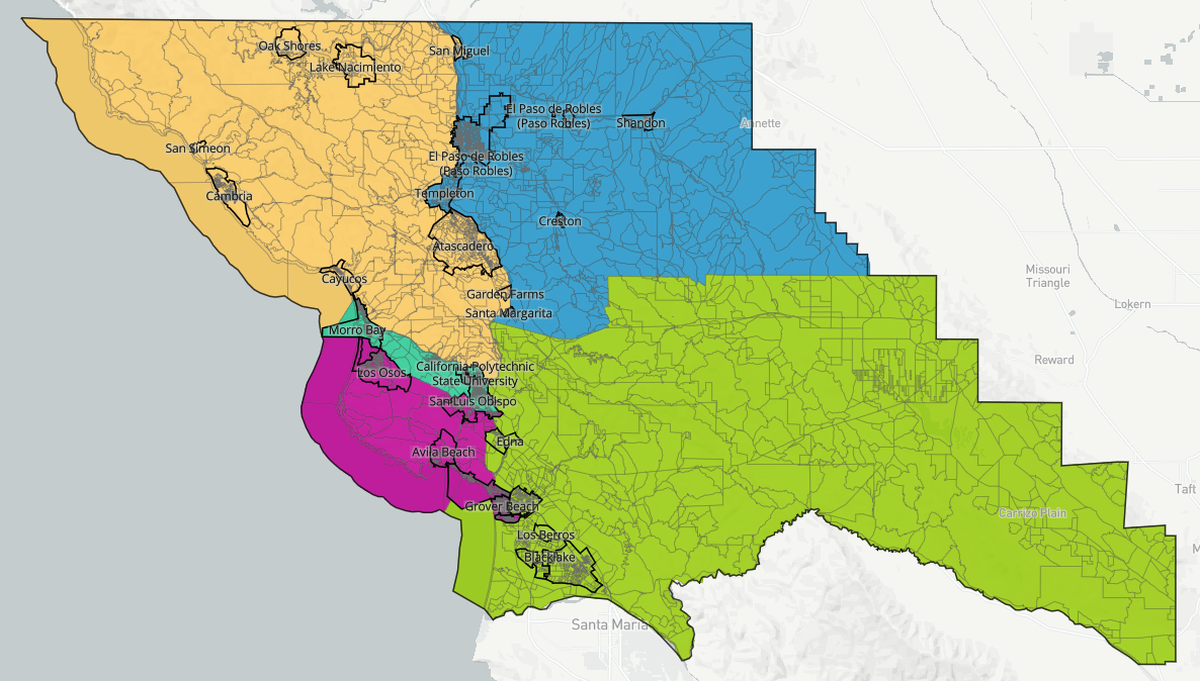
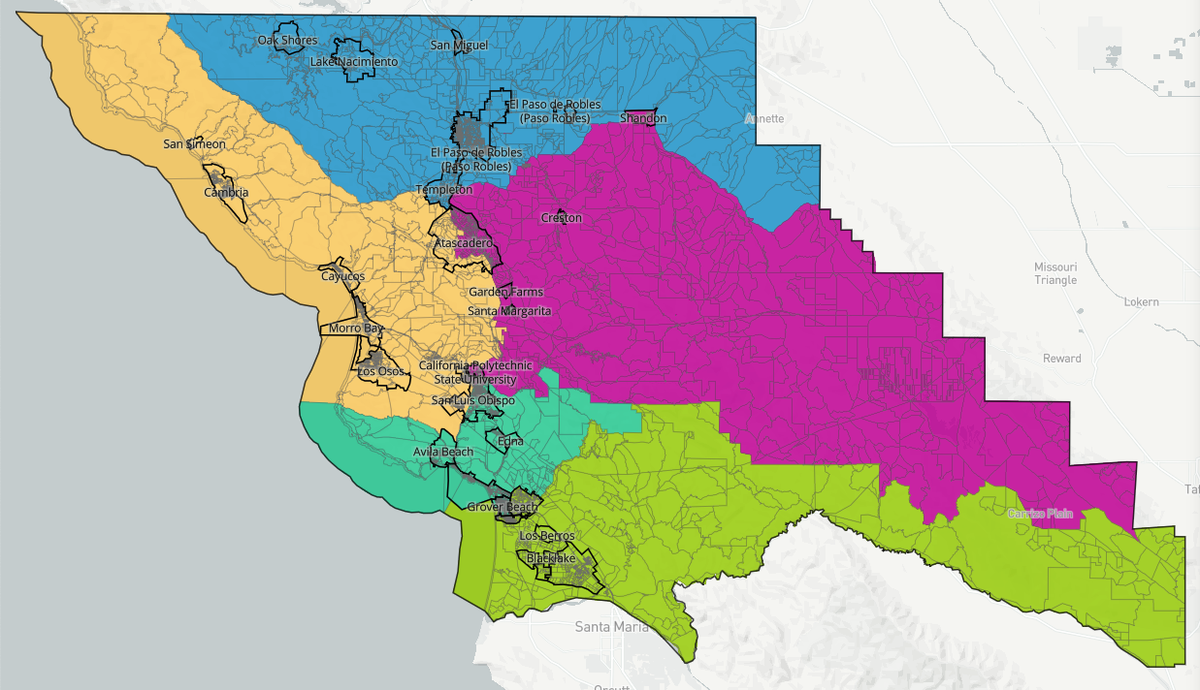
View a zoom-able version of Richard Patten’s map here, and a zoom-able version of the SLO Chamber of Commerce map here. Click ‘data layers’ and select ‘municipalities’ to view city boundaries.
Supervisors discuss redistricting maps
When the supervisors finally began deliberating around 5 p.m., the discussion was tense.
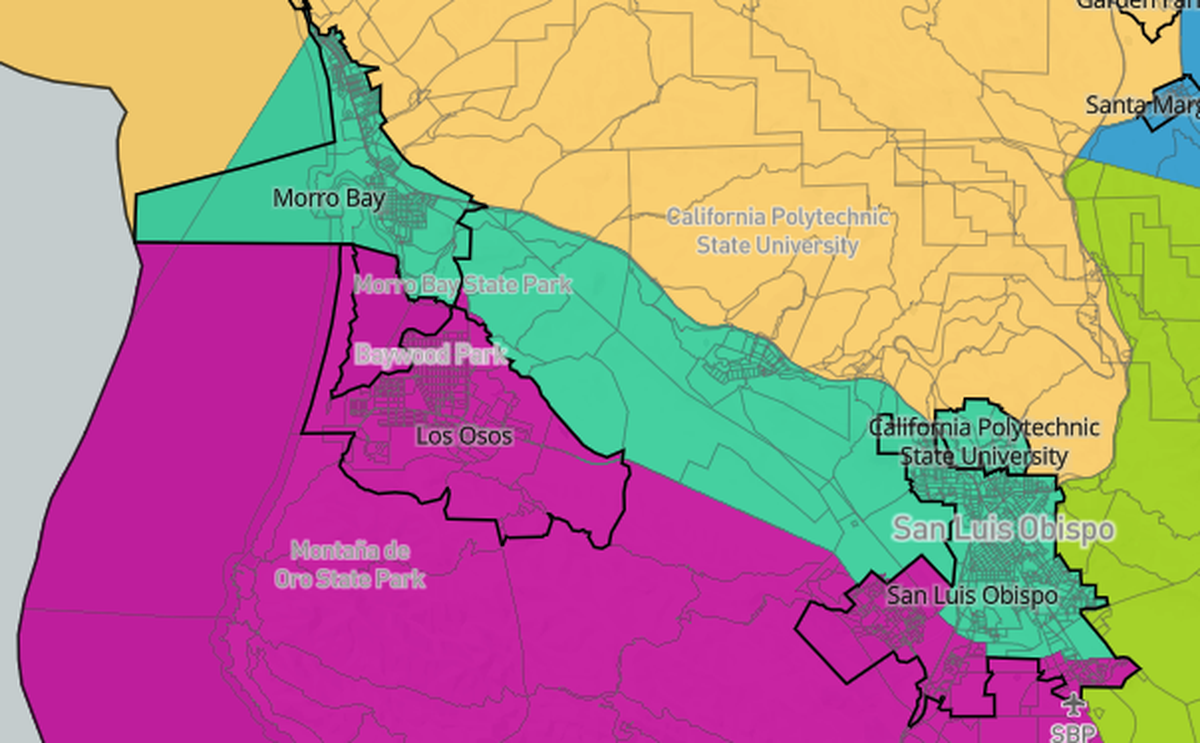
Ortiz-Legg, in particular, expressed frustration about the Patten map’s version of District 3, which creates a narrow, dog bone-shaped representation area with a large chunk of San Luis Obispo, Morro Bay and the Highway 1 corridor between the two districts.
She pointed out that the district would contain few unincorporated residents, as most people in that area live in the two cities. This would give a very small workload to the District 3 supervisor and potentially overwhelm other board members, possibly making it challenging for them to adequately represent all their constituents, Ortiz-Legg said.
“If you drill down into District 3, what you’ll see is that bone actually has a total population of unincorporated residents of about 1,300,” Ortiz-Legg said. “That’s malapportionment.”
She and Gibson also argued that North Coast residents — most of whom live in unincorporated communities — would have their voices diluted by being broken into three districts.
“It’s so interesting that people in South County are so, like, it’s no big deal, so nonchalant about what happens to the people in the North Coast,” Ortiz-Legg said. “No skin off your nose, is it? And I’m really upset about this, because I know that people in Cambria, Cayucos and Morro Bay, they are physically sick about this. Because it’s their representation, what happens to their futures and their children’s futures.”
During Arnold’s comments, she used an overhead projector to show pictures of old district maps from 1990 to the present, saying she’d lived in different districts through the years, even though her home had remained in the same place.
“I have confidence that this county, this Board of Supervisors, everyone will be represented well, as historically has been the case,” Arnold said. “This exercise, for me, is about equalizing the population and then trying to follow the criteria, some of it new now, and get our district map up and running.”
Peschong also laid out his case for picking the Patten map, the cornerstone of which was his perception that the new boundaries keep cities in single districts to the extent feasible. However, even Patten’s map does not keep San Luis Obispo in one district — it divides it between two supervisors instead of three.
Gibson, Compton argue over partisan map analysis
Throughout the meeting, Gibson and Ortiz-Legg said they wanted more data on the partisan makeup of the newly drawn districts, arguing that’s the only way to know whether the maps advantage one party over another.
Ahead of the public comment period, Ortiz-Legg made a motion asking Redistricting Partners, the county’s consultant, to analyze the potential partisan makeup of districts in both maps ahead of the next Dec. 7 hearing.
Gibson joined her in voting for the analysis, but Peschong, Compton and Arnold voted it down.
During the supervisors’ final discussion, Gibson brought up the data again. However, Peschong, Compton and Arnold wanted no part of that information, saying the board is legally not allowed to consider party data as part of their redistricting decision.
Gibson attempted to read into the record a self-commissioned partisan district analysis during discussion ahead of the Patten map vote. However, Compton wouldn’t let him read it, and the two argued back and forth and talked over each other until she called the vote.
When Gibson’s turn came, he refused to vote until he provided his comments and analysis, which showed Patten’s map advantages Republicans over Democrats. Compton, clearly displeased, began packing up her bags partway through Gibson’s comments.
Patten’s map will cause many voters to switch election years
Prior to public comments, Ortiz-Legg also asked Chaffee to compare voter accelerations and deferrals in Patten’s map and the Chamber’s map.
Accelerations refer to voters who recently cast ballots in 2020 supervisor races, but who would be shifted into districts that would be up for election in 2022. The map redrawing would “accelerate,” or move up, their voting timeline from four years to two years.
Deferrals refer to voters who were supposed to cast ballots in 2022 under the current map, but who would be forced to wait to vote until 2024 under the redrawn map. This would require them to wait six years to cast their votes for a supervisor, instead of four.
Redistricting Partners’ data showed 48,622 voters would be accelerated under Patten’s map, while 49,418 would be deferred.
Under the Chamber’s map, approximately 9,499 voters would be accelerated, and 9,833 would be deferred.
Some residents said Patten’s map is a ‘power grab,’ others said it’s ‘the fairest’
Supervisors and residents who supported Patten’s map wanted to see the county’s districts change significantly. Those backing the Chamber’s map wanted to mostly maintain the current map boundaries.
Patten’s map would dramatically redraw supervisor districts, splitting the current North Coast into three pieces, dividing neighboring North County communities and sharing the city of San Luis Obispo between two supervisors instead of three.
In addition, Patten’s map would separate Oceano from Nipomo in a district that straddles Diablo Canyon nuclear power plant and runs to the edge of Morro Bay State Park.
The Chamber’s SLO County 2030 map would keep the five districts closer to their current shapes, preserving the North Coast as one district, splitting San Luis Obispo among three supervisors and retaining Oceano in a district with Nipomo. It would divide Atascadero into two districts.
Members of the public commented on the maps for nearly the entire day.
Commenters were split between the two maps. However, ultimately, the majority of speakers had either stated their preference for the Chamber’s map or called on supervisors to adopt a plan that makes even fewer changes to the one currently in use.
Chamber map supporters said Patten’s map was a blatant attempt by the local Republican Party to gerrymander districts in a power grab. Others said Patten’s map was “the fairest” and does the best job of following state redistricting rules.
Andrea Seastrand, a former Republican congresswoman, said she appreciates the way Patten’s map groups Cal Poly and the northern portion of San Luis Obispo in one district and also ties Grover Beach and Oceano together.
“I am here to support the Richard Patten map,” Seastrand said. “... Oceano has more of an interest with Grover Beach than it does with Nipomo.”
Atascadero resident Tom Bolton said he doesn’t like either map, but he’s not happy to see his city split in the Chamber’s map.
“San Luis Obispo really has nothing to do with Atascadero, and to join them at the hip is really ridiculous,” Bolton said.
Those supporting the Chamber’s map said they want to see some existing regions of the county remain together.
Paso Robles City Councilwoman Maria Garcia said she’s visited with San Miguel residents who are concerned about their community being separated from Paso Robles in Patten’s map.
His map pulls San Miguel out of the North County District 1 and into District 2 with North Coast communities.
“San Miguel and Paso Robles are united, and they do not want to be divided, at this point,” Garcia said.
San Luis Obispo Mayor Erica Stewart and Morro Bay Mayor John Headding both expressed support for the Chamber’s map. Stewart said Patten’s map divides San Luis Obispo in a poor way that does not preserve communities of interest within the city.
Headding said the City Council wants to see Morro Bay remain in a district with other North Coast communities.
Some Chamber map supporters also said they believe the board’s majority had already decided to pick Patten’s map before, even over their objections.
“I fear you’ve already made up your mind, and this meeting is merely a façade of fairness,” Anita Judd said. “But I hope I’m wrong.”
Vita Miller pointed out North Coast residents didn’t have any input into the creation of Patten’s map. She said supervisors seem to be giving one person, Patten, a lot of political power.
“You have shut out the people of this county, your own constituents, out of this process,” Miller said.
This story was originally published November 30, 2021 at 9:36 AM.