Where did 2 final SLO County redistricting maps come from — and who supports each one?
San Luis Obispo County supervisors on Tuesday will consider two redistricting maps as they decide how local residents will be represented for the next decade — but where did they come from and who supports each one?
The county Board of Supervisors voted 4-1 on Nov. 19 to advance two maps, one of which supervisors will pick on Tuesday.
One map will substantially rewrite the five districts’ borders, while the other makes some changes but mostly keeps current electoral regions intact.
One map was drawn by a local resident and is backed by the county Republican Party. The other map was drawn by the San Luis Obispo Chamber of Commerce and is supported by local business leaders.
What are the origins of the two maps? How do they differ? And which map will the Board of Supervisors likely choose?
Here’s what you need to know ahead of Tuesday’s redistricting hearing, which will begin at 9 a.m.
To learn more about the redistricting process, visit the county’s website. Emailed comments can be sent to redistricting@co.slo.ca.us.
The county will air the meeting live online at slo-span.org and on TV at cable channel 21.
Richard Patten’s map
View a zoom-able version of Patten’s map here. Click ‘data layers’ and select ‘municipalities’ to view city boundaries.
One of the maps the supervisors will consider was submitted by Arroyo Grande resident Richard Patten on Oct. 12.
Patten’s map would dramatically redraw the county’s supervisor districts by splitting the current North Coast into three pieces.
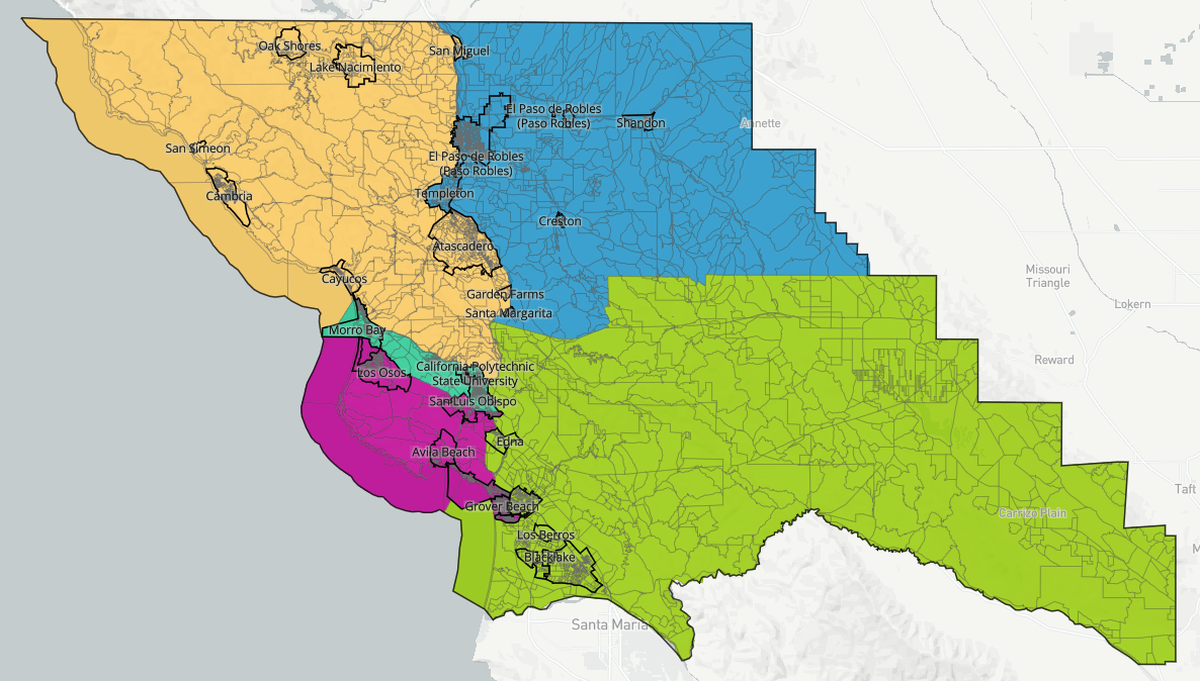
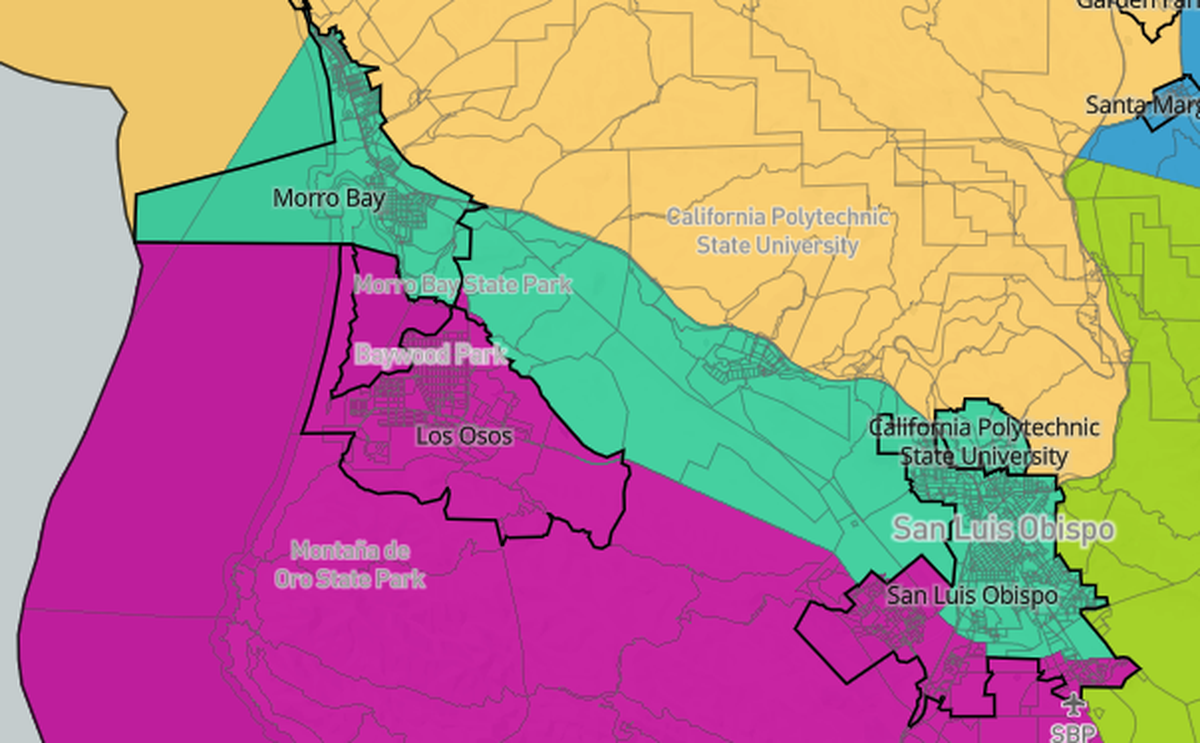
Los Osos would be in one district and Morro Bay in another. Cayucos, Cambria and the rest of the North Coast region would be in a third district with Atascadero.
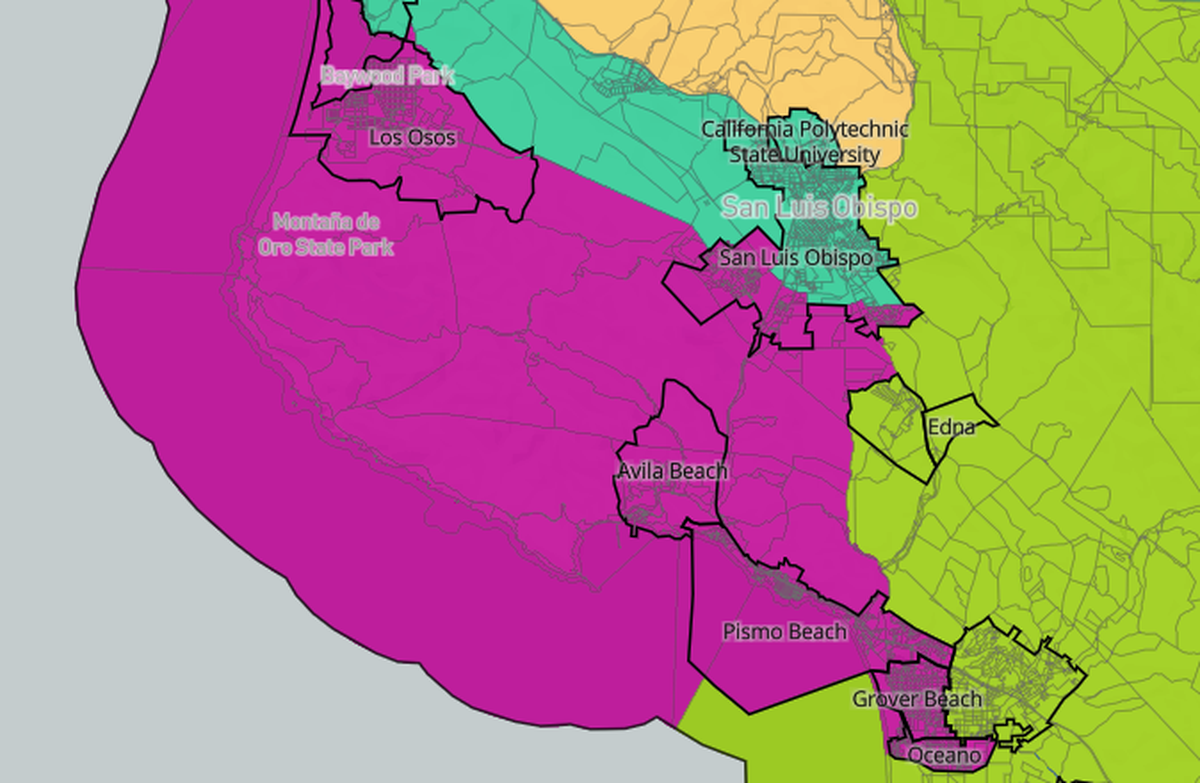
Patten’s map would also divide the city of San Luis Obispo between two supervisors instead of three. The northern two-thirds of the city — including downtown and Cal Poly — would be combined in a dog bone-shaped district stretching down the Chorro Valley to Morro Bay.
In addition, Patten’s map would separate Oceano from Nipomo in a district that straddles Diablo Canyon nuclear power plant and runs from Oceano to the edge of Morro Bay State Park. This district would also include the Laguna Lake and airport areas of San Luis Obispo.
Patten’s map would also change the North County districts by grouping Santa Margarita with Templeton and Paso Robles, rather than neighboring Atascadero.
The county Republican Party began visibly organizing on behalf of Patten’s map in early November. However, some residents were pushing Patten’s map right before the Oct. 26 redistricting hearing, just two weeks after he submitted it.
It’s unclear how Patten’s map came to be or why it swiftly became the map of choice of the Republican Party.
The Tribune requested an interview with Patten, but he declined to make himself available in time for this story.
Patten has appeared at Republican redistricting trainings, and the party has sent emails to members providing them with talking points to lobby for the map at meetings.
Some of those claims — including one that says Patten’s map will keep all of San Luis Obispo in one district — are false. The city would not be kept whole, as San Luis Obispo would split into two supervisors’ districts.
County Republican Party Chairman Randall Jordan did not respond to The Tribune’s questions about his organization’s involvement in the Patten map’s creation and why members are now vigorously campaigning for its adoption.
SLO Chamber of Commerce ‘SLO County 2030’ map
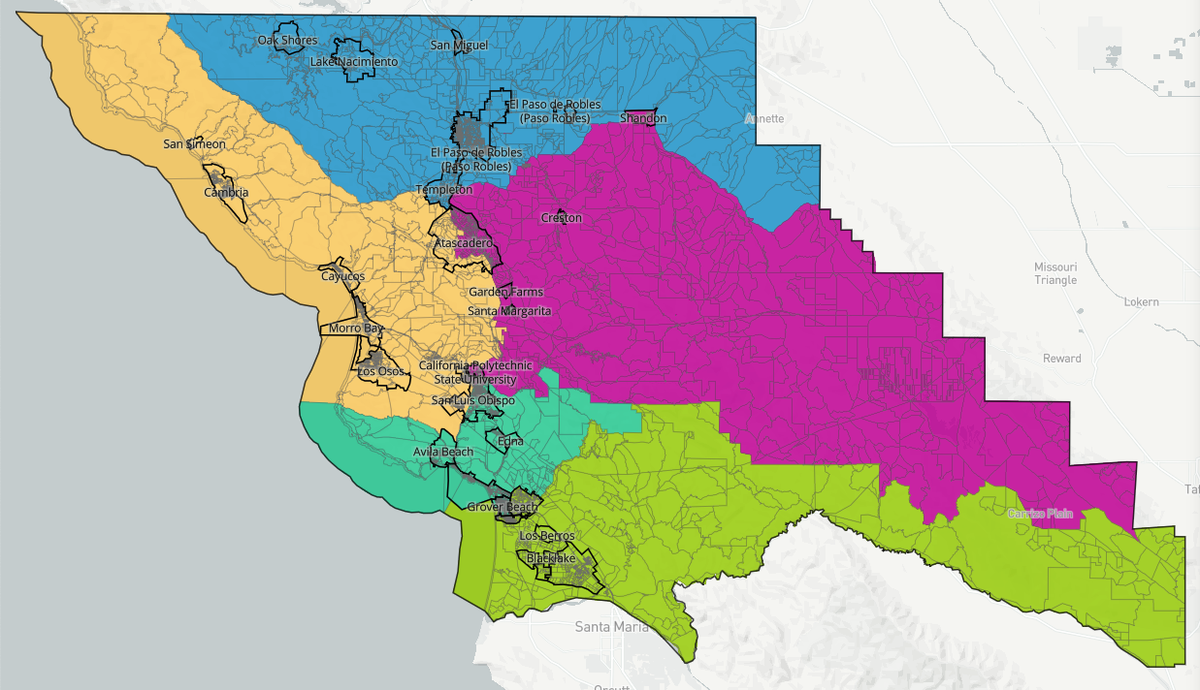
View a zoom-able version of the SLO Chamber of Commerce map here. Click ‘data layers’ and select ‘municipalities’ to view city boundaries.
The second map being considered by the board comes from the San Luis Obispo Chamber of Commerce, which began working on its version early in the summer.
The organization’s board of directors “identified redistricting as an important priority because the resulting map will set the table for important conversations on topics that are key to our economic and community success over the next decade,” Jim Dantona, chamber president, told The Tribune in an email.
The Chamber’s map hews much closer to the current version. It maintains the North Coast in one district, splits San Luis Obispo among three supervisors and keeps Oceano in a district with Nipomo.
However, the map would also split Atascadero into two districts. It would place part of the city with the North Coast and the other part with Santa Margarita, Pozo, Creston and other North County communities.
Dantona cited issues including “economic development, housing and homelessness, the closure of Diablo Canyon, and the transition of the Oceano Dunes“ as important to business leaders countywide.
The Chamber’s board appointed a group of business leaders “who live in different districts, work in different industries, and have a wide range of political perspectives” to help create the organization’s map, which the board of directors unanimously approved, Dantona said.
The Chamber prefers its map to Patten’s because “it takes into account the challenges and opportunities faced by each of the unique, vibrant communities throughout our county and, as dictated by law, prioritizes communities of interest over municipal boundaries,” Dantona said.
“The SLO County 2030 map also recognizes real geographic barriers between, for instance, the North Coast and the North County,” Dantona said. “The Patten map creates districts that cross real geographical boundaries, like these mountains that do not have roads over them which results in San Miguel, Atascadero and Garden Farms in a district with Cayucos and Cambria, while Templeton and Paso Robles are in a separate district from their neighboring communities.”
Peschong, Arnold undecided on which maps they’ll choose
Supervisor John Peschong — who proposed advancing the two maps on Nov. 19 — said he picked Patten’s map because it reduces the number of supervisors representing San Luis Obispo from three to two.
“I think that the Patten map does a pretty good job of trying to keep the bulk of the city whole,” Peschong said. “It may be impossible to make it all whole, but you don’t I don’t think you need three (supervisors). And so I wanted to get more analysis on that.”
Peschong said he appreciated the Chamber’s map because he feels the organization devoted more resources to developing it than the county’s consultant, Redistricting Partners, spent on its four maps.
“The people that developed it for the Chamber, they spent a lot of time on it, really doing some analysis,” Peschong said. “And the people (Dantona) mentioned, I know some of them, and they sound like they’re really into it. And, like Mr. Patten, I think they spend a lot of time on it.”
“I don’t think there was a lot of time spent on on on map A or B or C or D,” Peschong added. “You know, those were draft maps. And I think that the community, with these two maps, there’s pretty good representation of a lot of thought behind them.”
When asked why his constituents from districts outside San Luis Obispo were so concerned about limiting the number of supervisors representing the city, Peschong said he thinks it’s an issue of fairness.
“They believe by having three supervisors represent the city of San Luis Obispo and Paso Robles only having one supervisor means there’s less voices for the concerns of that community, that doesn’t have as many supervisors,” he said.
Peschong said he hasn’t yet decided which map he’ll support, that he will “listen to the community, and I hope they all come out to the meeting.”
Supervisor Debbie Arnold said she also hasn’t decided which map she’ll support on Tuesday.
“I like those two maps, and they were striving to get close to equal in population,” Arnold said. “And then, like I said in the board meeting, I feel like I’ve had a lot of years now working all over the county and understanding the kind of communities and community associations and so forth and so on.”
“So, I think that as we continue to discuss these, then my mind will just be trying to find the best solution for equaling those population numbers and trying to keep communities whole and then trying to make it the best fit for everybody,” she added.
Neither Peschong nor Arnold indicated they knew how Patten had developed his map or why the county Republican Party had decided to support it.
Supervisor Lynn Compton declined The Tribune’s interview request, saying “(it) just exacerbates the rhetoric on both sides when we supervisors weigh in outside of a public board meeting on this topic.”
SLO Democrats, 2 supervisors strongly against Patten’s map
The San Luis Obispo County Democratic Party is fervently against Patten’s map, which the organization sees as a Republican power grab.
“We believe that the board is only moving forward with the Chamber map in addition to the Patten to not make it as blatant but will move forward with a map that gives the Republican majority a lead for the next 10 years regardless,” said Rita Casaverde, county Democratic Party chair, in a text message.
“We know the Republican Party is 100% behind the Patten map,” Casaverde added. “It’s clear with their own communications. One year ago, these three supervisors decided to raise their own campaign contribution limit despite and against strong public sentiment. They are and will do it again. No doubt.”
Supervisors Bruce Gibson and Dawn Ortiz-Legg also told The Tribune they will not support Patten’s map. Ortiz-Legg — the only supervisor to vote against the two maps — said she’s “in favor of working with the SLO Chamber 2030 map to ensure communities of interest and spheres of influence stay together, serve those communities and the County as a whole.”
Ortiz-Legg said her ‘no’ vote “was to state my concern of the Richard Patten map specifically, due to the way district lines were drawn to get the populations numbers to meet the deviations.”
“One example is putting SLO and Morro Bay cities together in the new District 3,” Ortiz-Legg said in an email. “This will dilute representation of the unincorporated citizens throughout the county. The end result is that many residents will have reduced opportunity and ability to have their voices and needs addressed. It is important to remember this is a rural county, and not a metropolitan area. Making radical changes such as the Patten map may have unintended consequences for county citizens.”
Gibson said he joined Peschong, Arnold and Compton in voting to advance the Patten and Chamber maps on Nov. 19 because “it (was) quite clear from the actions of the board majority that they were going to move the Patten map forward. He saw voting against it as a “meaningless gesture.”
“I suspect (Patten’s map) is going to get advanced by ... it’s going to get approved by the board majority,” Gibson said. “That’s just my suspicion. The Chamber map is better, not perfect, but of the two is clearly the preferred alternative. And so I voted to at least bring that forward. We’ll see if it does any good.”
Gibson speculated that the Republican Party “engaged Patten to put (the map) forward to its benefit.”
He said it’s clear to him that Patten’s map is set up to challenge his hold on the North Coast district.
Gibson assumes the map’s North County District 1 would remain largely conservative. He said removing Oceano from District 4, as Patten’s map does, would strengthen Compton’s hold on that area. The new District 5 — which would include Los Osos, a chunk of San Luis Obispo and Avila Beach — would likely require entirely new candidates, and District 3 would remain a liberal stronghold, he said.
By joining the North Coast with more conservative areas of the North County, that would leave Gibson’s District 2 open to a challenge.
“I mean, I have to read it that way,” Gibson said. “I can’t see any other way of interpreting the effects of it.”
This story was originally published November 29, 2021 at 5:00 AM.