Trawlers catch deep-sea predator with ‘very large’ eyes. It’s a new species
Around an island off mainland Taiwan, shrimp trawlers hauled in their nets and started sifting through their catch. A deep-sea predator with “very large” eyes caught their attention — and for good reason.
It turned out to be a new species.
Scientists spent four years working with shrimp trawlers around Dongsha Island as part of “long-term bycatch surveys” to document marine life in the South China Sea, according to a study published Aug. 28 in the peer-reviewed Journal of Fish Biology.
During the surveys, researchers noticed dozens of unfamiliar-looking deep-sea fish accidentally caught by the trawlers, the study said. Intrigued, they took a closer look at the animals and soon realized they’d discovered a new species: Zenion boops, or the bigeye armoreye dory.
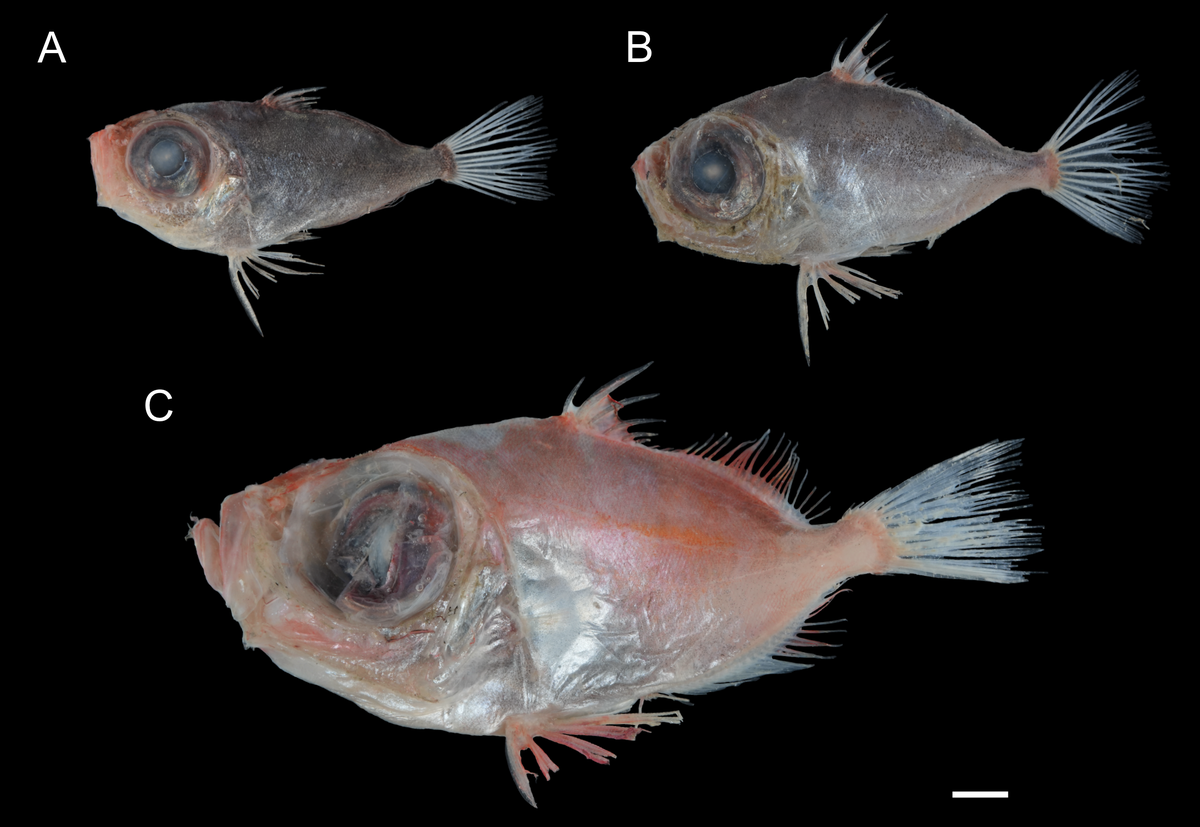
Bigeye armoreye dories have “compressed and oblong” bodies reaching up to about 5 inches in length, the study said. Their “large” heads have “very large” eyes and “tiny teeth.”
Photos show the new species, which varied in color but generally looked “rosy” and silvery.
Bigeye armoreye dories live at depths of about 1,700 feet so “its ecology remains poorly understood,” study co-author Yen-Ting Lin told McClatchy News. “We do not yet have any live photographs (of the fish).”
Generally, armoreye dories are found “near the seafloor along continental slopes, seamounts and oceanic ridges” with “muddy or sandy substrates,” the study said. “As opportunistic predators, they primarily feed on zooplankton, crustaceans and small fishes.”

In the South China Sea, armoreye dories are “often found as bycatch in deep-sea shrimp fisheries,” Lin said via email.
Researchers said they named the new species “boops” after its eye size “which is greater than half the head length.”
So far, bigeye armoreye dories have only been found around Dongsha Island, also known as Pratas Island, a small island in the South China Sea roughly 260 miles southwest of mainland Taiwan.
The new species was identified by its DNA, body proportions, eye size, fin spines, internal anatomy and other subtle physical features, the study said.
The research team included Yen-Ting Lin, Chia-Hao Chang, Yu-San Han and Chien-Hsiang Lin.
This story was originally published September 8, 2025 at 8:34 AM with the headline "Trawlers catch deep-sea predator with ‘very large’ eyes. It’s a new species."