3-foot-long predator found waiting in ambush on rooftop of Oman. It’s a new species
On a sunny rooftop of Oman, a 3-foot-long creature coiled its patterned body and waited to ambush unsuspecting prey. Instead, passing scientists noticed the lurking predator.
They didn’t realize it right away, but they’d discovered a new species.
Researchers wanted to study an overlooked group of snakes found across the Arabian Peninsula. The snakes, known as Arabian cliff racers, had been documented in the late 1800s and mid-1900s but, more recently, had been largely ignored by scientists, according to a study published Dec. 12 in the peer-reviewed Swiss Journal of Zoology.
The team suspected some of these snakes were being misidentified. To investigate, researchers tracked down almost 90 specimens from the field and archive collections then compared the animals to each other and to other known species.
Slowly, patterns began to emerge. The snakes from the Hajar mountains were subtly but consistently different. Researchers realized they’d discovered a new species: Platyceps hajarensis, or the Hajar cliff racer.
Hajar cliff racers can reach almost 4 feet in length, the study said. They have over a dozen teeth, pale bellies and yellow or brown eyes.
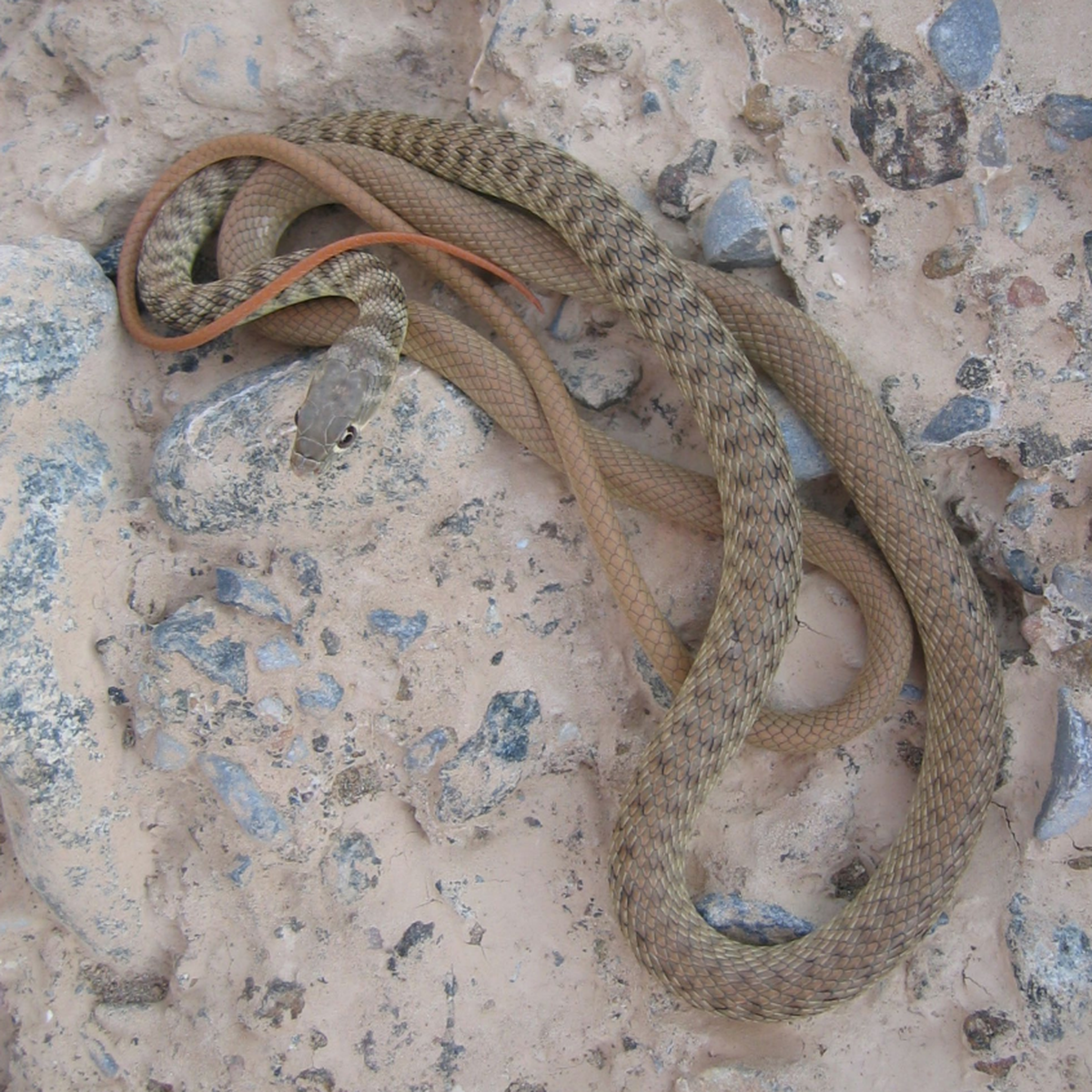
A photo shows the dusty brown coloring of a Hajar cliff racer. Its pattern shifts from being “banded” on its neck to “zippershaped” on its back, researchers said. Further down its body, the pattern fades away, and its tail ends in a bright orange hue.
The new species varies in color and pattern, the study said. Some snakes are completely “plain.”
Hajar cliff racers are relatively common and live in rocky areas of the desert or low mountain foothills, researchers said. The snakes enter “all kind of buildings including inhabited places in search of shelter and food,” preferring “barns and rooftops, ready to ambush potential prey.”
The new species is a skilled predator that “easily climbs walls and trees in hunt for lizards and birds,” the study said. It is also an “excellent swimmer,” lurking along the edge of pools to eat toads, “submerging to escape attention” and diving for fish. It has also been seen eating bats in caves.
Researchers said they named the new species after the Hajar mountains where it lives.
Hajar cliff racers have been found throughout northeastern Oman, a country on the southeastern tip of the Arabian Peninsula, and may also live in neighboring United Arab Emirates.
The new species was identified by its coloring, scale pattern, body proportions and other subtle physical features, the study said. Researchers did not provide a DNA analysis.
The research team included Beat Schätti, Frank Tillack, Andrea Stutz and Christoph Kucharzewski. The team also discovered two more new species of cliff racer snakes.
This story was originally published December 16, 2024 at 1:02 PM with the headline "3-foot-long predator found waiting in ambush on rooftop of Oman. It’s a new species."