January was ‘a complete bust’ for rain — here’s what that means for SLO County residents
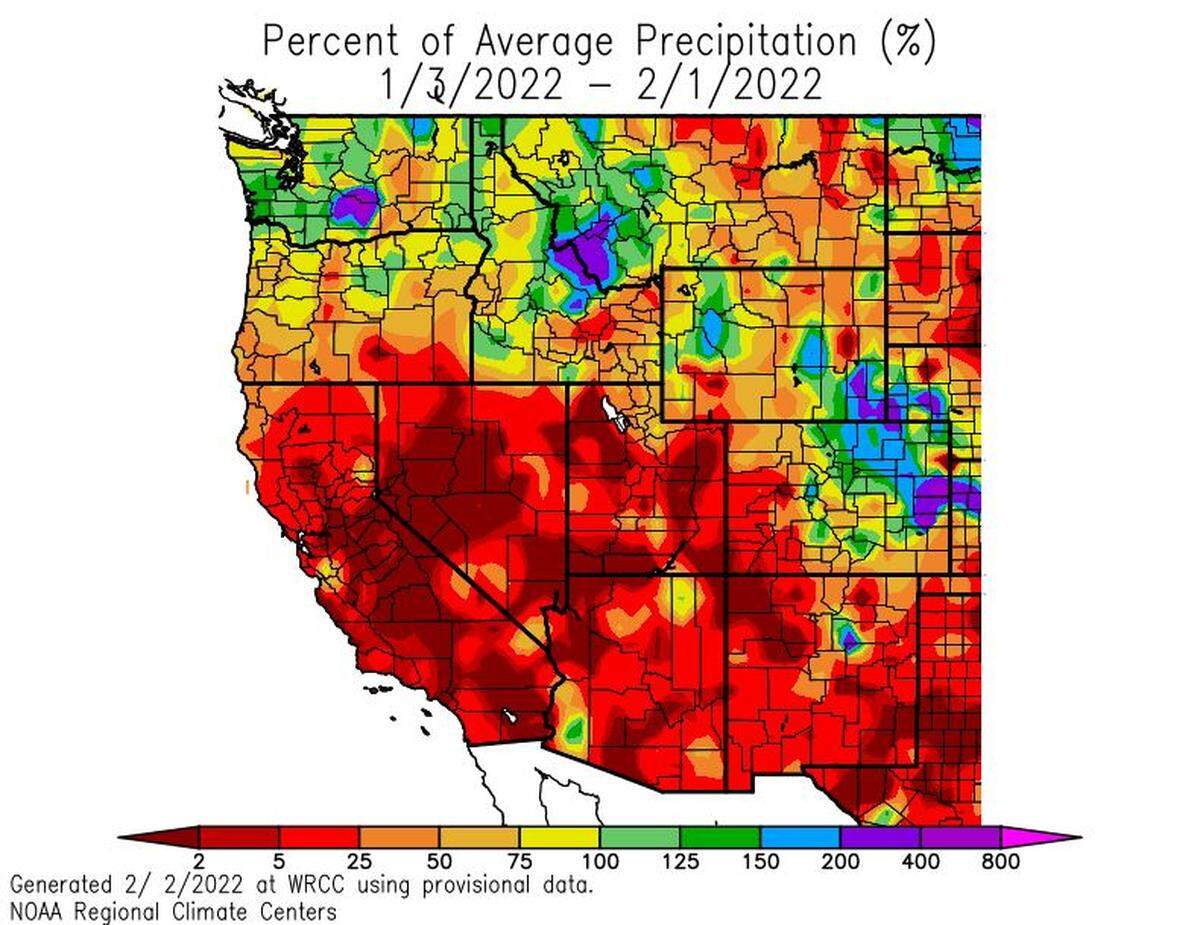
After heavy December rains refreshed thirsty reservoirs, rivers and wells, January proved to be quite the opposite for San Luis Obispo County.
No area of the county received more than a half-inch of rain during what has historically been one of the wettest months in the Central Coast’s rainy season.
The lack of precipitation leaves some water purveyors on the edge of their seats, hoping for rain to come soon so they do not have to impose stricter water restrictions on residents.
“We had such a great December and then a complete bust in January,” said Arroyo Grande Utilities Manager Shane Taylor. “If we don’t get rain in February, the Five Cities are going to be in trouble.”
Current short- and long-range weather forecasts certainly don’t wash away any fears over worsening drought conditions. All indications point toward a dry, windy and warmer-than-normal start to 2022.
San Luis Obispo County is experiencing what the U.S. Drought Monitor classifies as “moderate” and “severe” drought conditions — down from the “extreme” and “exceptional” conditions experienced in late December. Whether that changes depends on the weather, and if the southeasterly rains push and moisture over the Central Coast.
“La Niña, the diva of drought, has shown her true colors,” said PG&E meteorologist John Lindsey.
How well is SLO County conserving water?
Thanks to an exceptionally wet December — the rainiest recorded in at least 50 years at some precipitation monitoring stations — the county has not yet been thrown back into more severe drought conditions.
Even so, local water purveyors are encouraging residents to continue to save water to prepare for the warm and dry months ahead.
Data show residents have been responsive to the calls to conserve water but still fall short of Gov. Gavin Newsom’s call for Californians to reduce water consumption by 15% compared to 2020.
The Nipomo Community Services District reduced its water consumption by about 8.4% in July-December 2021 compared to July-December 2020.
Meanwhile, the Cambria Community Services District reduced use by 8.1%. Arroyo Grande and Atascadero both reduced water consumption by about 7.5%, according to the state’s data.
Pismo Beach reduced by 6.7%, San Luis Obispo by 5.1%, and Paso Robles by 3.8%, state data show.
Morro Bay reduced its water consumption in the same time period by 1.1%, according to the data.
Some residents in the county have been required — not asked — to reduce their water consumption.
Arroyo Grande, for example, declared a water shortage emergency in late October. That means residents there must limit some excess water uses such as no irrigation of landscaping on Wednesdays, limited irrigation between 10 a.m. and 4 p.m. and only using hoses with a shutoff nozzle.
“We’ve done everything we can do,” Taylor said. “And our citizens have responded really well.”
In Cambria, the community services district in late July declared a Stage 4 water shortage emergency and asked residents to severely cut back their water use to contribute to a 40% overall reduction for the community. During the emergency declaration, residents were each limited to three units of water per month, or 2,244 gallons.
But in a board meeting on Jan. 20, the community services district — its wells flush with the recent December rains — rescinded the state of emergency and is now in Stage 1 of its water shortage contingency plan, the lowest and least restrictive. That means residents of the community still must conserve water when possible and avoid excess use but are not limited to a certain allocation.
“We’d appreciate it if they (community members) didn’t make any changes in their water behavior despite our change,” said Cambria Community Services District Board of Directors member Harry Farmer during the Jan. 20 meeting.
Data shows notable drop in average rainfall
Although the calls for water conservation come during a drought period, it’s clear that saving water is something residents in San Luis Obispo County will likely have to get used to.
That’s because over the past 50 years, data show less rain has fallen each year.
For example, the precipitation monitor at Cal Poly in San Luis Obispo used to gather an average of well over 20 inches of rain each year in the 1970s.
This past year, that average has dipped to below 20 inches.
A similar occurrence is happening in the northern part of the county, where a state-monitored rain gauge has also seen its annual rainfall amount trend downward over the past 50 years.
“Our water conservation program has never stopped, and it will never stop,” said Jaime Hendrickson, the conservation manager for the Atascadero Mutual Water Co. “It’s a little early to get worried about where we are right now — we have had dry Januaries and Februaries in the past ... but we usually get rain by mid-March or April. We do continue to tell our residents that our water resources are being stressed, and we need to continue considering how to better conserve water.”
How you can save more water
Many local utility companies have rebate programs for common home appliances that can save substantial amounts of water each year. Some offer turf removal rebates — also known as “cash for grass” in a few communities — or rebates on water-efficient appliances such as shower heads, toilets, washing machines and dishwashers.
You may also find rebates through your local utility that encourage installing more efficient irrigation systems in your yard, reducing high water pressure and harvesting rainwater.
Several city utility companies run the SLO Waterwise Landscaping website, where you can find tips on how to sustainably grow a garden full of native plants that conserve water. That website can be found at www.slowaterwiselandscaping.com.
For more water-saving tips, visit www.saveourwater.com.
This story was originally published February 4, 2022 at 9:00 AM.