
Photos from the Vault

What did Centennial look like in SLO County? Inside a July 4 with ‘fine style’

Monterey street was all decked out for the Fourth of July in this picture from 1885, as a military company swings down the street at the head of a long parade. The original Andrews Hotel appears at the corner of Monterey and Osos. It was built in 1885 and burned down in April 1886 after only nine months of operation. The Sinsheimer store appears at the right, little changed from today. At the left edge of the picture are the letters “SE” from the sign over the “White House” store. Sauer’s bakery appears just beyond the Western Union telegraph office, which became the lobby of the Blackstone Hotel. Note the great white hats that adorn practically every woman in sight. The print the Tribune has on file was cut in half and digitally reassembled here with edited caption information to correct errors from the Centurama edition that ran on May 9, 1956.

San Luis Obispo celebrated the Nation’s Centennial Independence Day on July 4, 1876.

The San Luis Obispo Tribune was a weekly newspaper at the time and a big change was on the horizon.

The narrow gauge Pacific Coast Railway was within a month of bringing railroad service into town from the terminus at Port Harford Pier.
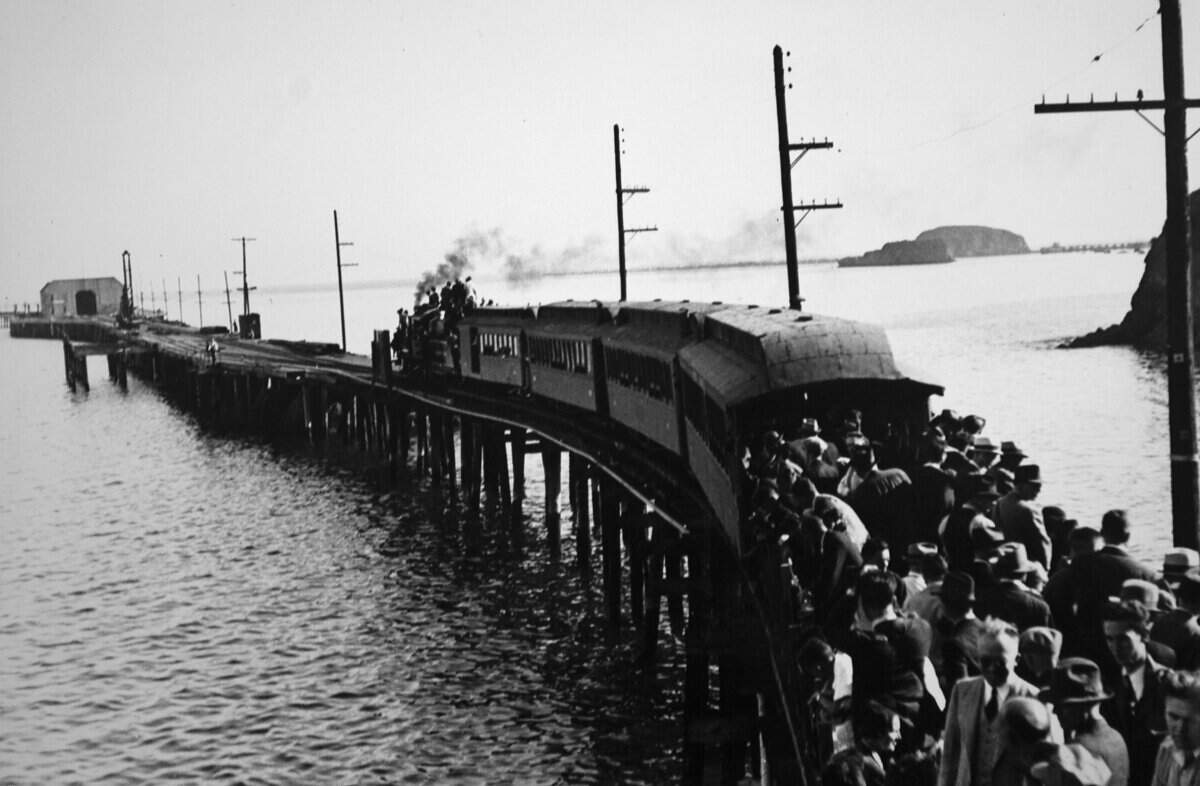
Port Harford served by Pacific Coast Railway. Special passenger excursions were held as the railroad wound down operations in the late 1930s and early 1940s.
Port Harford served by Pacific Coast Railway. Special passenger excursions were held as the railroad wound down operations in the late 1930s and early 1940s. David Middlecamp Point San Luis Lighthouse Keeper

Both Republican and Democratic national conventions had been held and each got over a column of newsprint.

Locally, Charles H. Johnson was the Independence Day keynote speaker. He was a politician, customs inspector and businessman who gave an hour-and-a-quarter speech about local history interwoven with United States history.

It runs on over seven columns of newsprint which the editors gladly typeset, filling the columns with local material.

Johnson must have been a good orator to hold the crowd, but then again this was the era before radio, film and internet.

Today he would make about 60 TikToks.

And what else did people do?

There was horse racing at the Fairview Race Course. Horses had names like Silvertail, Shenanegan, Dairy Maid, Croppy and Piedro Blanco.

Parade and barbecue were the other main attractions, though one of the editor/owners of the paper thought roasted meat was unrefined.

The article was probably penned by O.F. Thornton, loquacious but who often got in hot water with his hot takes.

H.S. Rembaugh was reserved and the more easygoing of the two.

Here’s the story from the July 8, 1876, Tribune. Odd spellings are retained from the original but paragraph breaks were included for readability.

Monterey street was all decked out for the Fourth of July in this picture from 1885, as a military company swings down the street at the head of a long parade. The original Andrews Hotel appears at the corner of Monterey and Osos. It was built in 1885 and burned down in April 1886 after only nine months of operation. The Sinsheimer store appears at the right, little changed from today. At the left edge of the picture are the letters “SE” from the sign over the “White House” store. Sauer’s bakery appears just beyond the Western Union telegraph office, which became the lobby of the Blackstone Hotel. Note the great white hats that adorn practically every woman in sight. The print the Tribune has on file was cut in half and digitally reassembled here with edited caption information to correct errors from the Centurama edition that ran on May 9, 1956.
Monterey street was all decked out for the Fourth of July in this picture from 1885, as a military company swings down the street at the head of a long parade. The original Andrews Hotel appears at the corner of Monterey and Osos. It was built in 1885 and burned down in April 1886 after only nine months of operation. The Sinsheimer store appears at the right, little changed from today. At the left edge of the picture are the letters “SE” from the sign over the “White House” store. Sauer’s bakery appears just beyond the Western Union telegraph office, which became the lobby of the Blackstone Hotel. Note the great white hats that adorn practically every woman in sight. The print the Tribune has on file was cut in half and digitally reassembled here with edited caption information to correct errors from the Centurama edition that ran on May 9, 1956. C.A. Smith

The Celebration.

Owing to giving up our space to the publication of the Hon. C.H. Johnson’s oration, we have to make brief notes of the days proceedings.

At the appointed time (10 a.m.) the procession formed in front of the Court House, in the following order. First the Mayor and Marshal of the day, on horse back, then the band, which was followed by the car of State, bearing upon an elevated platform, the Godess of Liberty, surrounded by little girls arrayed in white and decked out with the national colors, representing the states of the Union.

The car and its occupants were gotten up in fine style and made a beautiful display.

It was designed and under the general supervision of Mr. H. W. Little, whose tiny, delicate little daughter represented his native State, Ohio.

Next came the carriage with the officers of the day and Orator, then came the Independent Order of Odd Fellows, in full regalia, some eighty strong; after them the San Luis Obispo Social Club, wearing badges of their order, and next them, Good Will Fire Co. No. 2, resplendent in their brand new uniforms, consisting of a blue cap bearing above the visor “2” a red shirt with blue facing and a cream white belt bearing the emblematic words “Good Will No. 2.”

The drag ropes of the hose cart had been wound with the national colors, “red white and blue” and looked very tasty.

The company were preceeded by the San Luis band, some members of which belong to the Fire Company.
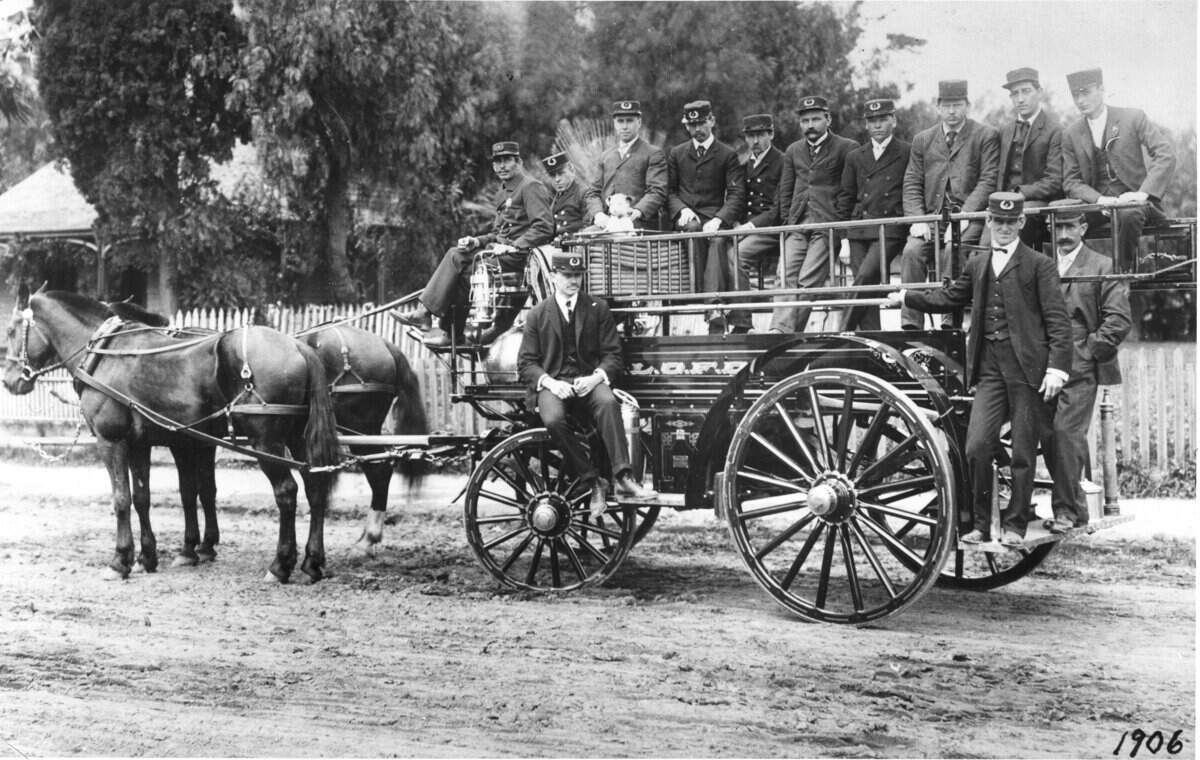
CHEMICAL TRUCK - The latest thing in fire fighting equipment - in 1906, that is-is pictured here in a photo which was presented to the San Luis Obispo fire department by Mrs. Callie M. John in 1948. The gallant volunteers in uniform are as follows: Top row, left to right-Charles Hasse, John Isola, Manuel Lopez, Billie Bambrouck, John Kirkeby, Johnnie Martin, a Mr. Parsons, Henry Berkemeyer, Frank Tercis and Warren M. John. Lower row same order, Frank Soto, Ernest Taylor and Joe Ghigliotti. Volunteer fire companies took great pride in their appearance and equipment.
CHEMICAL TRUCK - The latest thing in fire fighting equipment - in 1906, that is-is pictured here in a photo which was presented to the San Luis Obispo fire department by Mrs. Callie M. John in 1948. The gallant volunteers in uniform are as follows: Top row, left to right-Charles Hasse, John Isola, Manuel Lopez, Billie Bambrouck, John Kirkeby, Johnnie Martin, a Mr. Parsons, Henry Berkemeyer, Frank Tercis and Warren M. John. Lower row same order, Frank Soto, Ernest Taylor and Joe Ghigliotti. Volunteer fire companies took great pride in their appearance and equipment. David Middlecamp Telegram-Tribune archive

After the Fire Company came the car of justice nicely decorated with bunting and evergreens. Standing in the center was Miss

Effie Reed blindfolded to represent the alegorical figure of justice, holding in her right hand the balance and resting her left upon the sword.

Following the car of justice came the citizens on foot, in carriages and on horseback, altogether making a procession nearly half a mile in length. The line of march as laid down in the programme was strictly carried out.

In the olive grove there was an immense crowd who had not participated in the procession.
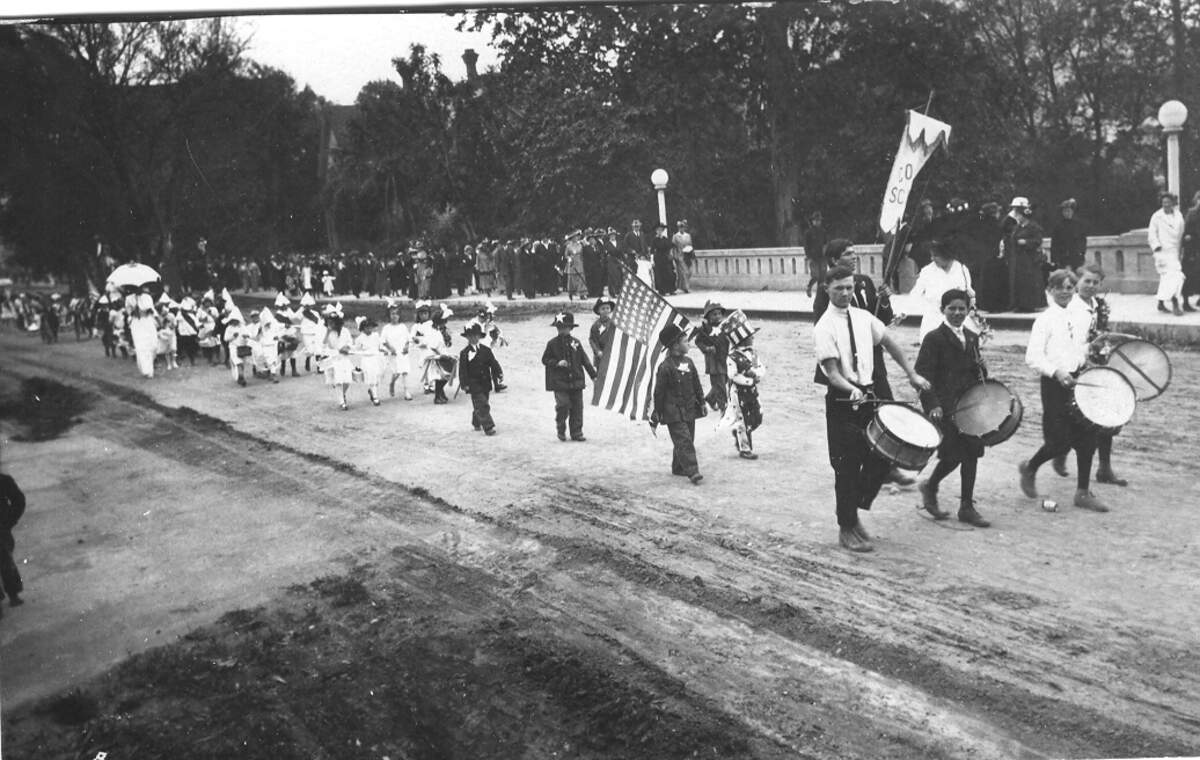
An undated postcard photo of a Marsh Street parade.
An undated postcard photo of a Marsh Street parade. Telegram-Tribune archive

And the whole length of Monterey street, when the procession passed, the sidewalks were packed; carriages and groups of people were awaiting the procession on every corner during the march.

The services were interesting and impressive. The Orator, Hon. C. H. Johnson, acquitted himself in fine style, delivering an oration of an hour and a quarter duration, without one reference to manuscript or note.

We publish it in full in to-days issue.

The picnic feeding, we trust was as ample as the crowd was gregarious who partook of it.

If our people could only educate themselves up to the point to dispense with the inevitable “roasted bullock” upon the service grounds, we think they would display a better appreciation of the eternal fitness of times and things, than by pondering to this antiquated custom of a primative, isolated people.

The entire proceedings were a success, thanks to the untiring energy of the Marshal, Mr. E. B. Morriss, and the executive committee of citizens who were appointed to make the necessary preparations for the occasion.
Follow More of Our Reporting on Uniquely SLO County

Related Stories from San Luis Obispo Tribune
David Middlecamp
The Tribune
David Middlecamp is a photojournalist and third-generation Cal Poly graduate who has covered the Central Coast region since the 1980s. A career that began developing and printing black-and-white film now includes an FAA-certified drone pilot license. He also writes the history column “Photos from the Vault.”
Get unlimited digital access
#ReadLocal

Try 1 month for $1

CLAIM OFFER