Forget iPhones: First SLO phone operator had nimble fingers and her ear on history
The smartphone has become an almost indispensable part of life these days.
It’s not just the social media sites, designed to distract us and farm our information for as long as possible.
We now get to do the jobs once held by living people, now outsourced to poorly written phone apps for things like medical services or tow truck dispatch.
Our time scrolling and filling in doesn’t cost the service provider a dime, but without the smartphone, often services are now behind a wall.
How did we get here?
If you smell leather saddles you are in the right place.
The narrow gauge Pacific Coast Railway installed a phone line between the railroad depot and Port Harford as noted in the San Luis Obispo Tribune on Dec. 4, 1880.
Soon the Cosmopolitan Hotel installed a line to the PCR depot on South Higuera Street.
The laughable prediction was: “This is the longest line likely to be required in this city for some time.”
The Cosmopolitan six months earlier had installed a line to Hecox’s Livery Stable as a sample installation of a Hoover patent telephone.
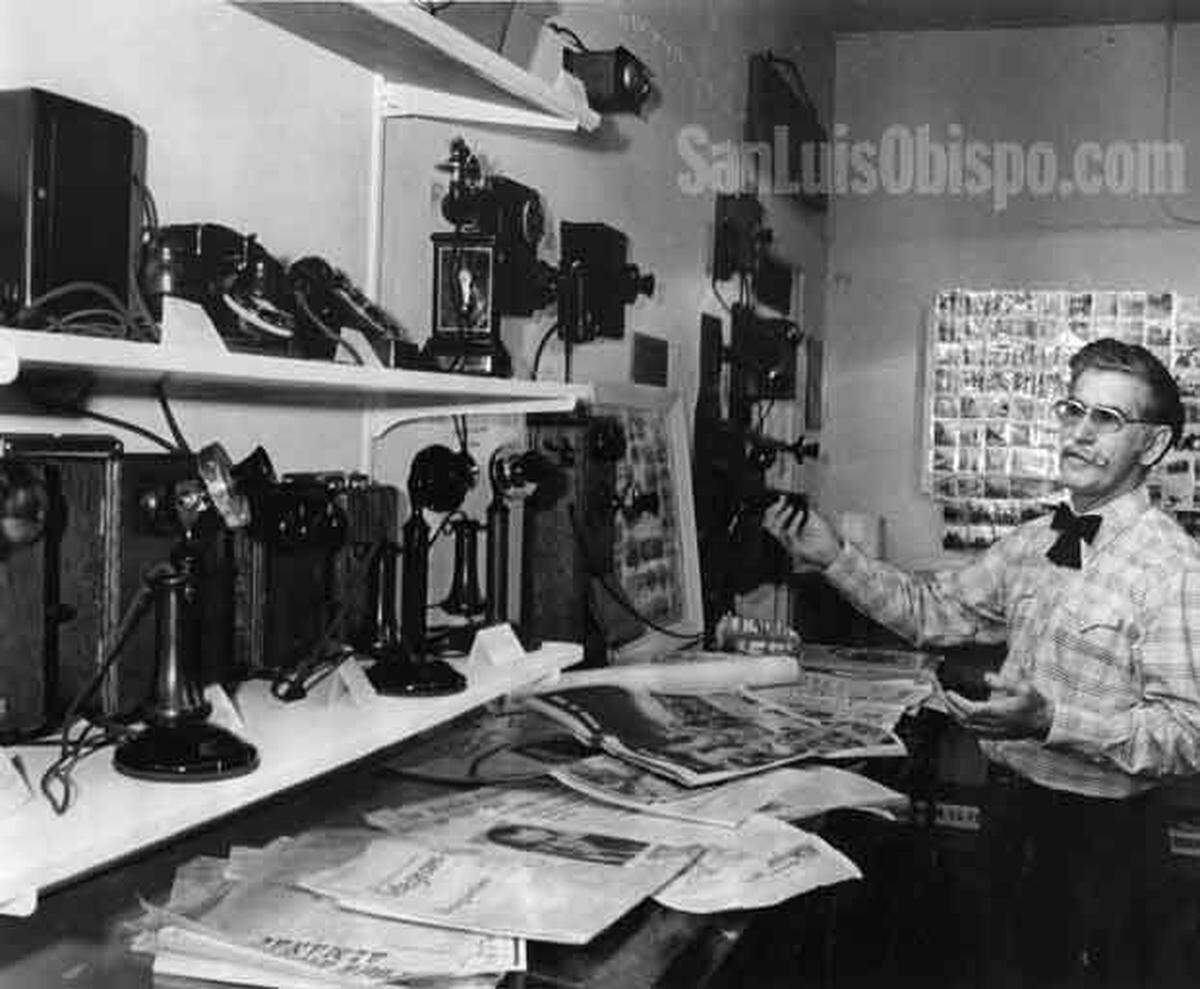
An electrician in San Luis Obispo, Leon F. Noah was in a profession that was new and growing in the mid-1880s, and he had a special interest in the new technology of telephones. He would go on to become a local manager of the Sunset Telephone Company, which opened offices in San Luis Obispo in 1885.
As the service grew, it moved to larger and larger offices.
At first the central switchboard was in a livery stable, drug store, a former barbershop and the Masonic Temple.
By 1892, a long-distance call was to Santa Maria.
Two years later, the paper wrote, “we are able now to have sweet converse with San Francisco.”
Messenger boys ran to houses without a phone to let people know that they had a call at the central office.
One of my great-grandfathers living in rural San Luis Obispo refused to install a phone in his house. If you wanted to reach Ben, you called a neighbor.
Pacific Telephone and Telegraph bought the lines in the county in 1906 but the Daily Telegram was not happy with the quality of service.
Too many calls and too few operators were the subject of two front page articles on May 9, 1928. Twenty-six operators were responsible for patching through by hand 10,000 local calls per day and up to 500 long-distance calls. Workload averaged a call a minute, though peak traffic saw much higher demand.
On the other side of my family, they cranked the magneto on a phone to listen for “Hello Central” to come through the earpiece.
Dial service arrived in the county by 1956, eliminating many of the central operator jobs.
But even when I was a kid, my grandparents’ rural home still had a shared party line. The phone rang in a different pattern depending on which of the four households the call was intended for.
My mom recalls being told to get off the line by an impatient neighbor when she and her future husband, my dad, talked for too long on the party line.
Transistors were invented in the Bell labs in 1947, but it took a few generations to fully take advantage of the new possibilities.
The ATT/Bell monopoly was initially slow to leap into wireless, allowing other companies to get a piece of the action.
Digital processing evolved into smaller and faster computing chips which enabled the smartphone 60 years after the transistor was born. The iPhone was introduced in 2007.
And now, almost a generation later in 2026, there are so many phones in so many hands that it is almost a necessity for many types of transactions.
But what was it like in the first telephone office in San Luis Obispo?
It was literally back in the horse and buggy days.
Robert Bander wrote about the memories of the first operator in the Oct. 30, 1948, Telegram-Tribune.
First telephone girl in S.L.O. recalls pioneer experiences
A small, ragged rectangle of pink paper dated 1885 has brought back a whole world of faded memories of San Luis Obispo to Mrs. Bessie McLeod Whiting of Portland, Ore., memories which many old timers will share.
Holding again the fragile sheet in her wrinkled hands, Mrs, Whiting is carried back in memory to those days of long ago when she sat at a strange new electric device in the dusty harness room of the Payne and McLeod Livery stable on Monterey street.
.JPG "The_Tribune_1948_10_30_1 (1).JPG")
When Mrs. Whiting first came to work at her “switchboard” under the hanging saddles, 1,500 ranchers, hotelmen and saloonkeepers, bringing cattle and beds and whiskey had settled with their families in the valley nested between the Santa Lucia mountains.
But it was young Bessie McLeod who first brought sound and speed to the town; she was San Luis Obispo’s first telephone operator.
Now 84 and living in Portland, Mrs. Whiting was a girl of six when her parents rocked into San Luis Obispo in a four-horse stagecoach in 1870 and remained to establish a commercial stable. Mr. McLeod soon became known and respected; he was appointed sheriff of San Luis Obispo County for two terms.
Ahead of Her Time
Through contact with her father’s official duties, Bessie learned the pattern of the expanding town and its hearty people to a degree which could not be matched by other girls in the valley, most of whom were ranch-bound. So when the unwinding of telephone wires began in San Luis Obispo, Bessie blended neatly into the newly forming communication picture.
Professor W.J McCoy, a musician who also had charge of the phone office, knew Bessie well.
“He was teaching me to be a telegrapher,” she says today, “but I was more interested in the telephone exchange.”
When the first telephone bell jangled in San Luis Obispo, it was Bessie McLeod’s nimble fingers in the hay-floored stable that were pressing the switch.
By 1885, there were 50 telephones connected in the town, and Bessie, still in the dark, leather-smelling harness room, was rapidly becoming an expert operator.
The single pink sheet, reminiscent of the Police Gazette, was the first directory — “The list of subscribers.” Perhaps it was the $20 installation fee which made the telephone a rarity in residences; only nine phones were located in homes.
New Fangled Gadget
The profitable professions in San Luis Obispo of 1885 are revealed by the thin Sunset Telephone-Telegraph company list of subscribers. Only three men had the distinction of maintaining telephones both in their offices and in their homes.
One was C.H. Phillips, a real estate agent, who must have been rising in the wake of a housing scramble which the San Luis Obispans of 1948 can without much difficulty imagine. The other two telephone gentlemen were undoubtedly kept both busy and prosperous by the street and saloon skirmishes of contentious pioneers: Dr. W. W. Hayes, and McDonald R. Venable, lawyer.
Telephones at four hotels, the Eagle, Central, French and Cosmopolitan, show that San Luis Obispo was already in the throes of becoming famous for its geographic location mid-way between San Francisco and Los Angeles. And the five saloons in town with telephones in the town including the Headquarters and the Elite, suggest that there were a good many thirsty settlers under the 188f western sun.
Two tinware store proprietors could point with pride to their new-fangled crank boxes, and such diverse establishments as Steele’s slaughterhouse, the Capitol cigar store, the Opposition stables and the Sebastopol brewery were wired for telephone sets.
Not Without Culture
Calls flashed through Bessie McLeod’s exchange to the only bookstore in town, owned by J.A. Goodrich. Fulton’s wholesale meat market took orders by telephone and so did the Tribune printing company.
The only business house to install two phones was the Schwartz and Beebee lumber company, which could be contacted in either the office or the lumberyard by the busy builders of a stretching California town.
Unfortunately the fire department did not have a Sunset bell to rattle its walls. If it had been on a telephone line, the flames which gutted the Andrews hotel might not have jumped across Monterey street to the Payne and McLeod stable in 1887.
But the fire did spread. When the stable began to ignite and the men of the town were working feverishly to guide the nervous horses out of their smoking stalls, Bessie McLeod was stacking all of the telephone company records she could gather.
Back and forth from the harness room she ran dragging the records outside. By the time the fire had crackled into its full fury the building was cleared of both horses and telephone books.
The stable, and the telephone office with it burned to the ground, two years after telephone service had been founded.
Telephone service did not lapse long, however. New headquarters were set up in the Booth and Latimer drug store, and while buying their liniment or having their prescriptions filled the townspeople would glance curiously at the buzzing exchange and the efficient young girl who linked neighbor to neighbor by this marvelous new invention. They could watch her at work from 8 a.m. to 8 p.m. each day, Sundays and holidays included.
Man Takes Over
Three years after she had connected her first telephone call, Bessie McLeod left her headset to an incoming young man. The reason: company officials had frowned upon her request for a $10 raise, evidently feeling that her monthly wage of $15 was entirely adequate.
“After my ‘termination’ with the phone company,” Mrs. Whiting says, “I took the stage to the El Paso de Robles for a two-week vacation — my first in three years.”
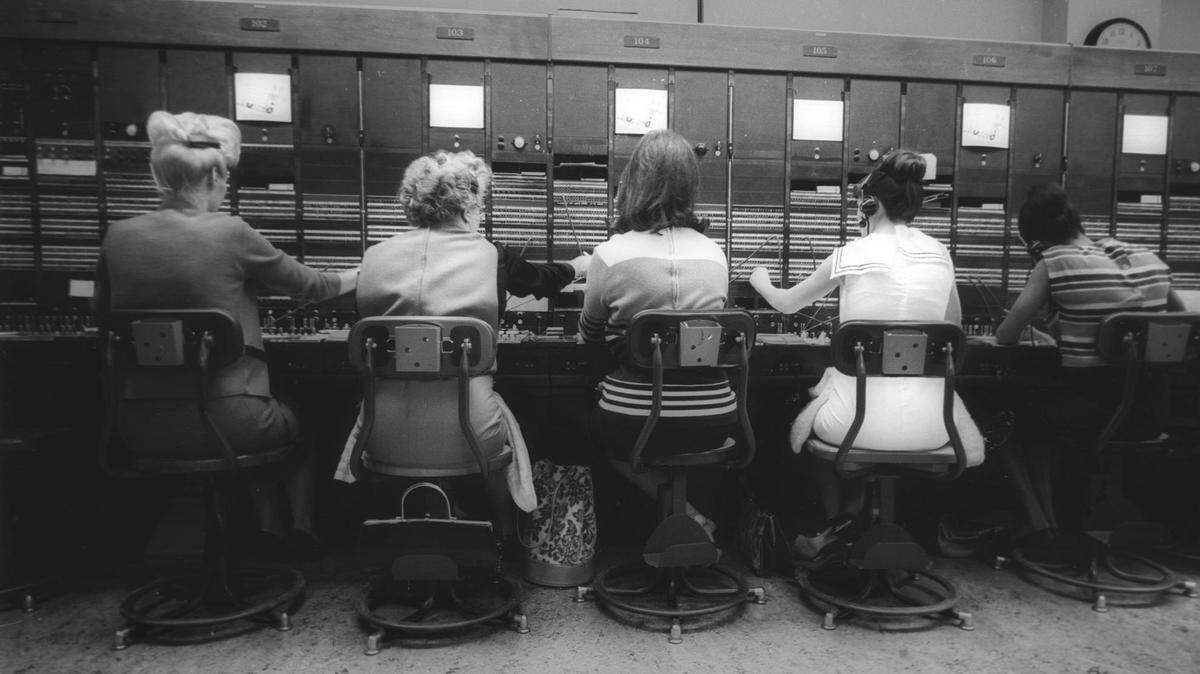
Sixty years after Mrs Whiting pushed back her stool for the last time from the electric beehive before her the telephone has acquired 95 operators in its service in San Luis Obispo in place of the original one.
Telephones are numbered in the thousands not the dozens now.
Rising on a city hilltop is the new building of the Pacific Telephone and Telegraph company, which will be one of the largest structures in San Luis Obispo when it is completed in January.
But at least one person remembers when “central” shook to the stomping of horses’ hooves. Bessie McLeod listened for three years to San Luis Obispo taking its early, uncertain steps toward modernization, and the voices of its sturdy first citizens resound in her ears still.