It took days to get pictures in SLO County newspapers. Then the Fairchild came
Technology can shape the way stories are told.
Today, algorithms influence what stories are sent our way. Click on a story about chainsaw juggling gophers and be assured you’ll soon see more.
Sometimes the influence is more subtle, based on the mechanical tools of the trade.
For example, cell phone video is easy to record and view while holding the camera vertically.
When algorithms on social media like TikTok, YouTube and Instagram decide that people are watching, those are the stories that get boosted, then we see more vertical videos created to fill that need.
Speed is also a hallmark of internet age communications. Today an image can be made on someone’s cell phone and transmitted to the world in seconds. And more and more, we need to be wary of unethical digital manipulation of images and false information.
But hey the good-old-days had problems too.
When you look at photos on news pages from mid-century, they often have a 4x5 proportion because the popular news camera of the day, the Speed Graphic, shot individual film sheets in a 4-inch-by-5-inch size.
But the Tribune and Telegram newspapers struggled in the early 20th Century to get local photos on their pages.
The problem wasn’t the images, several commercial photographers over the years shared images with the papers. Getting them into print was the bigger issue.
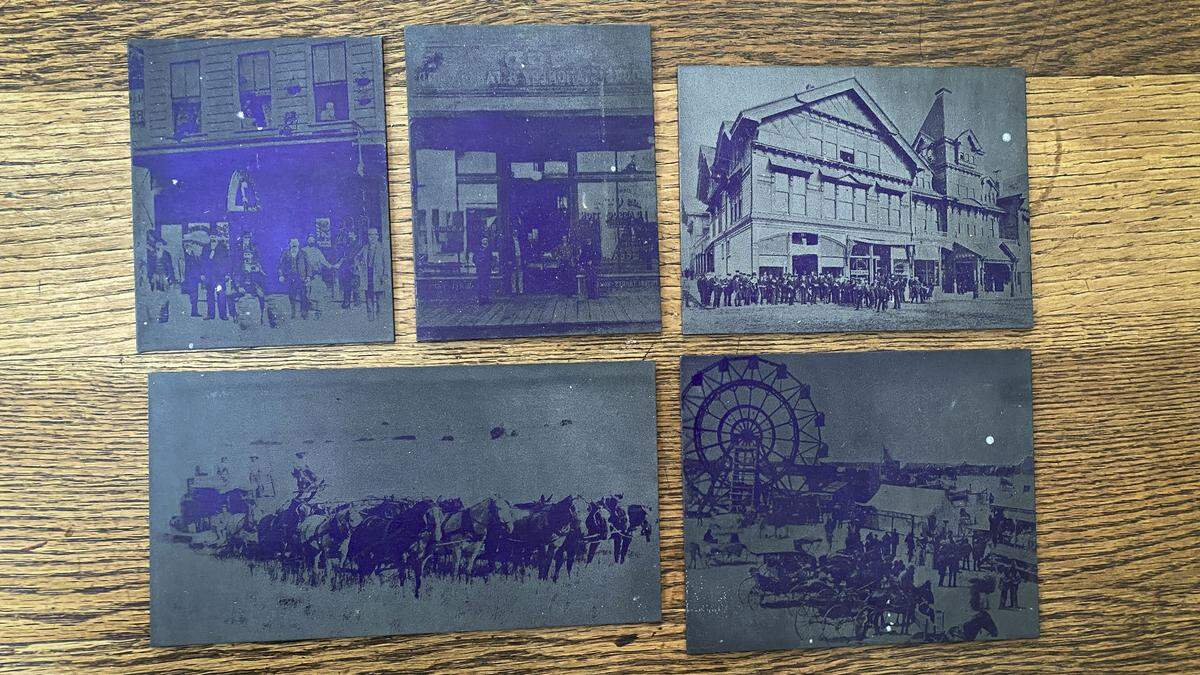
The problem was the printing process requires photos to be engraved into halftone dots that could read like a photo on absorbent newsprint.
Touch a felt marker to a paper towel and you see the problem.
When the 1926 Union Oil tank farm exploded in flames next to San Luis Obispo after a lightning strike, it was called one of the most disastrous fires in the history of the U.S. petroleum industry.
The tank farm fire is likely San Luis Obispo’s top story of the century. The incident killed two people caused $10 million in damage and shattered windows all over town on the morning of April 7, 1926.
But the Daily Telegram which carried tag lines of “Today’s News Today” and “Complete News Facilities,” would not publish a photo until three editions later on the afternoon of April 9.
Getting a machine that could make press-ready halftones locally didn’t happen until mid-century.
Until then, the county newspapers relied on days-old engravings made in Santa Barbara or Bakersfield and shipped back home.
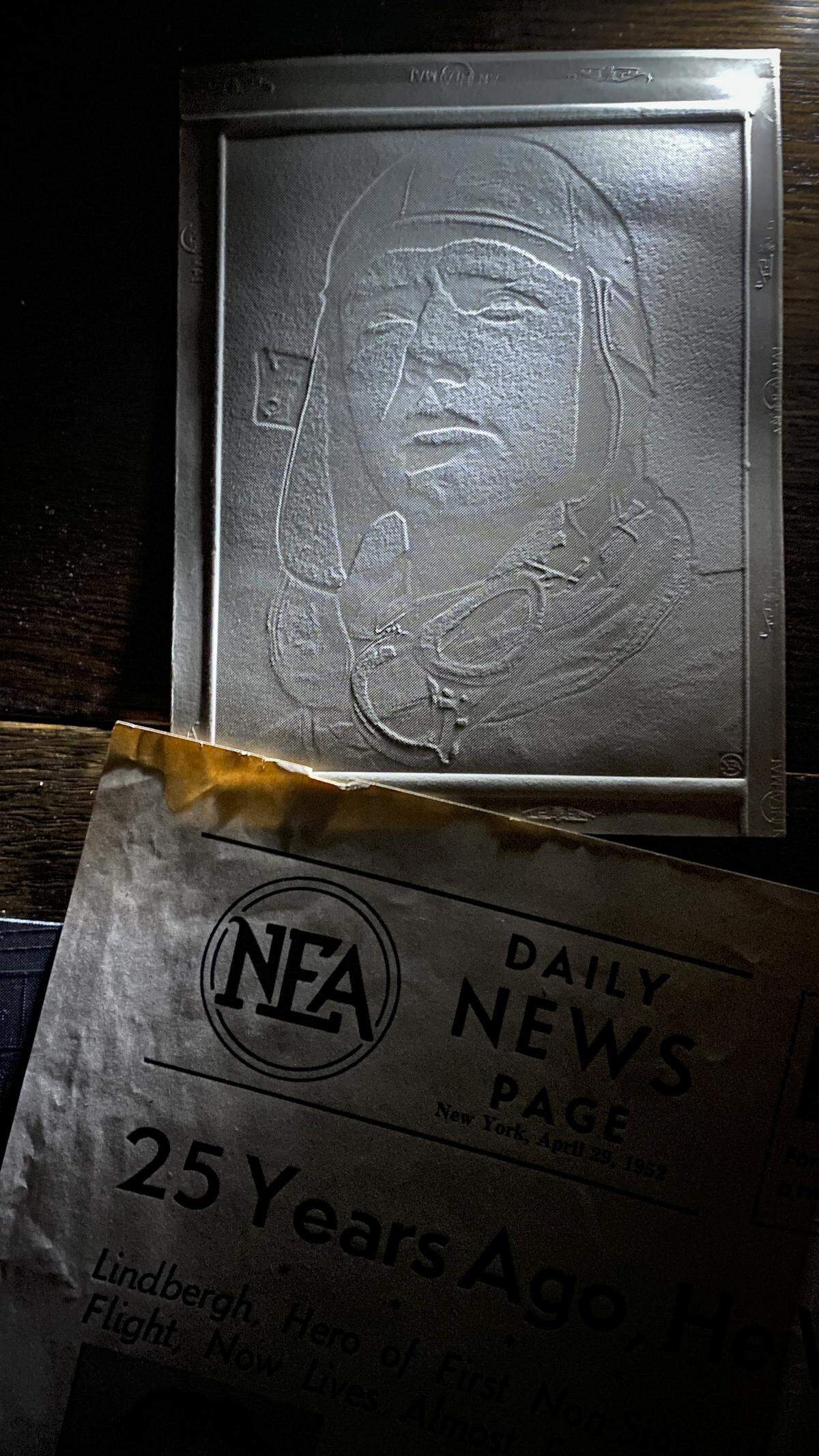
Another option were cardboard halftones distributed from the national news services sent by mail. Not current and not local.
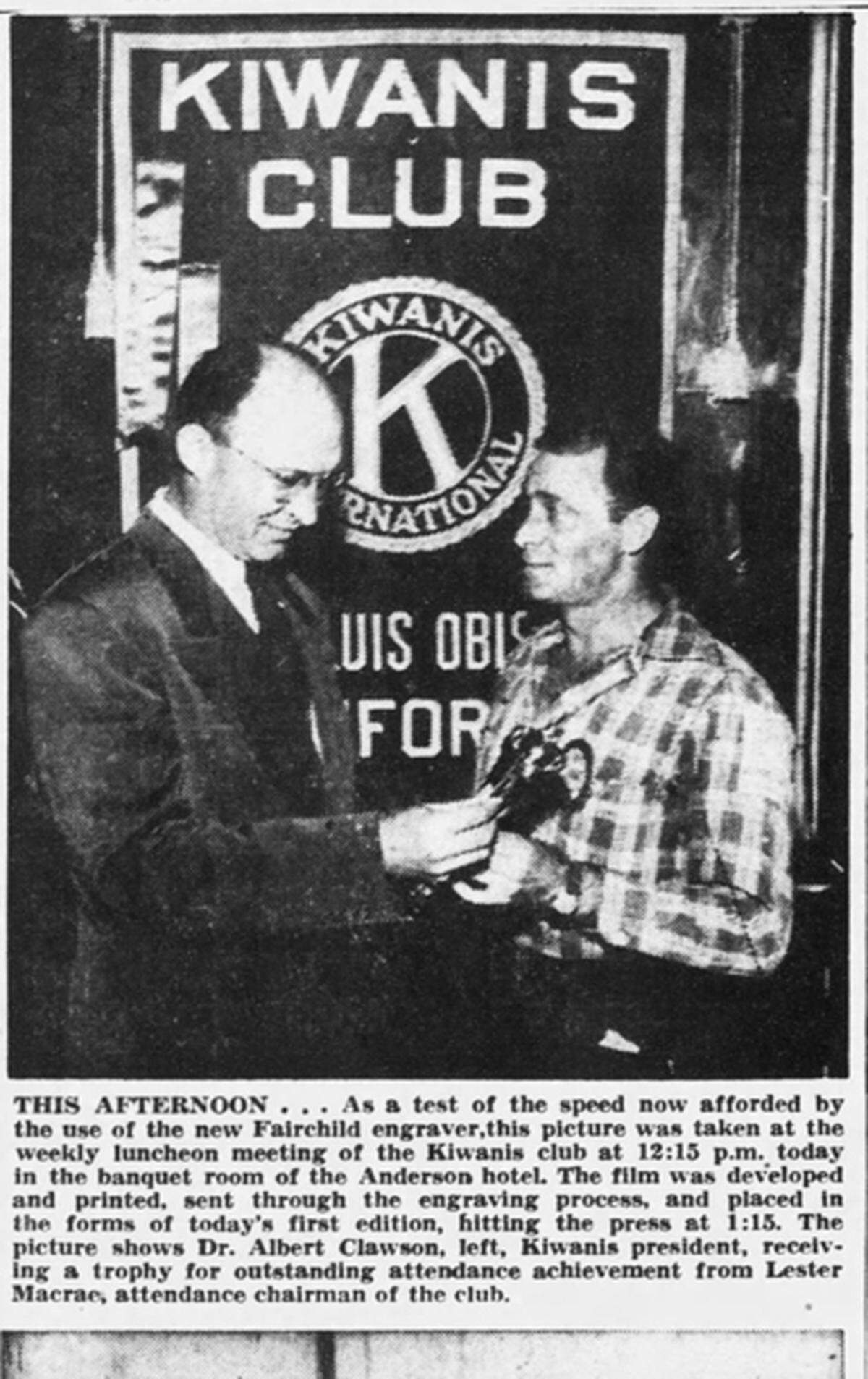
This story from Oct 25, 1950, was the dawning of a new age.
The paper could now have photos in print less than two hours after the film was shot. It would be 13 more years before The Telegram-Tribune would hire a full-time photographer who shot 35 mm film. Until then, the newsroom shared two awkward bulky 4x5 Speed Graphic cameras, the kind you see in period movies with flash bulbs and cigar chomping photographers in fedoras.
The picture that ran on the front page was not a great example of the power of visual journalism.
The Kiwanis club handoff of a trophy was mundane, but amazingly, copies were coming off the press an hour and a half after the event.
Faster News Photos by ‘Fairchild’
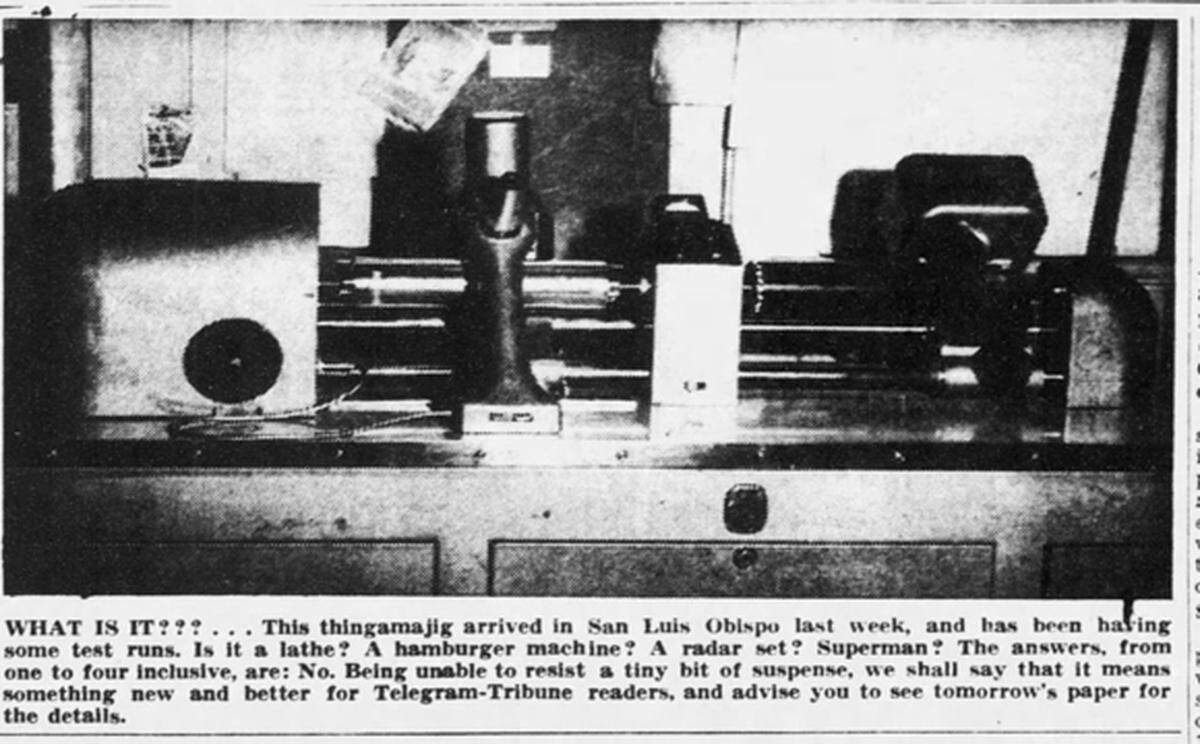
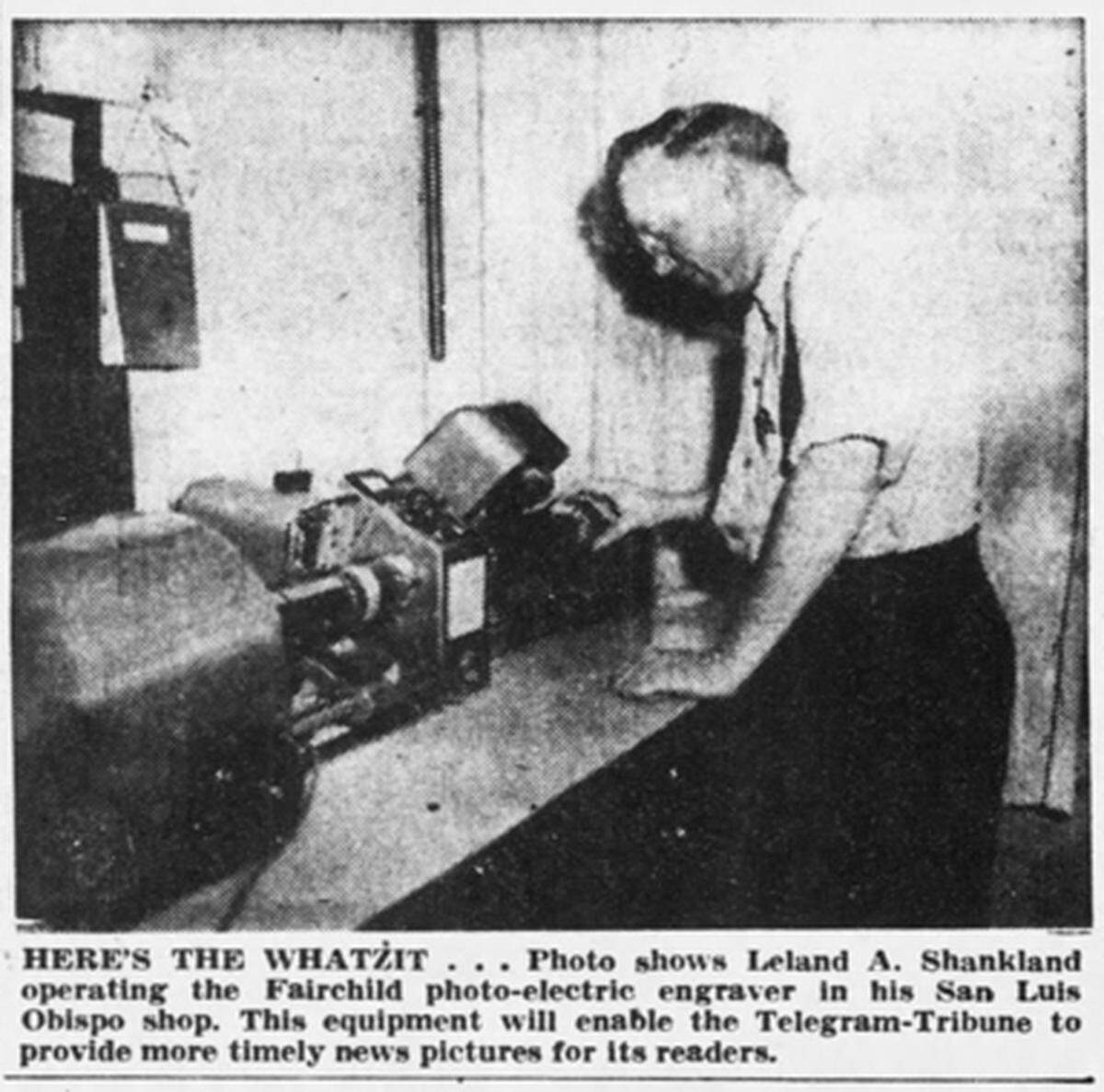
Better, faster news photo service is assured readers of The Telegram-Tribune with the arrival of a Fairchild photo-electric engraver in San Luis Obispo.
Installed at the Litho Art Shop, 1819-B Osos St., the machine will be operated by Leland A. Shankland, the shop’s proprietor. It has been leased by means of a cooperative agreement among 11 newspapers of this immediate area, including The Telegram-Tribune, which is expected to be the largest user of the service.
The Fairchild engraver is a comparatively recent development in the newspaper field, and is proving extremely satisfactory to many in the small and daily class. The simplicity and speed of the equipment is shown by the rapid overtime for the Kiwanis club picture on this page. Taken just after noon today, the picture was developed, printed and engraved in time for The Telegram-Tribune’s 1:30 p.m. first edition press time.
In the past, lack of a photoengraving plant in San Luis Obispo has caused a serious time problem in getting better live pictures. With Santa Barbara the closest place equipped with a photo-engraving plant, it has been impossible to have a news picture taken one day and printed the next — let alone using a picture the same day it is taken, as in the case of the accompanying Kiwanis shot. The Fairchild is the answer — and The Telegram-Tribune is particularly happy with the opportunity for better engraving service, which means the use of more local pictures.
The equipment is much simpler than the photo-engraving process, and produces plastic “cuts” instead of zinc.
Staff members will do almost all the picture-taking under the new setup. One Speed Graphic camera has been purchased, and another is on order.
Several “overnight” Fairchild engravings have been run since the engraver was purchased in the last few days, while experimental work on the machine was in progress. Shankland is now conducting full-scale operation of the equipment.
The machine is the result of a young boy’s dream 50 years ago. Because this vision was decades ahead of scientific development, the boy is now an aging man — but the dream which became his life’s work and led him from cub reporter to internationally known editor has come true for Walter Howey.
In 1899 he was a reporter for one of three small, daily newspapers in Fort Dodge, Iowa. Illustrations provided the most aggravating problem, and he became determined to find a way for all newspapers to use pictures.
Progress was slow because the science of electronics was far behind Howey’s vision. Many disappointments marked his slow progress, but by 1929 a photo-electric tube which would faithfully translate reflections in photographic images was available. About the same time the radio tube had been developed, and an amplifier of sufficient sensitivity and power had been invented, but not patented.
Its inventor, a young electrical engineer named John Hancock, built the first photo-electric engraving machine. He built several between 1929 and 1935, but the engravings made did not compare favorably with the quality of engravings produced by conventional chemical photo-engraving processes.
In 1935 Hancock developed the first wire-photo transmitter and receiver which could be packed in a suitcase and operated wherever there was a telephone. Before, such apparatus as developed by Howey at this time was director of International News Photos.
In 1937, he leased the Fairchild Camera and Instrument corporation to carry on all development and production of the engraver. The war temporarily halted progress, but in 1947 the engraver was ready for large scale production.
Operating on lease agreement. Fairchild now has made installations for more than 10 percent of the nation’s papers — more than 10 percent of the newspapers under 100,000 circulation which had a serious problem with fast local reproduction.
From now on, you will see more timely local pictures in The Telegram-Tribune because Walter Howey’s dream came true.