California’s next ‘sexy’ issue? Here’s how SLO County tackled rising home costs in 1980s
Housing been expensive on the Central Coast for a long time.
A 2019 list of least affordable counties in the United States featured California counties in a majority of slots — with San Luis Obispo County ranked as the sixth most expensive in the nation.
Houses have inflated in size over the years as housing prices have skyrocketed.
The median home size in 1950 was 800 square feet.
By 1981, it was 1,600 square feet, and in 2022 the number bounced between 1,800 and nearly 2,000 square feet.
Economics-driven construction for many years has prioritized free-standing single-family homes.
Tax and planning regulations have been cited as factors impacting the types of homes built and their affordability. Another issue is the growing number of private equity companies taking advantage of financial incentives to outbid individual home buyers and lock up inventory.
In San Luis Obispo, rising enrollment at Cal Poly has directly impacted the housing market.
Since 1979, the university has expanded enrollment by more than 25% to an estimated 21,022 students in October.
Cal Poly has been working on building on-campus housing to meet demands.
Over the past four or so decades, the percentage of students living off campus has fallen from 80% to a little over 60%. About 12,400 Cal Poly students lived off campus in 1979 and about 11,900 live off campus today.
The biggest factor affecting housing is that the Central Coast is a darn nice place to live. As long as people are willing to move here demand will push prices.
Judith Walthers von Alten wrote this story about San Luis Obispo County’s housing affordability issue in Oct. 21, 1981:
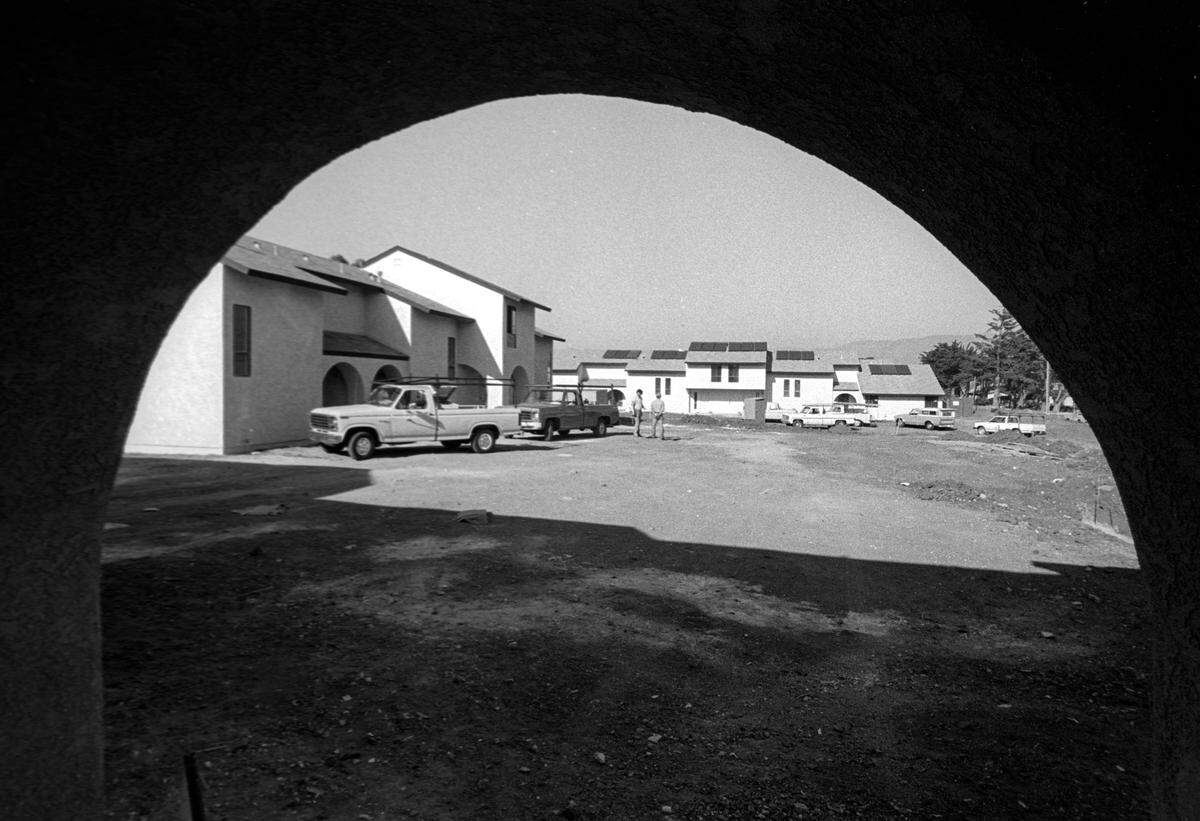
County eyes housing role
How should county government tackle housing problems in a county where the average home costs more that it would in 97% of the housing areas in the country?
Possible answers to that question are contained in a long-awaited county housing plan released Tuesday.
The plan is subject to change after public hearings that may start in three months. Once adopted, to would become part of the county general plan, and county land use policies would have to agree with it.
The plan is replete with controversial issues, chief among them the matter of “inclusionary” housing. That issue revolves around whether county government should insist that developers provide a mix of housing so homes are available to all income groups.
Providing affordable housing likely will be California’s next “sexy” issue, and it is “probably the most complex problem the county will have to grapple with in the next couple of years,” said county Planning Director Paul C. Crawford after he gave supervisors copies of the proposed plan.
The plan includes a chart that shows San Luis Obispo County ranks 12th highest in the nation’s 358 housing market areas in the cost of an average three-bedroom, one-bath home.
In releasing the document, supervisors stated clearly they are not endorsing its statements, only allowing the public to see and comment on it.
But several people in the audience immediately decried the plan’s mention of inclusionary housing, one of the 37 strategies it suggests to make homes affordable to all.
The plan notes one-half of the county households in 1980 had annual incomes of less than $16,700. For most families that is simply not enough to get into the marketplace at today’s housing costs and interest rates.
How, and whether, to help such families will be a question raised during the public hearings to come.
“There’s a real question,” Crawford told supervisors, “whether simply backing off local government regulations will solve low and moderate-cost housing problems.”
Mulling over the problem during Tuesday’s meeting, Supervisors Howard Mankins and Jeff Jorgensen both suggested that consumers must scale down their expectations of what they need.
The proposed plan notes that in the past 30 years, the median size of homes has increased from 800 square feet to 1,600 square feet, mostly with larger rooms, more bedrooms and a family room or den.
The housing plan quotes Anthony Downs, a nationally recognized specialist in housing policy and urban economics, to say, “Rising home prices have not curtailed the number of housing units demanded, as economic theory would predict. Rather they have increased the number by stimulating greater total demand by people who expect additional price increases.”
The plan adds that the purpose of buying a home has changed. A house isn’t just physical shelter; it’s an investment and tax shelter, which “leads many to purchase more space than they really need and to buy homes at an earlier age than they did just one decade ago.”
Supervisors mentioned, and the plan notes, that new home buyers in the county are primarily outsiders. More than 90% of the county’s new arrivals since 1970 came from other parts of California.
By 1982, the county Planning and Engineering departments plan to study how their processing and building requirements affect housing costs.
The plan says the county should guard against discrimination in housing by:
• Encouraging designers and builders to make doorways at least 30 inches wide in all homes so wheelchairs will fit.
• Naming an agency to handle discrimination and landlord-tenant complaints.
• Requiring new or expanding mobile home parks to provide at least one-third of their new spaces for families with children.
• Speed processing of projects with 25% or more of the homes or apartments in the low or medium-price range.
• Give a bonus — perhaps by allowing more buildings than the zoning allows — to developers in projects where more than 25% of the homes are inexpensive.
• Consider adopting ordinances to require a mix of housing prices in all developments.
• Encourage groups such as People’s Self-Help Housing, which helps owners build their own homes.
• Encourage Cal Poly to provide more housing on campus. Of 15,500 students enrolled at Cal Poly in 1979, 80% lived off campus, with more than three quarters of that number in San Luis Obispo.