Spraying sprinklers and dripping hoses: SLO City Council hired a ‘water cop’ in 1980s
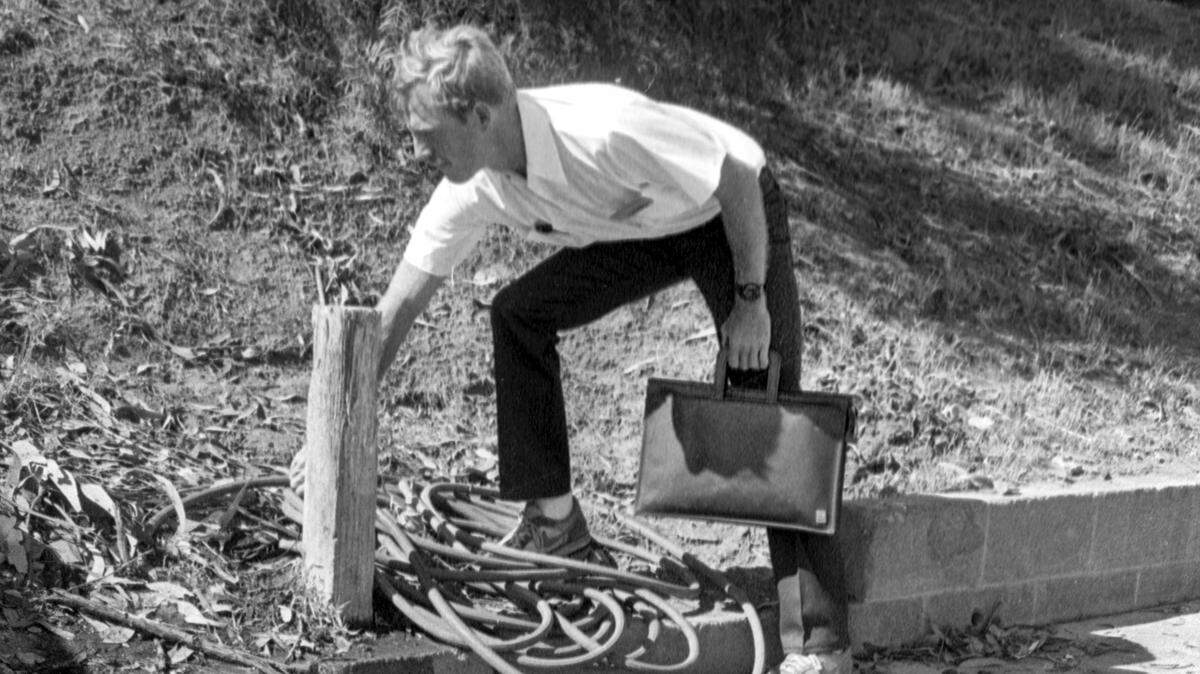
Unattended garden hoses and sprinklers spraying mid-day were common sights in the late 1980s.
But the era of cheap, almost unlimited water was about to come to an end as San Luis Obispo entered a drought-induced water crisis.
At that time, the city had yet not upgraded its wastewater system or joined with other agencies to build a pipeline transporting drinking water from Lake Nacimiento.
City voters would opt out of paying for state water but the city did implement a retrofit program that subsidized low-flow fixtures.
At the end of the 1980s water users were learning that water was a limited resource.
Ronald W. Powell wrote this story, which ran in the Telegram-Tribune on June 16, 1988:
SLO’s diplomatic ‘water cop’
Some call him a water cop, but Ray Cardwell feels more like a diplomat.
Perception aside, Cardwell is the point man in San Luis Obispo’s water conservation campaign. And as he sees it, he’ll have greater success with a light approach than by playing the heavy.
“You can bet that if you come across in a very authoritative way, people won’t be open to learn,” Cardwell said during a recent drive through Laguna Lake area streets.
“I have to make them understand that it’s in their best interest — as well as the best interest of the community — to save water.”
It’s also the law.
Stubborn drought conditions have prompted the city to step up enforcement of an ordinance that prohibits wasteful outdoor water use.
In addition, the San Luis Obispo City Council on June 6 voted to increase water fees and adopt even and odd watering days to underscore the need to conserve.
Beginning July 1, residents whose addresses end in even numbers can water outdoors on Mondays, Wednesdays and Saturdays; residents with odd-numbered addresses can water on Tuesdays, Thursdays and Sundays. No outdoor watering will be allowed Fridays.
Exemptions to the water regimen are made for vegetable gardens,, container plants and new landscaping.
Enter the 31-year-old Cardwell. At $6 and hour, he is a roving water educator who makes house calls in a city-issued white-and-orange pickup truck.
A Cal Poly graduate in environmental and systematic biology, Cardwell understands why people might apply too much water to sun-drenched plants.
But he is also serious about enforcing conservation rules — especially since outdoor water constitutes more than 40 percent of household use.
Because the city is serious about curbing excessive water use, Cardwell can use an enforcement hammer when words aren’t enough: He can cite repeated flagrant violators for misdemeanor fines ranging from $85 to $500.
Yet during a recent work shift, the citation book was nowhere in sight. At several stops along his lawn-to-lawn route, he was gentle, but firm advocate for water conservation.
At one stop he parked his truck in a Laguna Lake area housing development where a caller complained that one resident was watering more asphalt than grass. Among the well-manicured yards he met landscaper Keith Gaffney, whose workers water and tend the grounds.
Gaffney patiently listened as Cardwell explained the caller’s complaint, and then acknowledged that the water was indeed migrating from the lawns.
But Gaffney explained that much of the problem was an outdated and inefficient sprinkler system.
“This sprinkler system is 20 years old,” Gaffney explained, “and the owners can’t afford to spend $100,000 to re-irrigate.”
But he told Cardwell he would closely monitor the sprinklers to minimize waste.
“I think we do have to conserve,” Gaffney told a reporter who was traveling with Cardwell. “But if no one comes and tells you (how), you don’t know.”
Several blocks away, Cardwell stopped his truck at a home where sprinklers were running full tilt at noon.
One of the simplest conservation measures is to curtail out-door watering between 10 a.m. and 4 p.m. — the high evaporation periods.
“That never would have occurred to me,” an owner of the house admitted to Cardwell before shutting off the spigots.
The City Council and other city officials are concerned about how much water is being consumed by residents because two years of drought and customer demand have joined to reduce the levels of the city’s two water sources. Santa Margarita Lake is down 74% and Whale Rock Reservoir is down 28%.
But city officials aren’t the only ones hoisting the red flag against water waste.
Charles M. Burt, professor of agricultural engineering at Cal Poly, has studied water resources statewide and says San Luis Obispo’s situation is critical.
“There is no doubt that there is a drought problem here,” said Burt. “They (city officials) are not just blowing smoke.”
Burt said the problems in San Luis Obispo are part of a troubled water picture statewide. Each year Californians pump more ground water and surface water — 2 million acre-feet — than is replaced by runoff from rain and snow.
San Luis Obispo’s conservation program is aimed at trimming that kind of deficit water use at the local level.
And Cardwell, the traveling water educator and enforcement officer, can fill in the blanks for those needing answers to conservation questions.
“We’ve been living in a state of luxury for so long that it’s hard to get out of that thinking,” he said of historical water use practices. “I have to make the public more aware that water is a resource that you have to conserve.”