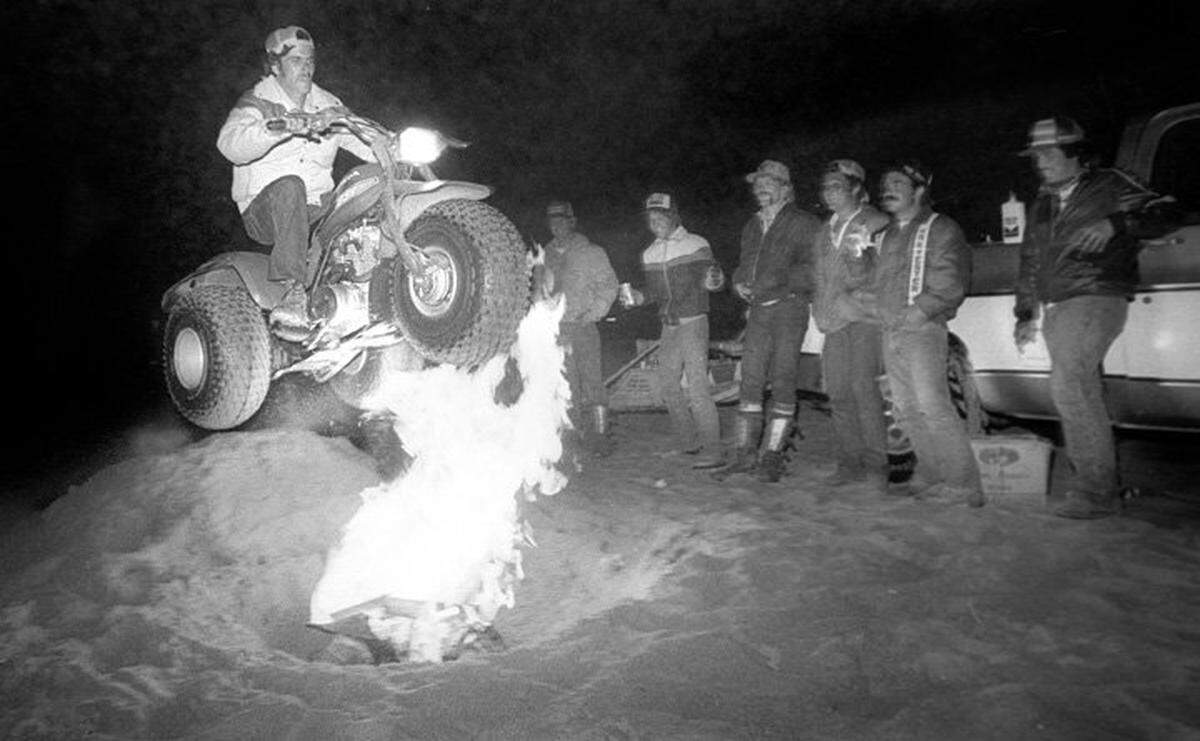
From Spanish soldiers to off-road riders, Oceano Dunes have attracted visitors for centuries
Wind, sand and surf are the constants on the Central Coast. Only the people change.
Sand dunes envelop an 18-mile stretch of coastline reaching from Pismo State Beach south to Point Sal near Guadalupe.
The Guadalupe-Nipomo Dunes span parts of southern San Luis Obispo County and northern Santa Barbara Counties, encompassing a massive state park, beaches and nature preserves. It is one of the largest remaining dune ecosystems in the state.
Sediment from the Santa Maria River and Pismo Creek washes into the Pacific Ocean, where currents, tides and wind combine to pile sand back ashore.
The prevailing wind out of the northwest can be inferred from satellite photos showing the sculpted shapes the dunes.
According to the 1977 Soil Survey of San Luis Obispo County, California-Coastal Part, “As a transect is made from the ocean in a southeast direction, or in the direction of the prevailing wind, the particle size groupings become increasingly finer.”
This was published long before the air quality on the Nipomo Mesa was tied to wind-blown sand from Oceano Dunes Vehicular Recreation Center.
The Chumash found the region to be rich in resources, including the Pismo clam and fish. They used tar-like oil seeps to caulk the their ocean-going, plank-built boats, known as tomols, or used the tar to trade with other distant tribes.
Pismo Beach takes its name from pismu, the Chumash word for tar.
Spanish soldiers nicknamed the regional tribal leader El Buchón, Spanish for “the goiter,” because of the growth on his neck. He wore a cape of otter pelts and was offered tribute from the Santa Barbara Channel to the Santa Lucia Mountains.
The Spaniards passed through the area as part of the 1769 Portola expedition, the first Spanish land expedition into Alta California. Author Nick Neely retraces the steps of Gaspar Portola and his men in his book “Alta California: From San Diego to San Francisco, a Journey on Foot to Rediscover the Golden State.”
The Spaniards had their first hunting encounter with a fearsome grizzly bear at Paraje del Oso Flaco, Spanish for “place of the lean bear.” The bear was strong, and the soldiers struggled to bring their prize back to camp.
Father Juan Crespí described the beast, writing about “the toes, soles and forepaws like a human’s but with monstrously large digits, the nails alone being not under a good finger thick and three fingers in length.”
“God deliver any living creature from their clutches,” Crespí wrote. “These huge ones have more meat on them than a large beef has.”
Unlike the Chumash, the Spanish explorers suffered from scurvy with their meat-first diets lacking in fresh fruit. The strawberry fields and citrus orchards of the future would have eased their suffering from fatigue, shortness of breath and loss of teeth.
Most of the dunes became part of the Rancho Bolsa de Chemisal, Guadalupe Rancho and a small portion of Pismo Rancho land grants.
As the 19th century closed and the 20th century, dawned the arrival of the railroad brought land speculators advertising the so-called “Atlantic City of the West.”
When the La Grande community went bust, many lots became San Luis Obispo County property due to the owners’ failure to pay property tax.
Ill-advised landscapers tried to slow the wind-driven, drifting sand by planting non-native ice plant, eucalyptus trees and European beach grass.
The Dunites, an eccentric mix of hermits and utopian idealists made their homes at the Oceano Dunes in the early 20th century.
Filmmaker Cecil B. DeMille and photographer Ansel Adams found the stunning sands worth photographing. And oil companies and sand miners extracted dollars from the dunes.
On Feb. 27, 1963, PG&E announced it wanted to locate a power plant in the sand. But an unlikely alliance between the Sierra Club and the Pismo Beach Dune Riders opposed the move in 1965.
Dune Riders member Evelyn Tallman even offered a ride in her dune buggy to environmentalist Kathleen Goddard Jones.
The dune proposal was shelved and Diablo Canyon Power Plant near Avila Beach was announced as thelocation of the “atom-fueled power plant” on Sept. 21, 1966.
Tallman was celebrated as grand marshall of the 2018 Old School Dune Buggy Reunion.
Jones and Bill Denneen organized walks into the dunes and were leading voices in the effort to regulate or eliminate off-road riding there. Both are remembered fondly by the environmental community.
On March 18, the California Coastal Commission unanimously decided to require California State Parks to end off-highway vehicle use at the Oceano Dunes by 2024.
It is likely that the next chapter of the history of the dunes will unfold in a place sometimes considered gritty but never sandy: the courtroom.