
What’s up with the ragged-looking elephant seals at SLO County beach?
The spring months bring more seals to Piedras Blancas than even the winter breeding season. All 5,000 or so adult females return, along with the same number or so non-breeding juveniles. It’s the busiest beach season for these migratory seals.
Their peaceful spring rest on the beach belies the drama of their lives — both within their pregnant bodies and in the effects of human activities on their habitat.
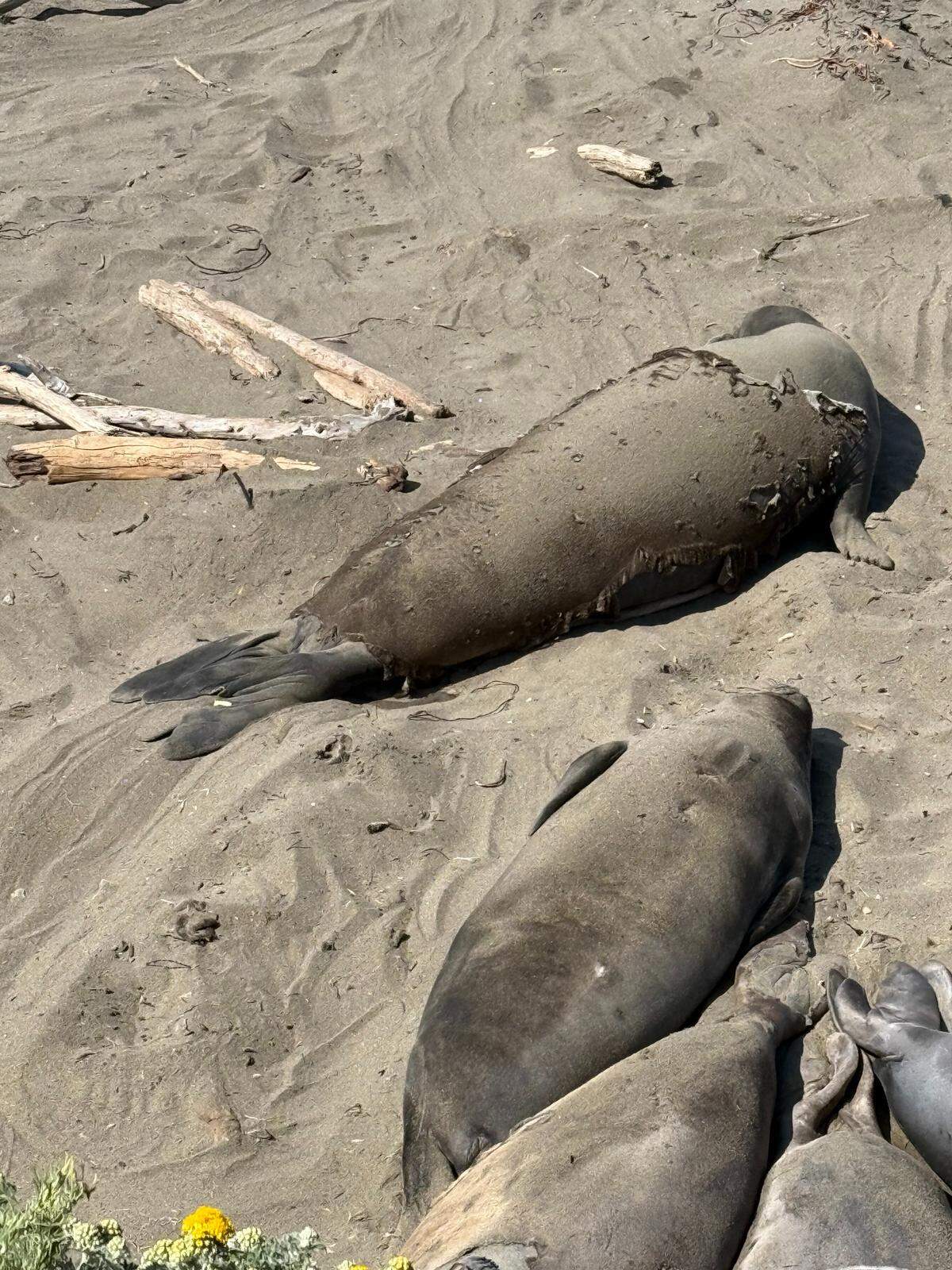
Right now the seals look ragged, like something is wrong with them. Their skin is peeling off. For northern elephant seals, it’s normal, the annual molt. They will be on the beach through June.
Berney LeBoeuf, in his book “Elephant Seals: Pushing the Limits on Land and at Sea,” recounts an incident from the 1960s, when elephant seals were unfamiliar to local residents.
A woman called police to investigate the scruffy-looking seal on the beach near her house. The policeman who responded agreed that the seal was suffering, and shot it to relieve its misery.
“Of course, the seal was fine,” LeBoeuf wrote. “It was just molting, as residents came to learn with the increasing influx of seals in the following years.”
.JPG "Molting (7).JPG")
Molting time
Elephant seals, like only one other seal (the Hawaiian monk seal), molt their skin annually in a few weeks. All other seals molt, but gradually, one hair at a time, like dogs, so it isn’t as noticeable.
Elephant seals form a new skin layer under the old skin. Blood stops supplying the old skin. It dies and peels off in pieces. Scraps of it skitter across the beach.
Friends of the Elephant Seal docents have samples of it to show visitors. Children enjoy handling it. Adults are more dubious, extending a cautious finger for a touch.
The seals stop eating when they are on the beach at the rookery, fasting for the four weeks it takes for them to complete their molt. Female seals lose about a quarter of their body weight while they lie on the beach and let their skin peel off.
The new skin and hair underneath starts out gray. The hairs are short, but soon stand up and grow longer, turning brown. Look for pearly gray seals next to brown and tan seals.
The skin begins to molt off around eyes and ears, old scars and other body orifices. Then the belly and sides and back peel off.
Marked seals
Old scars remain, but temporary marks peel off with the skin.
That’s one of the challenges of identifying seals for research study. Numbers bleached or dyed on the fur peel off when the skin molts. Resighting seals with dyed numbers before their skin peels off depends on the luck of the seal being at a place and time when someone sees the mark and reports it.
Keep your eyes out for marked seals. With so many on the beach, you’re likely to see one or more.
If you see a marked seal, report it to a docent or contact elephantseal.org.
Seals can also be identified with small plastic flipper tags, but those numbers are difficult to read from a distance.
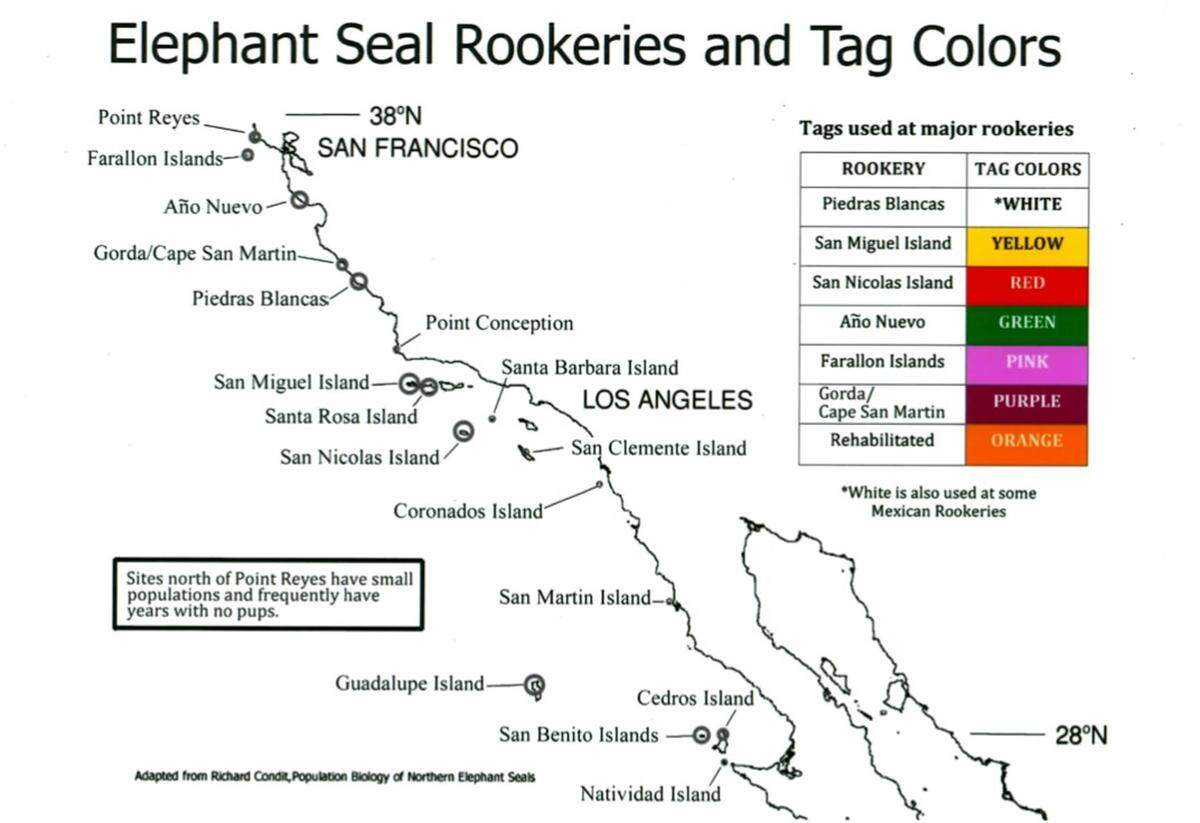
Friends of the Elephant Seal docents Rian Dom and Dave Lawrence walked the north beaches on a “tag hunt” in early April.
“There are many hundreds of seals near and north of the motel,” Lawrence said. “We got 43 tags, including greens, pinks, one yellow, and one orange tag, and, of course, mostly whites.”
Seals born at the Piedras Blancas beaches get white tags.
“We were amazed at each cove how many seals were present,” Lawrence said. “But — and this is very comforting — we saw no dead seals, and everybody looked healthy and happy to be there. There were many weanlings working on their water skills.”
Pup embryo development
Unseen, next year’s pups are starting to develop. The females mated after they weaned their pups in February and March.
That fertilized egg entered a state of embryonic diapause, or delayed implantation. Development was suspended, allowing the mother to regain blubber and condition after the weight loss of nursing her pup.
Embryonic diapause times all births to happen around the same time.
These slightly pregnant females spent the next ten weeks feeding freely. Now, in April and May, their bodies prepare for the embryo to begin gestation.
Embryonic diapause happens in other mammals. In some, it’s a response to conditions. In elephant seals, all pregnancies start this way.
After their molt is complete, the females return to the ocean for their long migration. They will stay at sea, feeding, until January, when they return to the beach to have their pups.
Juveniles
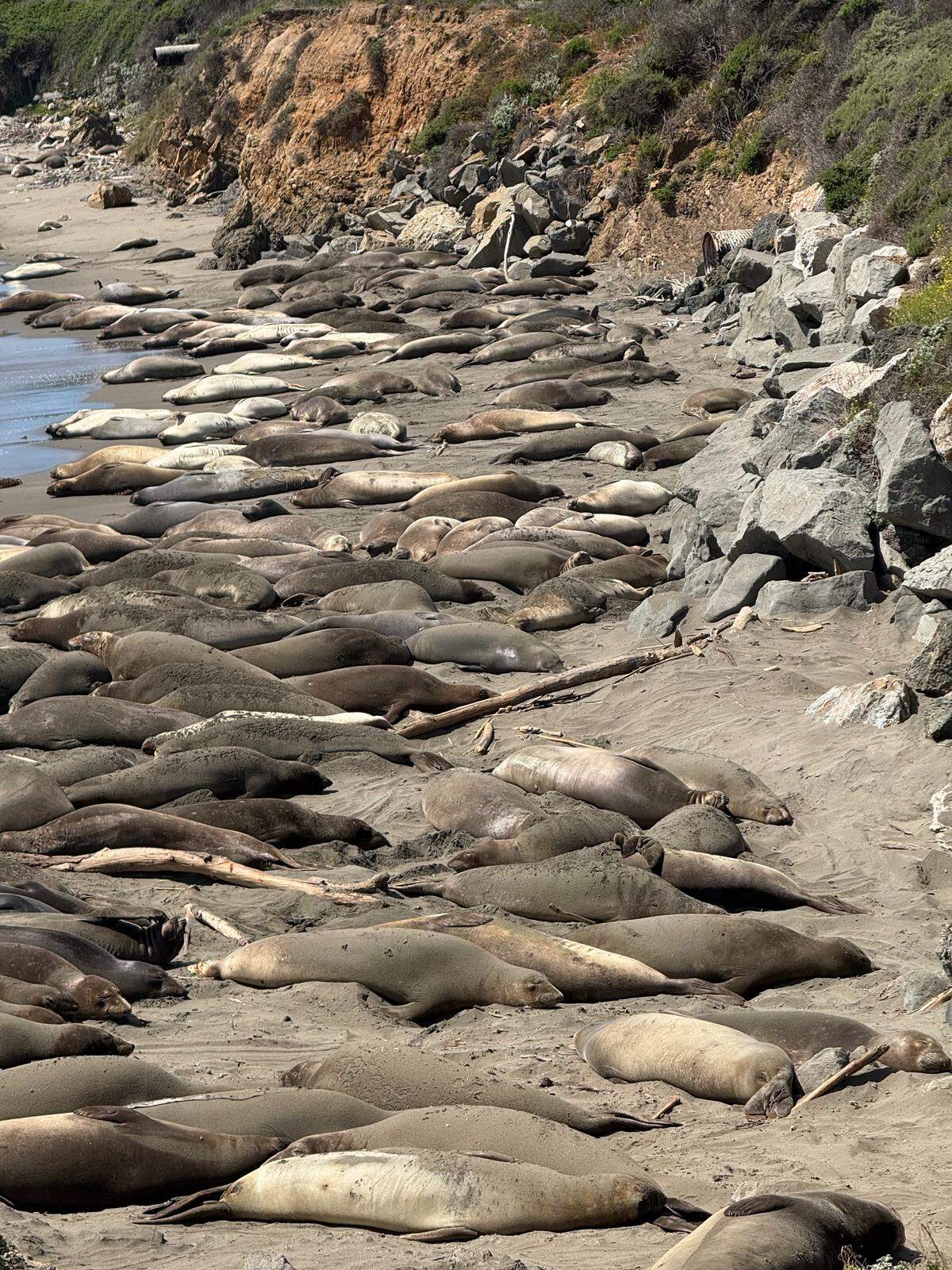
Juveniles, male and female seals not yet ready to breed, have been foraging and growing at sea while the adults dominated the beach during the winter breeding season. The beach, although crowded, is calmer now. No bulls fighting for dominance.
After the juveniles have finished their molt, they will return to the ocean to feed until September, when they return to the beach for six weeks of rest, the Fall Haulout.
Bulls are on their northern migration. They will return to the beach in July and August, time for them to molt their skin.
H5N1 outbreak
The outbreak of H5N1 virus, Highly Pathogenic Avian Influenza, at Año Nuevo, has not reached Piedras Blancas. One juvenile sea lion was found dead of the virus in the area, but young sea lions travel far and wide, and no other seals or birds were confirmed to be infected.
The threat is not gone. Teams of scientists continue to collect samples and test for the virus.
For the present, The Marine Mammal Center is tentatively responding to calls of stranded elephant seals and harbor seals. The Center has suspended rescues out of caution to avoid spreading the virus to the Sausalito hospital.
.JPG "Molting (1).JPG")
Mercury bioaccumulation
The molted skin takes with it some of the mercury that the seals have accumulated from the mercury in the ocean. The mercury got there from coal-burning plants, discharged into the atmosphere and rained down on the oceans.
Top predators such as elephant seals bioaccumulate it as it goes up the food chain.
Shed skin and other excretions from the elephant seals at Ano Nuevo are a major source of methylmercury contamination there, influencing the lower levels of the food web.
Methyl mercury is a human neurotoxin. Mercury affects the seals’ hormone levels, immune system and the ability to reproduce successfully, which may affect the population.
Research continues on how mercury may be affecting the seals.
Christine Heinrichs is the Monterey Bay National Marine Sanctuary Advisory Council SLO At-Large member. Her elephant seal column won first place from the National Society of Newspaper Columnists in 2024. Follow her on Facebook, Bluesky, LinkedIn and Substack.