SLO County public lands could be offered to oil and gas leases. Here’s where
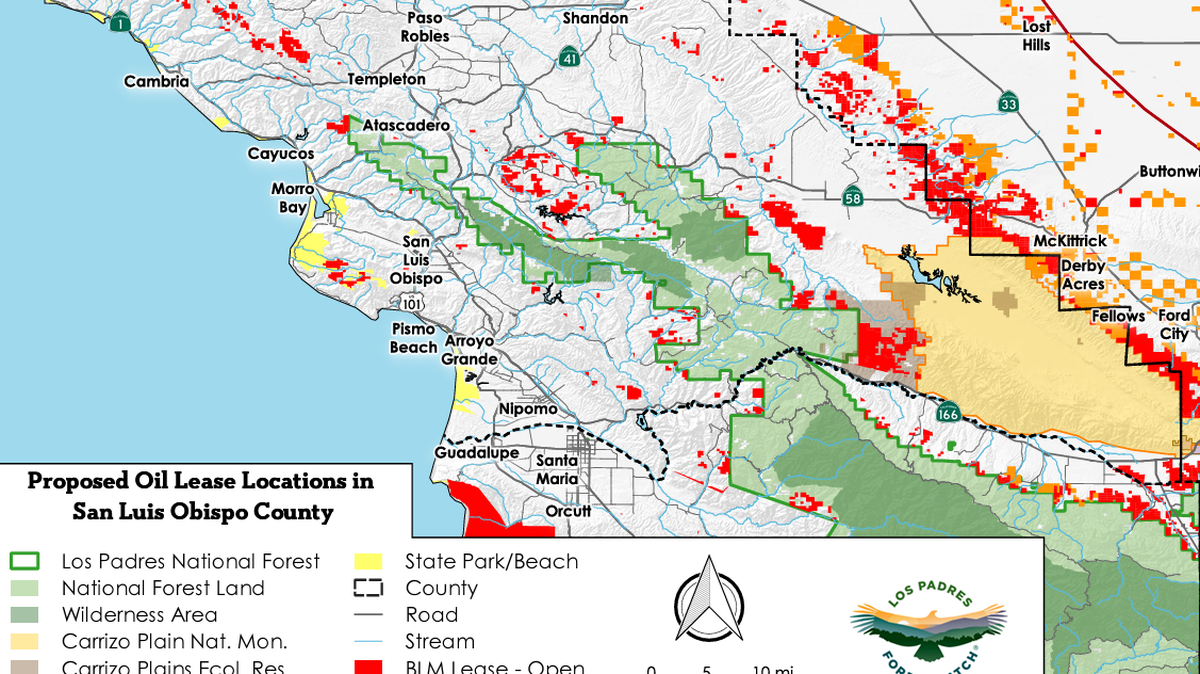
The Bureau of Land Management wants to open about 123,000 acres of San Luis Obispo County land to oil and gas leasing.
On Jan. 12, the bureau published a draft supplemental environmental impact statement in the Federal Registrar that evaluated the impact of allowing oil and gas leasing on about 400,000 acres of land managed by its Bakersfield Field Office.
That land stretches through eastern Fresno, western Kern, Kings, Madera, San Luis Obispo, Santa Barbara, Tulare and Ventura counties. The bureau also manages 1.2 million acres of federal mineral estate — some of which lies under privately owned land.
The draft report identified Lost Hills, Buena Vista, Bakersfield and Sespe as optimal locations to expand fracking.
While San Luis Obispo County lands were not identified by the report as a target for new fracking operations, the proposal still would make local land available to oil and gas leasing. Some of those parcels border sensitive areas like Los Osos Middle School or the Carrizo Plain National Monument.
Designated wilderness areas or national monuments like the Carrizo Plain would not be available for oil and gas leases, the report said.
The Bureau of Land Management said the project supports the Trump administration’s Secretary Order 3418, which calls for the expansion of oil, gas, coal and mineral exploration on federal lands, according to the notice.
The draft environmental review said expanding oil and gas development would have only a minimal impact on the environment, but local environmental advocacy group Los Padres ForestWatch disagreed.
“They keep missing what scientists have been telling us for years,” Los Padres ForestWatch executive director Jeff Kuyper said. “That this highly intensive oil extraction activity, fracking, causes significant environmental impacts to wildlife habitat, clean water, clean air, noise.”
The Bureau of Land Management will host a meeting on Zoom to discuss the proposal on Tuesday from 5 to 6:30 p.m. People can register to watch or to speak during public comment at bit.ly/45A9N7B.
Revived plan for oil and gas leasing
Environmentalists have been fighting the expansion of oil and gas production in Central California for at least a decade.
In 2014, the Bakersfield Field Office adopted a resource management plan that would have offered 1 million acres of federal land and mineral estate to oil and gas leasing and development, according to court documents.
In 2016, the Center for Biological Diversity and Los Padres ForestWatch sued the Bureau of Land Management, arguing that the 2012 final environmental impact statement for the plan did not adequately address the impact of fracking on air quality, water and wildlife — which would violate the National Environmental Policy Act.
The court agreed with the environmentalists, so the bureau “agreed not to conduct any new oil and gas lease sales within the Bakersfield Field Office planning area until it completed supplemental National Environmental Policy Act analysis to address the deficiencies identified by the court,” a court document said.
In 2019, the bureau published a new supplemental environmental impact statement for the project.
The Center for Biological Diversity and Los Padres ForestWatch sued again, arguing that the bureau still failed to address the impact of fracking on air and water quality and the health of nearby communities. The State of California filed a related lawsuit against the plan in 2020.
As a result of the litigation, the federal government couldn’t proceed with new oil leasing in the region without “a more thorough review of potential impacts,” the Los Padres ForestWatch said.
Now, like a case of déjà vu, the bureau developed a supplemental environmental impact statement to yet again review the impact of expanded oil and gas production — and determined that an amendment to the resource management plan isn’t necessary.
Report says proposal isn’t dangerous
The draft report concluded that there is no noticeable increase to environmental impacts between the 2012 environmental impact statement and this one — so the bureau does not need to amend the 2014 resource management plan, it said.
The proposed oil and gas development would cause “minor” emissions that “are not expected to significantly affect regional air quality or public health,” the report said.
Meanwhile, there will be a “minimal” impact to protected species like monarch butterflies and to groundwater resources, both of which would require appropriate management practices, the report said.
Los Padres ForestWatch didn’t buy it.
Kuyper said a thorough analysis would have identified significant environmental and community impacts caused by expanded fracking.
“A lot of places that are critical to protect for public health and critical to protect for environmental health are being placed at risk by this plan,” he said.
If the bureau were to revise the management plan, Kuyper would like to see recent state-mandated health protection zones excluded from land available for new oil and gas leases.
California Senate Bill 1137 prohibited new oil and gas extraction within 3,200 acres of homes and schools. Kuyper would have preferred to see the federal government respect this law, but instead, the U.S. Department of Justice filed a complaint in federal court against the law.
“It just goes to show that, once again, this administration is more concerned with lining the pockets of the oil industry than taking the time to really consider ways to protect the environment and protect our communities,” he said.
How to comment on the proposal
People can submit public comments to the Bureau of Land Management on the draft supplemental environmental impact statement by March 13 through the project website at bit.ly/4qRa0f7.
The bureau will also accept public comment at the meeting on Tuesday evening.
The bureau is then supposed use those comments to revise the draft and create the final report.
This story was originally published February 2, 2026 at 3:19 PM.