Residential well owners can’t protest Paso groundwater rates. Is that legal?

Property owners who pump water for their farms or businesses from the Paso Robles Area Groundwater Basin may soon need to pay for their groundwater. Right now, they have the opportunity to protest those fees.
Residential well owners, however, won’t be charged those fees directly — which means they can’t protest them either, according to Ryan Aston, a consultant who developed the proposed rates.
Templeton resident John Tucker said he thinks residential well owners have a legal right to protest the fees though.
He launched a petition protesting the process on June 30 through his advocacy group, Paso Basin Stakeholders. As of Friday, about 500 people had signed the petition.
“I launched the petition as a way to give those most affected a collective voice in a process that has excluded them entirely,” he wrote in an email to The Tribune.
Meanwhile the Paso Robles Groundwater Authority maintains that it is following the letter of the law, spelled out in Proposition 218.
Because residential well owners use so little water, the agency proposed charging Groundwater Sustainability Agencies the fees of residential well owners in their jurisdiction. If residential well owners aren’t charged the fees directly, Prop 218 says they aren’t eligible to protest the fees, Aston said.
The Authority mailed the notice of proposed charges to the owners of 1,315 parcels on June 6.
The agency will hold a public hearing to consider the rates on Aug. 1. If a majority of recipients submit a written protest, the agency can’t implement the rates. Otherwise, the board can vote to enact the fees.
What are the proposed water rates?
Irrigators would be charged different rates based on their use of the water, according to Aston.
The rates would vary annually depending on the budget adopted by the board. The rate study set a fee limit for each year, but the board could still vote to lower the fees.
Commercial groundwater users including wineries, breweries and groundwater systems like the city of Paso Robles could be charged up to $28.65 per acre-foot of water consumed during fiscal year 2025-26, while farmers could be charged up to $58.71 per acre-foot.
Meanwhile, each Groundwater Sustainability Agency would then cover the cost of residential well owners in its jurisdiction.
The fee per acre-foot of water for residential well owners would cap at $26.76 during fiscal year 2025-26.
SCI Consulting hadn’t decided what that billing system would look like as of Tuesday, but each Groundwater Sustainability Agency would likely receive an invoice for the cost of each domestic residential well owner in its service area, Aston said.
If the board adopts a lower-than-expected budget for a particular year, its members can vote to set lower fees, too.
“The budget justifies the rates,” Aston said.
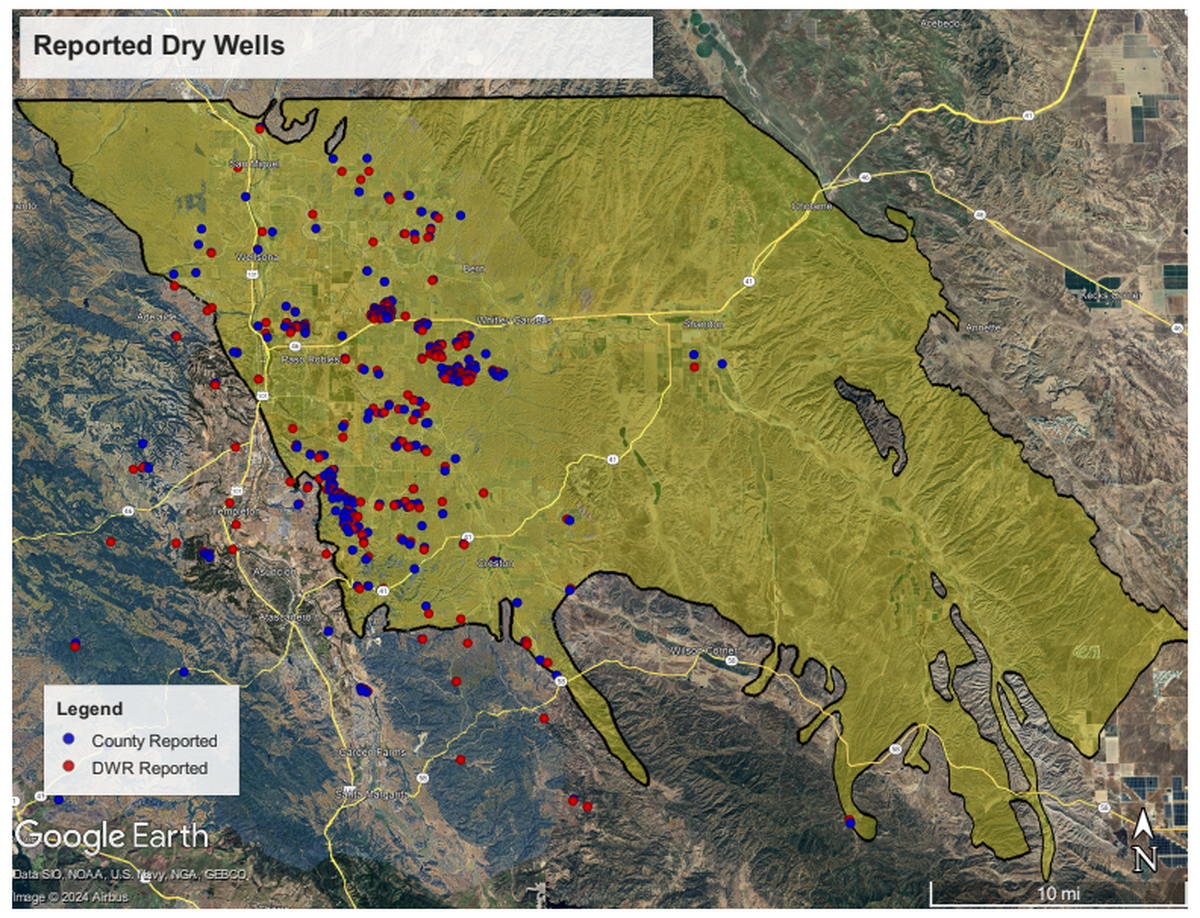
Residential well owners feel excluded from protest process
Like so many homes across the Paso Robles Area Groundwater Basin, Tucker’s family relies on a residential well.
The water usage of residential well owners was measured, priced and included in the budget. Even though the Groundwater Sustainability Agencies would pay those fees, Tucker said residential well owners should get to vote in the Prop 218 process because a tax is being applied to their property, even if they’re not paying the tax directly.
“Prop 218 doesn’t say fees only matter if you’re the one cutting the check. It’s about whether your property is subject to them in the first place,” Tucker said. “And by using accounting sleight-of-hand, the Paso Robles Area Groundwater Authority has denied thousands of us the protest rights guaranteed under state law.”
Tucker will submit the petition to the Paso Robles Area Groundwater Authority ahead of the budget vote on Aug. 1. While the petition doesn’t have any legal force, Tucker said the goal is to send the authority a message.
“I hope it forces the Paso Robles Area Groundwater Authority to take a step back and realize that thousands of families have been unjustly excluded,” Tucker said. “The petition is a call to do the right thing: Halt the budget process, and let everyone affected have a seat at the table. Let’s include and involve all primary stakeholders — not just those with financial interests in the basin. This is about preserving access to water for rural families, too.”
Prop 218 doesn’t allow residential users protest, experts say
Aston, however, maintained that the Prop 218 process only allows the agency to notice property owners who will pay the fee directly.
UC Law San Francisco professor and lawyer Dave Owen, who specializes in water and administrative law, agreed.
He said Prop 218 only requires an agency to send notice to property owners who will be charged a fee directly. If residential well owners won’t be charged a fee, there’s no legal requirement to notice them, and they would not be eligible for the Prop 218 protest process, he said.
“The whole point of Prop 218 is to give voters some say over fees that are imposed on them, not to give them a say on fees that are imposed on somebody else,” Owen said.
Owen added that fees are necessary for managing a basin in overdraft.
“When you have a groundwater basin where there’s competition for water, you cannot successfully manage it without regulatory oversight. It just doesn’t work — even though many, many people have tried,” he said. “Somebody’s got to pay for that regulatory effort, and the way to do that is fees.”
Tucker, however, said he’s skeptical that fees set by the Paso Robles Groundwater Authority will actually benefit the basin.
The basin is still in overdraft despite efforts by the county and the Paso Basin Cooperative Committee, he said.
“We’ve spent millions of state taxpayer dollars and thousands of hours in meetings, with very little to show for it,” Tucker said. “Meanwhile, wells continue to go dry — sometimes literally next door to people profiting from massive pumping operations. And the very entities managing this process — alongside their consultants — keep drawing a paycheck. If the last decade’s spending didn’t yield solutions, how can we justify another five years of the same, especially when families are left out of the decision-making?”
This story was originally published July 23, 2025 at 9:00 AM.