2 seabirds coated in oil wash up on SLO County beaches. What happened?
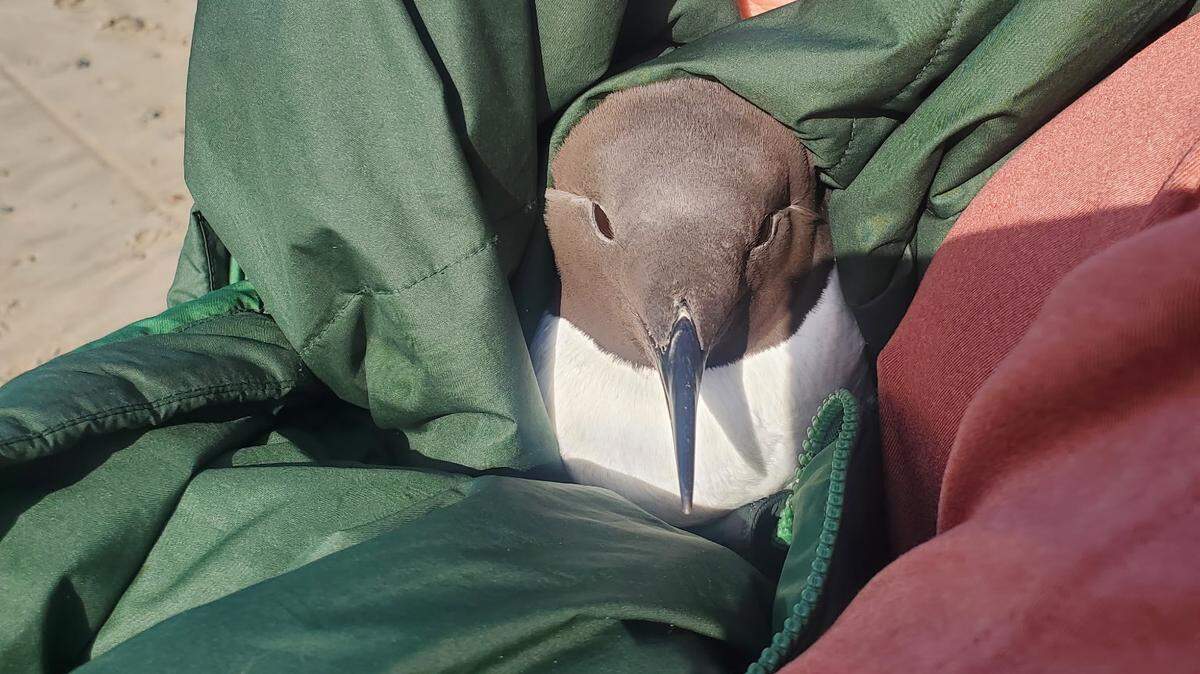
A penguin-shaped seabird stumbled down Morro Strand on March 7, much to the curiosity of Oregon resident Jim Winkle.
Winkle, who was on vacation in Morro Bay, approached the bird — and he knew something was wrong when the waterfowl didn’t try to waddle away.
Instead, the bird tilted his head toward the sun with his eyes half closed as if he was sunbathing, Winkle said.
The bird was a common murre — and he was covered in oil.
This seabird was one of 13 oily birds treated by Pacific Wildlife Care this year so far, according to center director Vann Masvidal.
These birds weren’t victims of an oil spill, however. They were caught in a natural process where oil seeps out of the seafloor — a phenomenon that intensifies during the spring, Masvidal said.
Last year, Pacific Wildlife Care responded to 100 oiled animals, most whom were impacted by natural seeps, he said.
Winkle called Pacific Wildlife Care for help, and they instructed him to wrap the bird in a blanket and bring him to their facility.
“They’re adorable, so I think anyone would try to help,” Winkle said.
If you encounter an wild bird in distress, call Pacific Wildlife Care’s hotline at 805-543-9453.
2 oil-covered birds euthanized after rescue
Per Pacific Wildlife Care’s instructions, Winkle wrapped the the murre in his down jacket “like a burrito,” he said.
“I carried it like a baby to the car, and it didn’t make any noise, it was pretty calm,” Winkle said. “It did poop all over my jacket, but otherwise it was pretty easy.”
Winkle’s car filled with the smell of gasoline as he drove to the center. Still, he said he was glad to help the bird.
“The fact that I got to hold a common murre was a very special experience,” he said.
Winkle’s bird was one of two oil-coated murres dropped off at Pacific Wildlife Care on March 7 — one from Morro Bay and the other from Cambria.
Both birds suffered severe chemical burns from the oil and had to be euthanized as their injuries were too severe to recover from, Winkle said.
The common murre is a black-and-white seabird about the size of a crow. They spend most of their life at sea and require a tightly woven patchwork of waterproof feathers to protect them from frigid ocean temperatures.
Common murres rarely recover in captivity, Masvidal said.
Other birds, however, do survive exposure to oil, he said.
Masvidal said he expects Pacific Wildlife Care to treat more oily birds this spring as offshore winds increase upwelling — a process that drives oil to leak from fractures and sediments in the ground, according to the National Oceanic and Atmospheric Administration’s Office of Response and Restoration.
Natural offshore seeps in Southern California deposit about 5 million gallons of oil in the ocean each year — though that number can vary, NOAA said.
Oil seeps are particularly active off the coast of Santa Barbara County. In fact, the Coal Oil Point Natural Reserve leaks about 4,200 to 25,000 gallons of oil per day, NOAA said.
Tourist also rescues injured sea bird
Winkle returned to Morro Strand after delivering the murre to Pacific Wildlife Care, and he spotted a western grebe who appeared to be injured.
As he approached, the bird tried to run away but stumbled and fell.
Winkle and Pacific Wildlife Care caught the bird in a long net and brought him to the facility for treatment. This bird was not coated in oil, Masvidal said.
The western grebe sports black-and-white feathers and bright red eyes. They spend most of their life in the water, according to Cornell Lab.
The bird underwent surgery for puncture wounds to the neck, and as of Monday, he was recovering at Pacific Wildlife Care’s facility, Masvidal said.