Citizen group fights new development in Los Osos. ‘To save our only water supply’
A 35-year-old building moratorium may have been lifted on the sleepy, seaside town of Los Osos last year — but a citizen group worried about the water supply is still fighting new development there.
The Los Osos Sustainability Group appealed permits for two homes and two hotels in Los Osos, which the San Luis Obispo County Board of Supervisors is expected to review at its Tuesday meeting.
“To save our only water supply — that’s what our goal is,” group chair Patrick McGibney told The Tribune ahead of the meeting.
Los Osos has long been home to water woes.
During the 1970s and ‘80s, poorly designed septic systems leaked nitrates into the community’s only water supply: the Los Osos groundwater basin. Meanwhile, a population boom overdrew the basin, and chlorides from seawater intrusion contaminated the groundwater.
The SLO County Regional Water Quality Board banned Los Osos from installing new septic systems in 1988, essentially placing the community under a building moratorium.
The Los Osos Water Recycling Facility started operating in 2016, allowing most of the town to stop using septic systems and reduce nitrate contamination in the basin. All new development must connect to the facility.
The facility also pumps recycled water back into the basin to boost its water levels.
The Board of Supervisors and California Coastal Commission approved the Los Osos Community Plan last year, which allows up to 1% growth for new residential developments annually — about 50 units per year.
The Los Osos Sustainability Group, however, said they don’t think the basin is ready to support new development.
The community pumped within sustainable levels in 2023, but chloride levels — which indicate seawater intrusion — still increased, according to the 2023 basin monitoring report.
Los Osos Sustainability Group consultant Lynette Brooks said the County should halt development until chloride, nitrate and water level metrics meet their targets. The retired civil engineer moved to Los Osos in July 2024.
“They’re just jumping the gun,” Brooks said. “They need to wait for these numbers to be better, or they just need to say: We know it’s not sustainable, but we want development.”
SLO County Director of Groundwater Sustainability Blaine Reely, however, said water levels have overall increased since the 1990s, and improvement of the chloride metric will follow.
“The groundwater system responds slowly to changes,” he said. “As we get more and more water filling up that basin, that creates more and more pressure to push sea water further and further out, but it doesn’t happen immediately.”
Additionally, the County will halt development if conditions in the basin worsen, he said.
“Is it imperative that we’re cautious? Yes,” Reely said. “But it’s also imperative that we look at the information and the data and the science and use that to make, you know, reasonable judgments about what the basin can sustain.”

SLO County supervisors to consider development appeals
McGibney appealed four developments on behalf of the Los Osos Sustainability Group, which will be presented to the Board on Tuesday.
The first appeal is for a minor use permit and coastal development permit that allows grading at 2831 Alamo Drive to prepare for the construction of a single-family home.
Two other appeals contest permits awarded to a 3-unit hotel and a restaurant and 4-unit hotel on Second Street. Those hotels were built without the proper permits, and the Planning Department hearing officer later approved permits for them after they started operating.
The final appeal opposes minor use and coastal development permits awarded for the construction of a single-family home at 200 Madera St.
Is Los Osos pumping groundwater sustainably?
The Los Osos Basin Management Committee is mandated by a 2015 court order to maintain sustainable pumping levels in the basin.
This is measured by the sustainable yield, which is the amount of water that can be drawn from the basin without worsening seawater intrusion.
In 2022, the sustainable yield was set at 2,380 acre-feet of water. In 2023, people pumped 1,650 acre-feet of water from the basin — an amount within the sustainable yield, according to the 2023 basin monitoring report prepared by the environmental consulting firm Cleath-Harris Geologists Inc.
The San Luis Obispo County Board of Supervisors and the California Coastal Commission voted to proceed with development based on the basin yield metric, which is yearly pumping divided by the sustainable yield as a percentage.
In 2023, Los Osos pumped 69% of the sustainable yield — so the county felt comfortable proceeding with limited development, Reely said.
But chloride levels in the basin increased to 199 milligrams per liter of water in 2023, the report said. That’s higher than the chloride level limit established in the Basin Management Plan, which is 100 milligrams per liter.
Brooks questioned the accuracy of the sustainable yield if seawater intrusion could worsen while people pumped less water than the limit.
“It doesn’t seem to be working,” she said. “It should be stopping saltwater intrusion, and it isn’t.”
She said the county should consider chloride, water and nitrate level data before proceeding with development, too, she said.
“All of these measurements are another tool, and they’re just ignoring them right now,” she said.
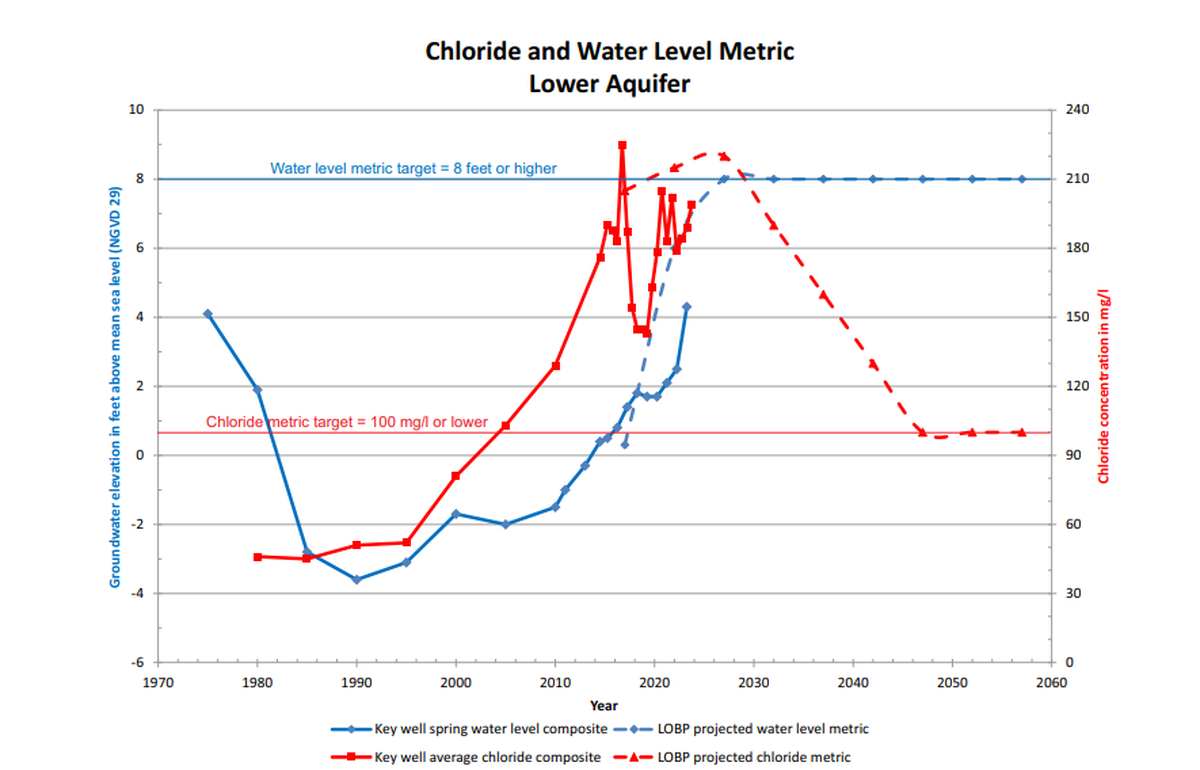
Reely, however, said it takes time for chloride levels to respond to reduced pumping in the basin. As water levels in the basin increase, it slowly pushes saltwater back into the ocean.
Chloride levels in the basin steadily started to climb in the 1980s, then began to decline in 2013 — and have been fluctuating ever since.
The model created by Cleath-Harris Geologists Inc. predicts that chloride levels will spike during the next five years, then decline steadily to the target metric between 2040 and 2050 as freshwater fills the basin.
Permitting the development of less than 50 new units per year won’t use enough water to worsen seawater intrusion, Reely said.
.jpg "111324LosOsos-1 (1).jpg")
Meanwhile, Cleath-Harris Geologists is developing a new model to tighten up calculations for the sustainable yield.
Right now, the firm implements a steady-state model — which uses rainfall and pumping averages to calculate the sustainable yield.
By the end of the year, the firm will adopt a transient model, which will take 30 to 50 years of historic rainfall data and apply it to the future. This allows hydrologists to understand how consecutive dry years followed by wet years will impact the basin, producing more accurate analysis, Reely said.
The Los Osos Sustainability Group urged the county to wait until the transient model is developed to proceed with development.
But Reely said the county is confident in the accuracy of the existing data and will only halt development if conditions in the basin worsen.
County Supervisor Bruce Gibson said he hasn’t yet made a decision about how he will vote on the appeals, but he did defend the county’s decision to proceed with development in general.
He said Cleath-Harris Geologists’ monitoring of the basin show that Los Osos is pumping within sustainable levels.
“We have done the technical work that shows we are providing a safe and reliable source of drinking water for the community,” he said.
This story was originally published March 10, 2025 at 2:46 PM.