
‘Where the bitey bits are!’ Inside annual ‘weaner weighing’ at SLO County elephant seal beach
Elephant seal pups are only a month or two old, but they are being weaned, their first big step to independence.
At this point, they go from birth weight of around 70 pounds to 200 pounds — or more — in that first month.
And they are loud! Visitors hear them as soon as they get out of their cars at the Piedras Blancas viewpoint parking lot.
While visiting, listen for all three distinct calls: the squawking of the pups, the barking of their mothers and the bellowing of the bulls.
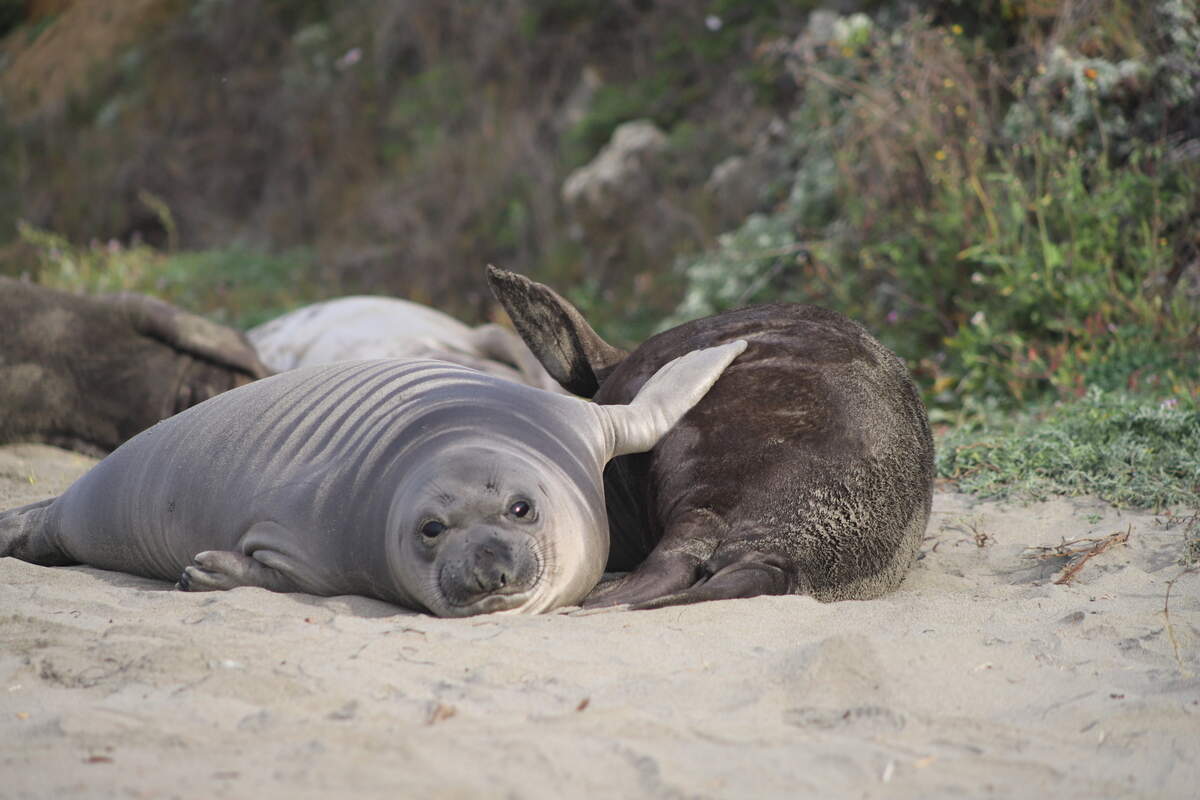
Look for them in groups, called pods, on the beach. Weaner pups are easy to recognize. They are fat, even roly-poly.
They were born all black, but they shed that black coat in their first molt. Now they are countershaded, light on the belly and dark on the back. Many marine animals have that color pattern, helping camouflage them from their predators.
What is weaning?
Weaning is a major transition in elephant seal life.
Pups go from gaining weight fast — 200 pounds or more of blubber in a month — to metabolizing that blubber to sustain them for eight to 12 weeks.
Long fasts, periods of not eating, are a feature of elephant seal life.
Their mothers didn’t eat for the month they nursed the pups. Bulls on the beach may not eat for 100 days.
This is the pups’ first fast.
As the mothers come to the end of lactation, they are at their thinnest. Their blubber has been metabolized into milk, feeding those chubby weaners. Neither they nor the bulls have had anything to eat since they arrived on the beach.
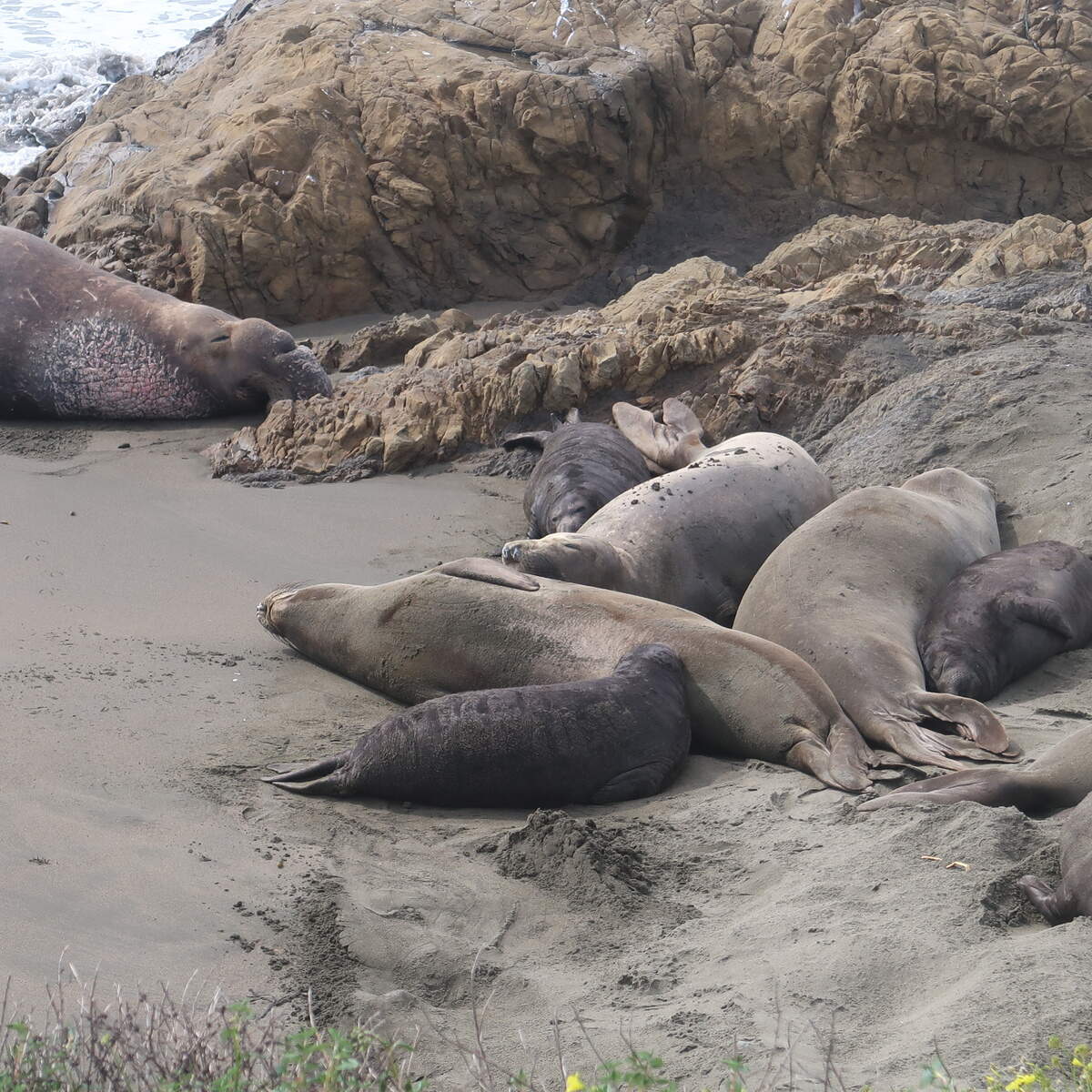
Females come into estrus as they wean their pups. They are then ready to mate with the bulls.
That’s when the bulls get competitive. Earlier battles were over territory. Now, they battle over breeding.
Look for bulls raising their heads to stare at each other. One or the other will make a move, and one may back off from a fight. It’s called dominance interaction, displacement.
From the viewing area, visitors can see which bull is dominant.
If neither backs down, they’ll battle. The loser may leave the beach entirely, finding another beach to recover. Deaths are rare. Both live to fight — and breed — another day.
Weaners, meanwhile, stay out of the way of the adults, who are still in the drama of breeding. Mid-February is the height of the breeding season, but it will continue through March. X-rated.
What do elephant seal pups doing while weaning?
It’s not all sleeping in the sun.
Weaners have developmental tasks to accomplish to prepare for their first migration.
Some of that blubber will become muscle as they tussle around the beach. They lose their baby teeth and get their permanent teeth, so they can hunt their own food. The better to eat fish with!
Pups aren’t born with much ability to swim, so this transition time is when they go from beach to ocean.
They venture into the surf to practice diving, swimming and holding their breath. Weaned pups learn to hold their breath for around six minutes, some as long as 12 minutes. That will help them stay underwater and dive deep enough to catch food.
They are on their own now.
Weaners may be splashing around during the day when visitors see them, but they do most of their practicing at night. Most will leave the beach on their first migration by the end of April.
How Cal Poly researchers study elephant seal pups
Cal Poly’s Team Ellie, led by associate professor of biological sciences Heather Liwanag, has been weighing weaners at this stage of their lives since 2018.
Weaned pups may be called either weaners or weanlings. Weaners is an earlier name, perhaps sounding more comic. Weanling is more formal, sounds more scientific. Weaner seems to me to fit these seals, at a roly-poly stage of life.
“I would definitely still call it weaner weighing!” said Dr. Liwanag.
They mark potential pups to weigh when the pups are about two weeks old. They mark the pups with a letter-number code, using hair dye.
Pups are still nursing at that point. They stay with their mothers until the mother weans them. Weaning is abrupt: the mother simply leaves the pup on the beach, mates with one or more bulls and swims back into the ocean.
The team keeps track of the now-weaned pups by the dye marks.
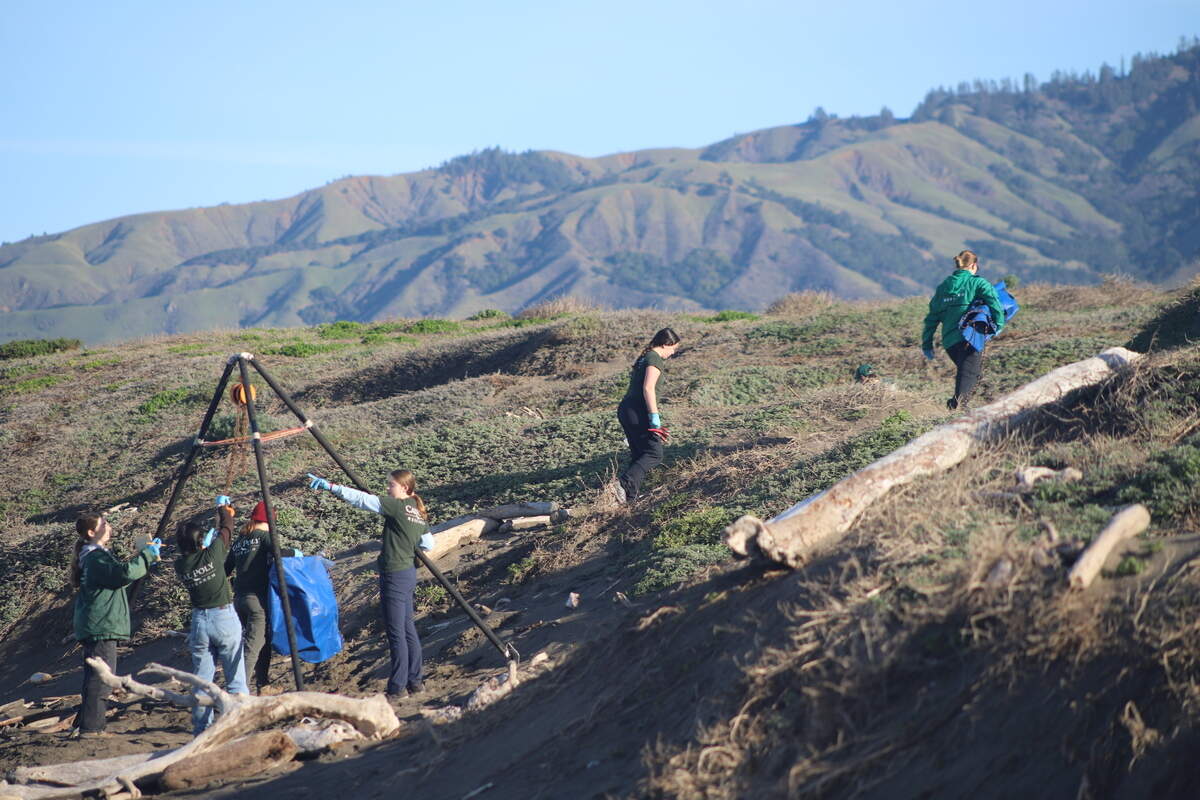
As team members re-sight them after they are weaned, and no longer with their mothers, Team Ellie takes their equipment down to the beach to weigh them.
Weaners are generally mild-mannered, but they are wild animals.
Dr. Liwanag and Team Ellie members — who have trained to work with these animals, corral them into a canvas bag they had specially designed to be the right size and shape for weaner weighing. It’s snug enough to safely keep their front flippers next to the body and let the back flippers hang out.
Except for a hole to breathe through, the weaner’s head is inside the bag. Keeping the eyes covered helps keep the pup calm for the five to 10 minutes while it’s being handled. The pup can’t poke its head out.
“That’s where the bitey bits are!” Dr. Liwanag said.
A 300-pound weaner can give a nasty bite.
Once contained, the whole weaner — bag and all — is hooked to an industrial scale suspended beneath a 10 foot tripod. Each seal gets two white flipper tags, one in each rear flipper. White tags designate the Piedras Blancas rookery, and double tags indicate that this seal was weighed.
Team members measure how long the seal is, and how fat it is, around the underarm girth.
These procedures were approved under NMFS permits 22187 and 27514, a California State Parks Scientific Collections Permit, and by the Institutional Animal Care and Use Committee at Cal Poly.
Weaners typically weigh between 220-330 lbs.
Data analysis can increase understanding of how weaner weights relate to overall population trends at Piedras Blancas.
“The population has been fluctuating at the Piedras Blancas colony in recent years,” Dr. Liwanag said. “Comparing weaner weights between years will give us further insight into the health of the population, which may be approaching its maximum population size at this breeding site.”
The Bill & Linda Frost Summer Undergraduate Research Fellowship will support an undergraduate student next summer to work on the data.
How to become a docent
If you love seals, you could be a docent.
Hearst San Simeon State Park is recruiting volunteer docents for spring training. Docents become informal educators and wildlife interpreters to visitors to the viewpoint.
The application deadline is March 2. Apply at app.betterimpact.com/Application?OrganizationGuid=859c04f0-4e3e-42e0-9fe6- 06097947ee04&ApplicationFormNumber=1.
Meet the State Parks interpreters who lead the program at in-person interviews in San Simeon during the first two weeks of March.
The training is professional, and includes reference materials and mentoring. Training includes independent study assignments, two virtual sessions and two in-person sessions. After training, docents are mentored individually three times on site at the bluff.
The time commitment for docents is three or four three-hour shifts a month. Docents are asked to commit to at least one year of service. Most stay for years. I’ve been doing it since 2007.
Further information is available at parks.ca.gov/?page_id=31822. You can also call State Park Interpreter Monica Rutherford at 805-460-8762 with questions.
This story was originally published February 28, 2025 at 5:00 AM with the headline "‘Where the bitey bits are!’ Inside annual ‘weaner weighing’ at SLO County elephant seal beach."