Devastation in L.A. sparks a question here at home: Is SLO County prepared for wildfire?
While firefighters in Los Angeles battle a trio of wildfires that have destroyed thousands of homes and killed 24 people, other emergency responders stand ready to defend San Luis Obispo County from a potential blaze.
Cal Fire SLO is as prepared as it can be for a large wildfire, but the county isn’t likely to experience an incident as devastating as Los Angeles this winter, Cal Fire spokesperson Eric Carreiro said.
On Monday, the National Weather Service warned of dangerous fire weather in parts of San Luis Obispo County, issuing a red flag warning for gusty winds and low humidity in the mountains from Monday at 10 p.m. to Wednesday at noon.
But still, San Luis Obispo County has received more rain this winter than Los Angeles — rolling out a green carpet of grass on Central Coast hills that would slow the spread of a fire. Larger vegetation like brush and trees aren’t fully saturated with water yet, but the fuel load is still more manageable in San Luis Obispo County than in Los Angeles, Carreiro said.
Los Angeles also experiences warmer, harsher, Santa Ana winds that spread the fire more forcefully than San Luis Obispo County’s Santa Lucia winds.
“We aren’t anticipating any kind of events near the scale that we’re seeing in the L.A. Basin,” Carreiro said.
Still, Cal Fire SLO prepares for the worst every year.
“We always have that threat,” he said.
During peak season, Cal Fire SLO has a staff of 362 personnel, Carreiro said. If a large wildfire swept across the county and exhausted Cal Fire SLO’s resources, the agency could partner with other local fire departments and request reinforcements from other Cal Fire units in the state.
Between Cal Fire and municipal fire departments, about 120 San Luis Obispo County firefighters had traveled to Los Angeles to support firefighting efforts there, Carreiro said on Monday.
When to expect the next big blaze
The county experiences multiple small wildfires each year, with the potential for a 20,000-acre or larger wildfire every seven to eight years, according to the San Luis Obispo County Multi-Jurisdictional Hazard Mitigation Plan.
Cal Fire, however, prepares to respond to a 20,000-acre fire every year, retired Cal Fire Chief Dan Turner said.
More importantly, a fire doesn’t have to be large to cause serious damage, Turner said. A 20,000-acre fire on the Carrizo Plain may not be a significant risk to people or property, but a similarly sized blaze in a populated area would be devastating, he said.
“It doesn’t have to be big to be damaging,” Turner said. “If you put a 2,000-acre fire in the middle of Cambria, you’d wipe out the entire community.”
Turner noted that hot, dry wind combined with dry brush can make a fire unwieldy.
“These fires can travel great distances,” he said.
For example, the 1985 Las Pilitas Fire scorched 84,271 acres of brush and destroyed 10 homes. The blaze ignited north of Santa Margarita Lake, then traveled over the Cuesta Grade into the city of San Luis Obispo.
In 1994, the Highway 41 Fire burned 50,729 acres, destroyed 42 homes, 61 other structures and 91 vehicles, according to county records. The blaze threatened Atascadero and Morro Bay, caused the most damage in the Tassajara Canyon area of the county and could be seen on the ridge lines behind San Luis Obispo.
Later, in 1996, the Highway 58 Fire sparked on Shell Creek Road and spread toward Pozo and the Los Padres National Forest — burning 106,969 acres and destroying 13 homes, county records said.
One of the most destructive was the 2016 Chimney Fire, which burned more than 46,000 acres and destroyed 49 homes and 21 other structures near Lake Nacimiento, according to county records. More than 3,943 firefighters battled the blaze for 25 days before it was contained.
“The conditions are right every single year for that type of event,” Turner said.
Firefighters grapple with longer fire season
During his 37-year career as a firefighter, Turner has watched fire risk extend into the winter.
When he worked for Cal Fire, the state budget identified fire season as May 1 to Oct. 15. But during the past decade, rain has fallen later in the year and winds blow with more speed — so fire risk crept into the off-season, Turner said.
Historically, a storm would drop at least 2 inches of rain on the county by mid-October, which would saturate the grass and brush well enough to effectively end fire season, Turner said.
But lately, a 2-inch rain event has occurred later in the year, sometimes in November or December — which means the brush is dry and flammable for a longer period of time. That brush is then vulnerable to warm, dry, autumn winds that could fan a spark into a blaze.
Scientists say drought and increasing temperatures caused by climate change fuel wildfire risk.
Climate change-induced weather patterns dried out vegetation in the Western United States and “doubled the number of large fires between 1984 and 2015,” according to the National Oceanic and Atmospheric Administration.
A 2021 study showed that climate change “is the main cause for increasing fire weather,” the peer-reviewed report published in the Proceedings of the National Academy of Sciences Journal said.
Founded in 1885, Cal Fire was designed to hire a mostly seasonal workforce that responded to fires from May to October, Turner said.
“That model hasn’t really kept up,” Turner said. “These positions need to become full-time, year-round positions.”
Meanwhile, battling fires year-round takes a toll on firefighters, Turner said.
Not only is firefighting physically difficult, but it’s emotionally taxing to regularly witness tragedy, he said.
“You feel that pain, you share some of that burden, and you take it with you,” Turner said. “They have to manage their own physical and emotional well-being to deal with what they’re seeing.”
Historically, firefighters could rest in the off-season. But with fire risk bleeding into the winter, firefighters have less time to reuperate, recover and re-connect with friends and family, Turner said.
How does Cal Fire SLO prepare for wildfires?
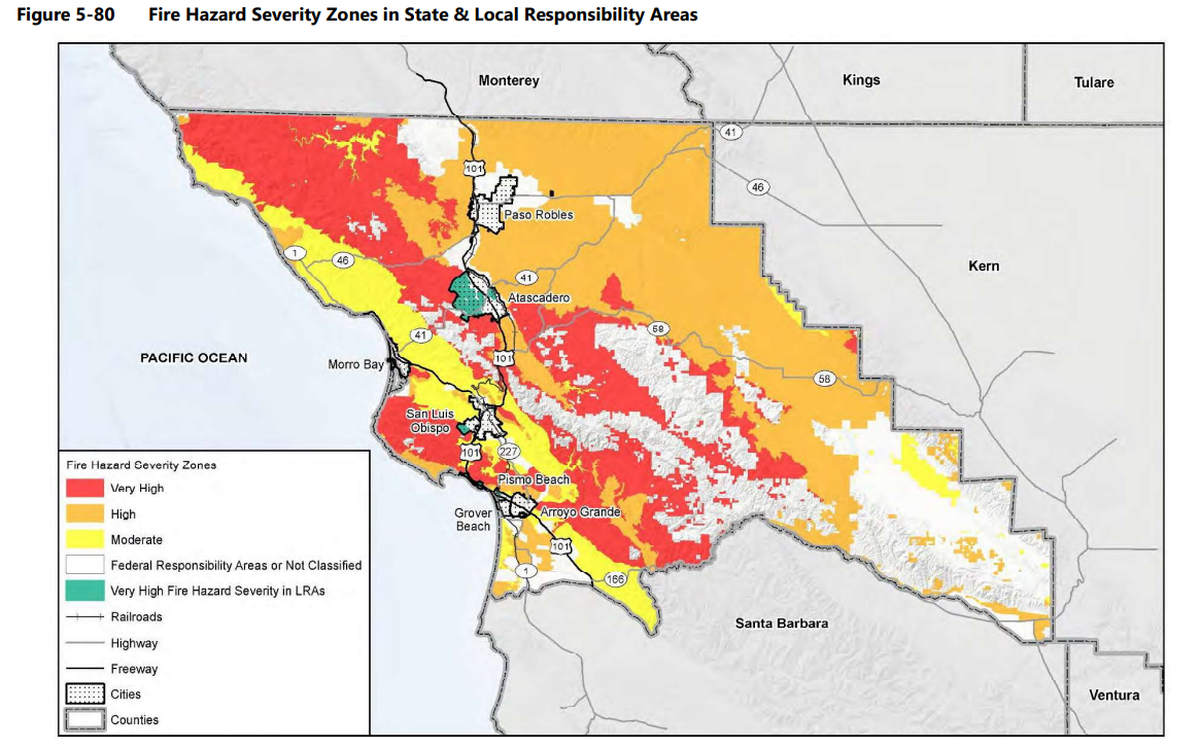
Fire risk is highest in wildland-urban interface areas, where open space borders human development. Communities most vulnerable to wildfire are north of Grover Beach, east of Nipomo, west of San Luis Obispo, and some places near and west of Paso Robles and San Miguel, the San Luis Obispo County Multi-Jurisdictional Hazard Mitigation Plan said.
To reduce wildfire risk, Cal Fire removes flammable material like dry brush, cured grasses, twigs, dead trees and tree leaves through its fuel management program. Strategies include prescribed burns, cattle grazing, crushing vegetation with heavy equipment and mowing, Carreiro said.
This way, if a fire sparks — it should spread more slowly and be easier to extinguish, he said.
Cal Fire also requires homeowners in rural areas to keep 100 feet of defensible space around structures on their property. That looks like mowing grass down to 4 inches tall, removing dead or dry vegetation from the property, and clearing space between trees and shrubs.
Meanwhile, increased accuracy with weather forecasting allows firefighters to predict where a fire could ignite, how it could spread and where they should position fire engines and personnel to prepare to fight that fire, Carreiro said.
In San Luis Obispo County, 70% of fires are caused by power lines, vehicles or equipment use, according to the county’s hazard mitigation plan. Debris burning, campfires, arson, lightning, smoking and playing with fire are the other lesser causes of wildfires locally, the report said.
If high winds knock a tree or debris into a power line, the resulting spark could cause a wildfire.
PG&E was found responsible for starting 2018 Camp Fire in Paradise, which killed 85 people and destroyed about 19,000 buildings, NPR reported.
As a result, PG&E initiates public safety power shutoffs when the weather increases the risk of wildfire, the agency said on its website. This normally occurs when the forecast calls for low humidity and high winds in areas with dry material on the ground and vegetation near power lines, PG&E said.
Turner encouraged people to prepare evacuation plans with their household for multiple scenarios. For example, families should have an evacuation plan for when children or pets are home alone.
“Two o’clock in the morning is not the time to figure out what to do,” he said.
People should sign up for cell phone emergency alerts with the California Office of Emergency Services for their neighborhood, their children’s school and locations of other vulnerable community members, such as elderly relatives, he said.
Sign up online at www.smart911.com/smart911/ref/reg.action?pa=slocounty.