Morro Bay offshore wind auction is a go as federal government sets date for sale
The federal government has set a date for the auction of large tracts of the Pacific Ocean off California’s coast for floating offshore wind energy development.
In total, about 373,268 acres of the ocean off the coasts of Morro Bay and Humboldt will be auctioned off on Dec. 6, according to an announcement by the U.S. Department of the Interior on Tuesday morning.
“The demand and momentum to build a clean energy future is undeniable,” U.S. Secretary of the Interior Deb Haaland said in a prepared statement Tuesday. “Today, we are taking another step toward unlocking the immense offshore wind energy potential off our nation’s west coast to help combat the effects of climate change while lowering costs for American families and creating good-paying union jobs.”
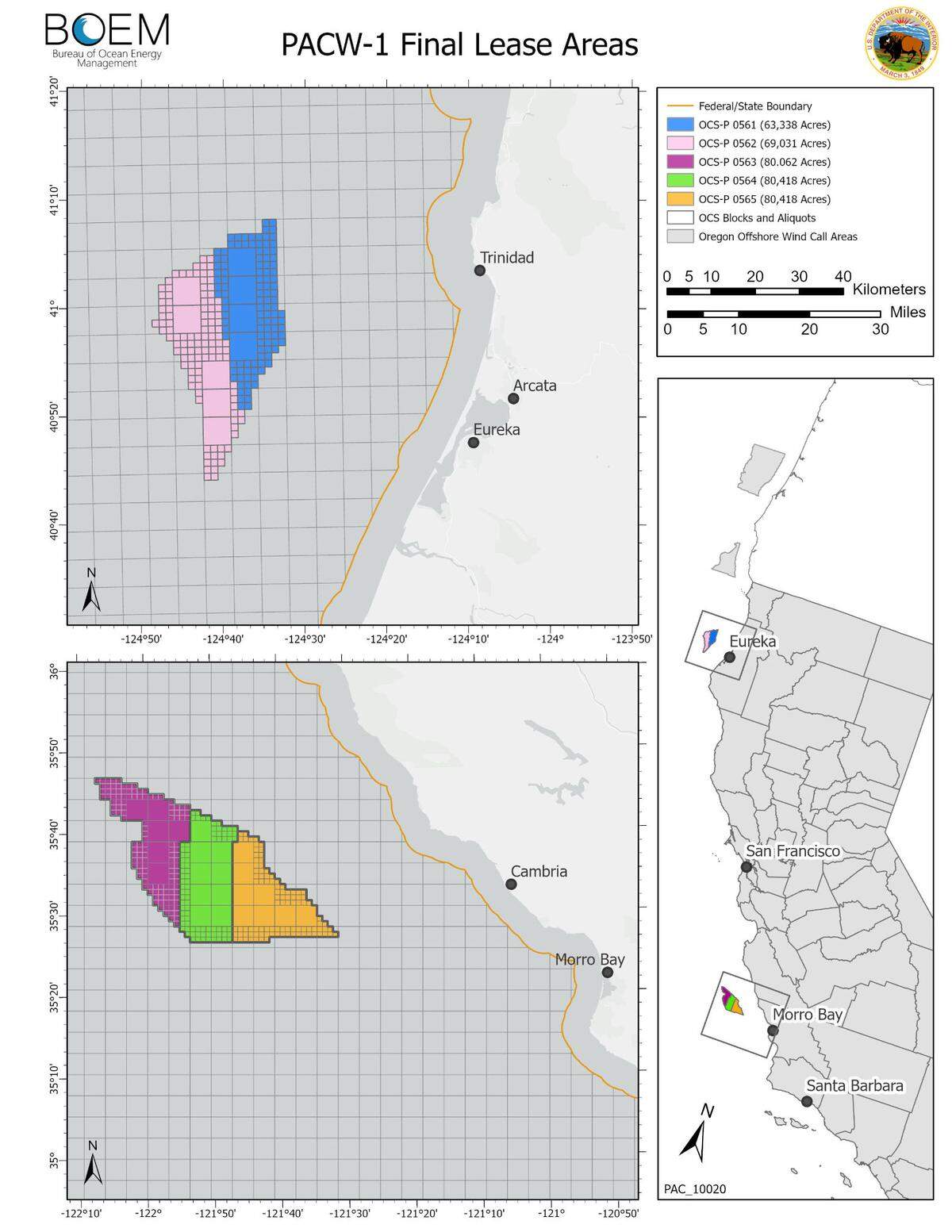
About 240,898 acres located roughly 20 miles west of Cambria and San Simeon in San Luis Obispo County will be auctioned off, plus another 132,369 acres about 20 miles west of Eureka in Humboldt County, according to the U.S. Bureau of Ocean Energy Management’s (BOEM) final sale notice outlining the terms of the auction and lease stipulations, which was released on Tuesday.
The two areas — titled the Morro Bay and Humboldt wind energy areas — have been divided into five leases. The Morro Bay wind energy area is split into three leases each of about 80,000 acres, while the Humboldt area is split into two areas of about 63,000 and 69,000 acres, according to the final sale notice.
Together, the areas have the potential to generate up to about 4.5 gigawatts of electricity at peak capacity. That’s enough to power nearly 1.6 million homes, according to BOEM.
“It’s an exciting day and significant milestone for the state’s renewable energy future,” California State Sen. John Laird, D-Santa Cruz, said in a prepared statement Tuesday. “This is exactly the direction we need to take to move away from the burning of fossil fuels and to face head-on the challenges of climate change.
“I take particular pride in knowing that the Central Coast is leading the way for a better future, for Californians and the rest of the world.”
The offshore wind energy lease auction would be the first of its kind for the West Coast.
When constructed, it would mark the first development to support floating offshore wind turbines in the United States. Other developments on the East Coast utilize fixed-bottom turbines because they are located in shallower waters.
U.S. Congressman Salud Carbajal, D-Santa Barbara, touted the offshore wind energy potential for the Central Coast.
“After years of collaboration with our local, state, and federal partners, we are now only a few weeks away from proving that the Central Coast is leading the charge on our renewable energy transformation by becoming home to one of the first-ever offshore wind leases on the West Coast,” Carbajal said Tuesday in a prepared statement. “The proposed sale in Morro Bay will help secure the Central Coast’s dominance as a renewable energy powerhouse, which will attract new businesses and good paying, future-oriented jobs in a burgeoning sector of the economy.”
Starting bids for both of the areas start at $100 per acre.
For context, the auction for an offshore wind energy lease off the coast of New York in February generated as much as $10,696 per acre.
As of Tuesday, a total of 43 companies had qualified to bid in the California offshore wind energy lease auction, up from 23 that originally expressed interest in May. The companies range from subsidies of oil and gas giants to companies solely focused on offshore wind or renewable energy development.
The companies can only win one lease area in the auction and must pay $3 per acre per year for the ocean space until the area is producing electricity, after which the federal government will charge an operating fee.
Additionally, the companies can qualify for bidding credits, or a certain percentage discounted from their winning bid.
Up to 20% off could be awarded should the winning company show that it will establish a pathway for offshore wind energy workforce training, supply chain development or a combination of the two.
Another 5% could be awarded off the winning bid if the company shows it has entered into agreements with communities, industries and tribes that have historically used and benefited from the ocean space set for offshore wind energy development.
This agreement could include “payments into a special purpose fund, such as payments to support gear changes, navigation technology improvements, and other efforts to improve safety and navigation, or to compensate the fishing and related industries whose use of the geographic space of the lease area is impacted by the lessee’s potential offshore wind development,” according to the final sale notice.
This bidding credit in particular has been of interest to many along the Central Coast as commercial fishing groups have repeatedly expressed distress over the potentially devastating impacts the proposed offshore wind energy developments could have on their businesses.
The winning bidders must adhere to BOEM’s lease requirements, which include working closely with local governments, commercial fishers, tribes and others impacted by the proposed developments to identify ways to minimize detrimental impacts.
After the December auction, a company has up to one year to submit a site assessment plan. That plan will outline how the company intends to assess the lease area so it can draw up plans to build the wind turbines.
Then the company can take up to five years to submit a construction and operations plan.
Such a plan would lay out how many turbines and which kind of turbines the company wants to build in the lease area, as well as how it will go about the construction and operation of the development.
That construction and operations plan will be subject to environmental review from local, state and federal agencies, and must be approved by BOEM before construction can begin.
BOEM officials have previously stated that the goal is to have floating wind turbines in the Pacific Ocean by 2030.
California State Assemblyman Jordan Cunningham, R-San Luis Obispo, praised the offshore wind energy development slated to come to the Central Coast.
“There is no doubt that the Central Coast is the next clean energy capital of the United States,” he said in a statement on Tuesday. “We laid the groundwork to extend Diablo Canyon (nuclear power plant’s operating life) for five additional years with my bill, Senate Bill 846, and soon we will have an offshore wind farm to complement the Topaz Valley solar facility and the potential Vistra battery plant.”
This story was originally published October 18, 2022 at 12:33 PM.