Friends of Oceano Dunes illegally fundraised to pay for court battles against California, DOJ says
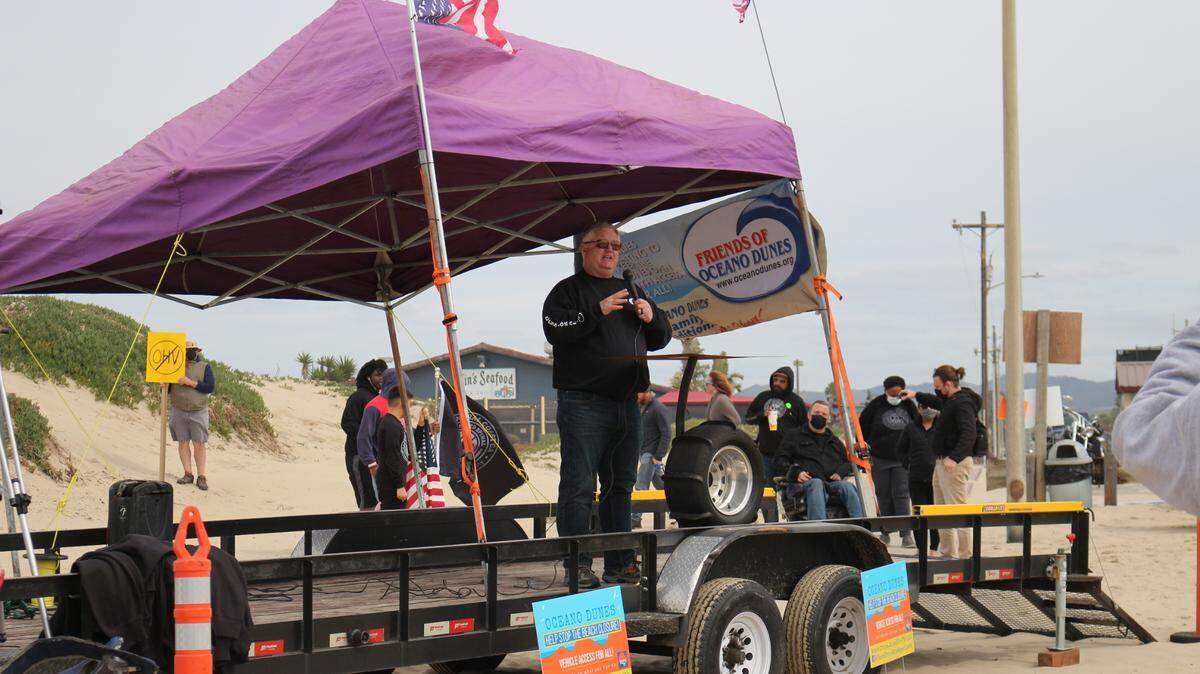
The nonprofit organization fighting to keep the Oceano Dunes fully open to off-road riding beyond 2024 has been aggressively raising money to sustain several lawsuits against the state.
One of Friends of Oceano Dunes’ fundraising efforts may have violated California law, according to a letter sent to the organization by the Attorney General’s Office in the state Department of Justice.
Friends of Oceano Dunes conducted an online raffle for a Genesis recreational vehicle worth about $30,000 that ran Oct. 23 to July 3.
In total, Friends of Oceano Dunes raised more than $46,000 in the raffle, it said.
But according to California law, raffles conducted online are illegal.
“A raffle may not be operated or conducted in any manner over the internet, nor may raffle tickets be sold, traded or redeemed over the internet,” according to state code established in 2001.
Was Friends of Oceano Dunes raffle illegal?
Each entry in the Friends of Oceano Dunes raffle cost $1, according to the group.
The winner of the RV bought $100 worth of tickets, the organization said in a post to its Facebook page.
An alternative method of entry may have been available for participants in the raffle, meaning that payment may not have been required for entry.
California law allows raffles if they involve “a general and indiscriminate distribution of the tickets,” the “tickets are offered on the same terms and conditions as the tickets for which a donation is given,” and the “scheme does not require any of the participants to pay for a chance to win.”
The California Department of Justice’s Registry of Charitable Trusts was made aware of Friends of Oceano Dunes’ online raffle, and a letter was sent to the nonprofit on July 19 making it aware of the alleged violation.
“Any violations ... may result in sanctions including, but not limited to a revocation of the organization’s raffle license, and a referral to the District Attorney’s Office,” the letter reads.
If found in violation of the law, Friends of Oceano Dunes could face a misdemeanor charge.
The Tribune reached out to Friends of Oceano Dunes multiple times but did not receive a response.
It’s not the first time Friends of Oceano Dunes has held an online raffle to raise funds.
In 2018, the nonprofit conducted an online raffle that earned $3,640, according to documents obtained by The Tribune.
Friends’ secretary at the time, William Knoff, wrote a letter to the California Department of Justice in 2019 apologizing for the violation and explained that the organization was in the process of refunding the money earned from the online raffle.
“We have amended our procedures to ensure this does not happen again,” Knoff wrote in his 2019 letter.
BetterWorld, an online fundraising platform and donation software used by Friends of Oceano Dunes to conduct its raffle, is also now being investigated by the California Department of Justice.
A July 19 letter sent to the company by the state Department of Justice and obtained by The Tribune shows the agency requested information regarding all of its charitable fundraising campaigns carried out in California since 2017.
Friends of Oceano Dunes raises money to fund legal battles
Friends of Oceano Dunes say its recent fundraising efforts are to fund its multiple lawsuits filed against the California Coastal Commission, California State Parks and other state and local agencies to fight against the imminent closure of much of Oceano Dunes State Vehicular Recreation Area to vehicles.
The Coastal Commission voted in March 2021 to permanently ban off-highway vehicle use in nearly all of the popular park near Pismo Beach — except for a one-mile stretch of the beach north of Pier Avenue — beginning in 2024. There, vehicles and RV camping will still be allowed.
Other access to the dunes such as hiking, horseback and bicycle riding will still be allowed after 2024.
Off-roading was prohibited largely due to environmental, health and tribal concerns associated with the intense use of the nation’s largest coastal dune habitat.
Friends of Oceano Dunes vehemently protested the closure prior to the Coastal Commission’s vote, and carried out with its threats to wage lawsuits against the agency.
So far, the group has filed four lawsuits against the Coastal Commission regarding its vote — although three of those cases were consolidated into one, so only two separate cases are being argued in court.
One lawsuit argues that the Coastal Commission violated state environmental laws and overstepped its bounds by voting to ban off-highway vehicle use in much of the park, while the other asks a judge to revert the dunes back to the way they were used historically by the public before any state control of the land.
One attorney, Thomas Roth of San Francisco, has represented the Friends of Oceano Dunes on all of its 19 cases filed over the past decade against state and local agencies over various Oceano Dunes concerns, according to court documents.
In one of the court cases, Friends of Oceano Dunes requested the Coastal Commission prepare an administrative record for the case, and they would pay for the preparation. Such an administrative record essentially consists of all the evidence — documents, emails and other records — used by the Coastal Commission to make its decision to close much of the Oceano Dunes to vehicles in March 2021.
The Coastal Commission initially indicated that it would take at least a year to prepare such a record and it would need to hire an outside professional to do the job. Friends of Oceano Dunes estimated that would cost the nonprofit $75,000 to $85,000.
To avoid such high costs, Friends of Oceano Dunes and co-petitioner EcoLogic Partners, a nonprofit group that works to protect public access to recreational venues, joined forces to create the administrative record on their own.
It took the organizations about five months and $20,000 to gather the roughly 82,000 pages of documents for the administrative record, according to court documents detailing the process.
When the Coastal Commission was presented with the index of the documents, the agency noted that it was concerned “over the lack of order and organization” in the index, rendering it impossible to sort through, court documents say.
So, the Coastal Commission proposed to take over preparation of the administrative record, which the agency expected would cost it about $20,000, according to court documents.
After protests from both Friends of Oceano Dunes and EcoLogic Partners, the state agency reduced the cost to $7,500 split between the organizations and only paid out if the Coastal Commission wins the court case.
“Friends spent $20,000 and a substantial amount of time preparing the administrative record, which was wholly rejected by the Coastal Commission, who then proceeded to create their own administrative record,” Roth said during a San Luis Obispo Superior Court hearing on May 2. “Friends does not think that was necessary. We don’t think it was appropriate.”
Roth estimated during the hearing that reviewing the Coastal Commission’s new administrative record could cost Friends of Oceano Dunes another $10,000 and “a substantial amount of time over the summer.”
Friends of Oceano Dunes receives most of its income in contributions or donations, as well as legal judgments in its favor.
On average, the nonprofit has earned about $130,300 annually over the past decade from “gifts, grants, contributions and membership fees,” according to its federal tax returns.
In 2020, Friends of Oceano Dunes earned about $136,600 in the form of those contributions and another $253,000 from a legal judgment against the Coastal Commission that covered past attorney’s costs, its most recent tax return shows.
Each year, Friends of Oceano Dunes spends the majority of its money on “legal fees and lobbyist fees to fight lawsuits by environmental and other groups trying to limit OHV (off-highway vehicles) in the area” of the Oceano Dunes, according to the returns.
In 2020, Friends of Oceano Dunes spent $322,103, its filing says. About 91% of that was spent on legal fees, while the remainder was spent on travel, conferences or meetings, insurance, outreach and other expenses, according to their tax documents.
This story was originally published July 25, 2022 at 9:00 AM.