
Bull elephant seals are arriving at SLO County beaches. Here’s what you’ll see
An otherworldly moan rose from the beach, warbling in the crisp wind.
It was the sound of a female elephant seal at the Piedras Blancas rookery north of San Simeon. If it weren’t such a bright sunny day, I would have been creeped out.
Female seals usually bark, unlike the belching bellow of the males. But they are capable of variations on their vocal theme. Those yodels must mean something to them, although that meaning is as yet undeciphered by human observers.
Most elephant seals have vacated the south beach at Piedras Blancas, but the seals still crowd the north end of the viewpoint in northern San Luis Obispo County.
Adult females and juveniles of both sexes who are concluding their molt take little notice, but adult bulls are arriving, one by one. Soon they will dominate the beach.
It’s time for the juveniles to return to the ocean for a few months.
They’ll return in the fall for a few weeks rest, then spend the winter at sea, leaving the beach to the breeding seals.
Pregnant elephant seals on SLO County beaches
The female elephant seals came into heat as they stopped nursing last season’s pups. They mated and the next pup got started, but in a process called delayed implantation, the embryo stopped developing after a few cell divisions.
The females returned to the ocean for their annual short migration, from February to May.
That gives them a chance to regain some of the blubber they lost while nursing their pups.
They will stay on the beach with their pups during the birth and breeding season, not eating. They lose about a third of their body weight during this time.
Adult females leave to spend the next seven months feeding at sea. They are pregnant with the next generation, and will return in winter to give birth.
Return of the bulls
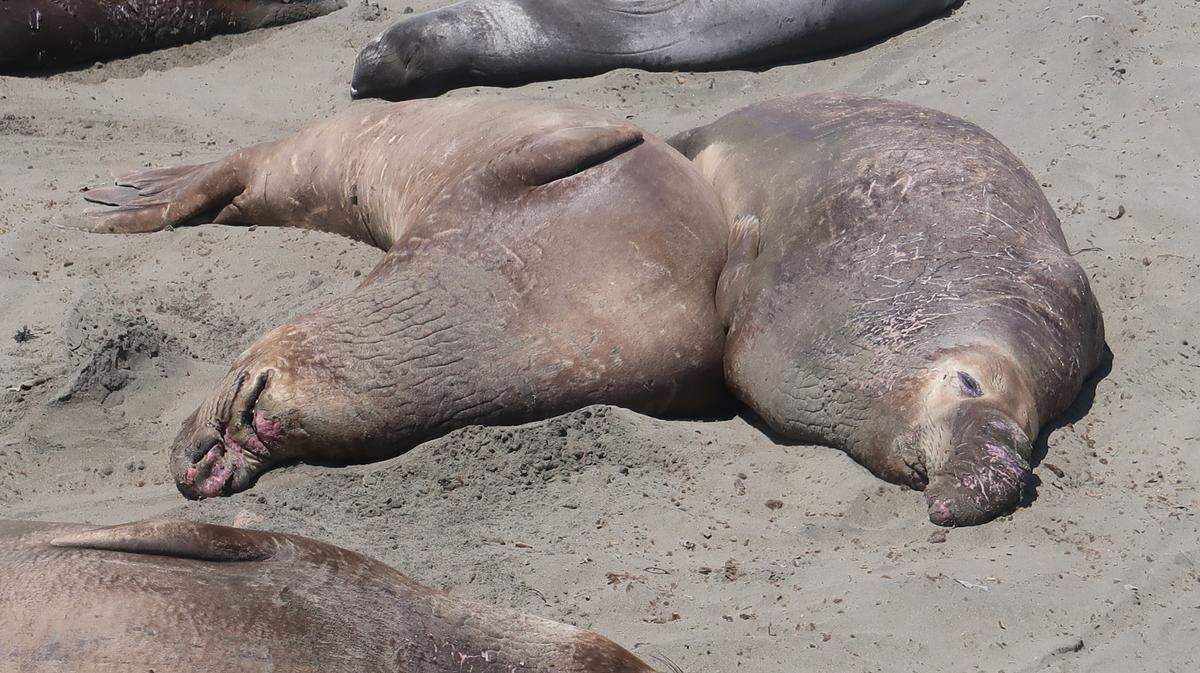
Bulls are returning to Piedras Blancas. It’s their turn to have the beach to themselves in July and August, while they molt their skin.
The old brown and tan skin peels off in chunks, revealing the new skin underneath. New hairs are just beginning to grow, making the skin gray. As the hair grows, the color becomes brown.
The upper layer of skin is new, but old scars remain.
The adult bulls are the ones with the trunk-like nose that gives them their name.
That proboscis, as it’s technically known, and the chest shield, begin growing at puberty, when the seal is about 5 years old. They grow throughout the seal’s life, so chest shield and nose size are relative indicators of age.
Bulls don’t fight much during the summer.
They may bellow at each other occasionally, but flipping sand is about the most activity on the beach in June. It’s a good time for summer visitors to observe them at rest.
Elephant Seal Visitor Center opens in San Simeon
Friends of the Elephant Seal celebrates the grand opening of its new, expanded visitor center in Cavalier Plaza, 250 San Simeon Ave. in San Simeon, on July 16.
Starting at 11 a.m., the group will offer a program of research and educational presentations, children’s story time, book signings, a Seal Science exhibit and new exhibits on how seal anatomy, diet and local predators. Guides will be available to answer questions.
California State Parks staff will lead a guided walk along the Boucher Trail north of the viewpoint, which overlooks several more elephant seal beaches.
The center is open for visitors 10 a.m. to 4 p.m. daily. For more information, go to elephantseal.org/july16