
8 young condors will spread their wings in Central California. Here’s when and where
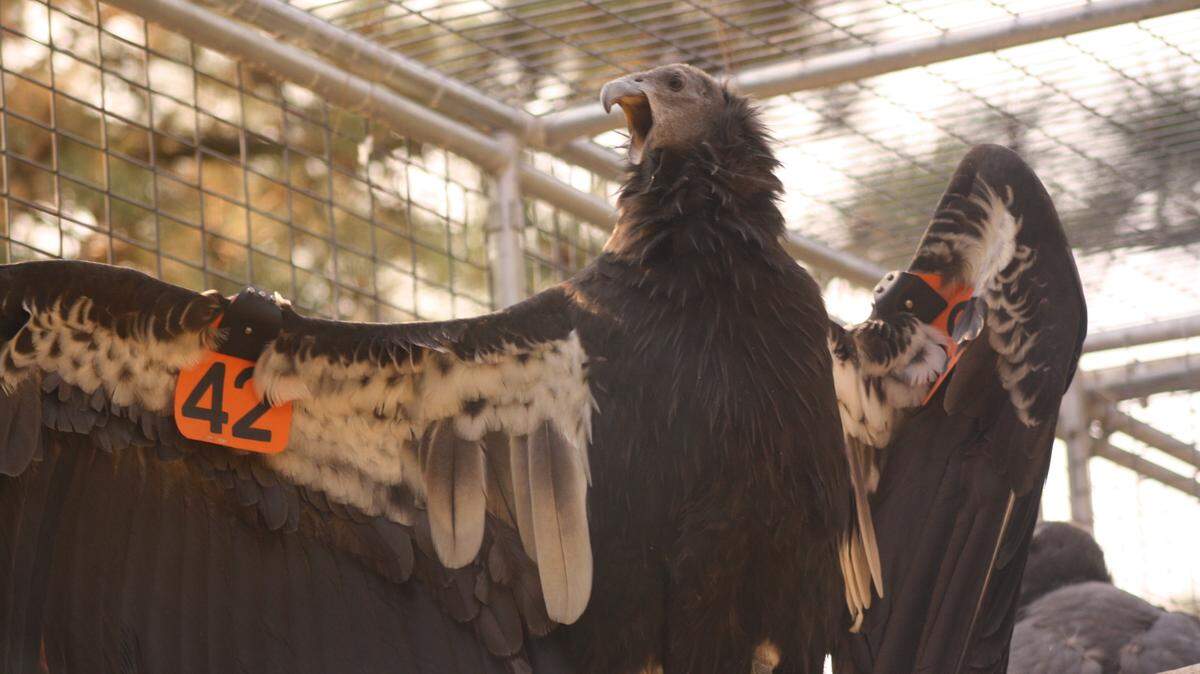
In a move that will fortify the condor flock in Central California, the Ventana Wildlife Society in Big Sur plans to release eight juvenile condors into the wild this fall.
The population of critically endangered birds currently numbers 91.
VWS senior wildlife biologist Joe Burnett revealed in an email that this year’s release has “a bit of a different spin. We are splitting up the release group evenly between Pinnacles and San Simeon.”
The genders of the eight condors will not be known “until a week or two before they arrive,” Burnette added.
The date of the condors’ transfer from their captive breeding site to flight pens has been tentatively set for mid-August.
Four of the giant birds, which boast 9 ½-foot wingspans, will be released from a prominent flight pen in the craggy mountains above San Simeon.
That holding pen has been the site of condor releases each fall since 2013.
The other four birds will be released from Pinnacles National Park, east of the Salinas Valley. Pinnacles joined the California Condor Recovery Program in 2003 and is considered among the best sites in California for viewing condors in the wild.
The VWS field staff transports the young condors from their captive breeding sites — the World Center for Birds of Prey in Idaho is a foremost site in the Recovery Program — to flight pens for later release.
The young birds are provided with stillborn calves for safe nutrition, and are monitored “for at least several weeks in the pen to ensure they are adjusting to their new environment and are well-prepared for life in the wild,” according to the VWS website.
The birds — North America’s largest land birds — are equipped with numbered wing tags, and GPS transmitters are attached to their huge wings for identification and tracking.
As adults, they can soar to heights of 15,000 feet and cover a hundred miles in a day.
The eight juveniles, which are around 2 years old, will not reach maturity — or display the familiar red-orange color on their heads — until they are 5 years old. They’re ready to mate around that time.
The hope is that the released condors will make the San Simeon mountains and Pinnacles their permanent home, where they can raise their young and thrive as a community.
Which threats do California condors face in the wild?
The juvenile condors will face a number of existential threats once they are released into the wild.
Lead poisoning continues to be the No. 1 threat to California condors.
Condors feed on carrion — the carcasses of deer, squirrels and other wildlife. When they eat animals that were killed with lead ammunition, condors may become ill – and some die.
Eighteen condors have perished over the past two years due to lead poisoning, according to the VWS.
Wildfires are an ongoing threat to condors. The Dolan Fire raged through the Big Sur region in 2020, scorching 125,000 acres and killing 12 condors.
Drought, extremely dry conditions and torrid heat make ideal conditions for future fires.
Power line collisions and electrocutions have claimed the lives of several condors in recent years, the VWS reports.
The heavy summer fog along the Big Sur coast sometimes obscures powerlines, limiting the
birds’ ability to navigate those hazards.
PG&E collaborates with the Recovery Program. Recently, the utility company buried a high-risk power line near the San Simeon release site. PG&E also retrofitted some spans with “insulated tree wire,” increasing the visibility of the lines, VWS explained.
Another threat to the health of condors is the insecticide DDT.
This lethal chemical was banned 50 years ago, but as many as half a million barrels were dumped in the Pacific Ocean years ago — and some are leaking.
A recent article in the Los Angeles Times that references the journal Environmental Science & Technology found that “DDT-related chemicals were seven times more abundant in coastal condors than condors that feed farther inland.”
The toxic compounds created by leaking DDT barrels “don’t kill the bird outright,” the article explained, “but they could interfere with estrogen receptors or any other endocrine pathway” in condors.
Kelly Sorenson, VWS’s executive director, said his group is working on “the most comprehensive and most revealing” DDT-related research vis-à-vis condors yet to be
published.
For more information on the release of the eight juveniles, threats to condors and the work that VWS is engaged in to repair the Big Sur Sanctuary destroyed by the Dolan Fire, visit ventanaws.org.