
A tiny shark with a funny name is to blame for bites on Piedras Blancas elephant seals
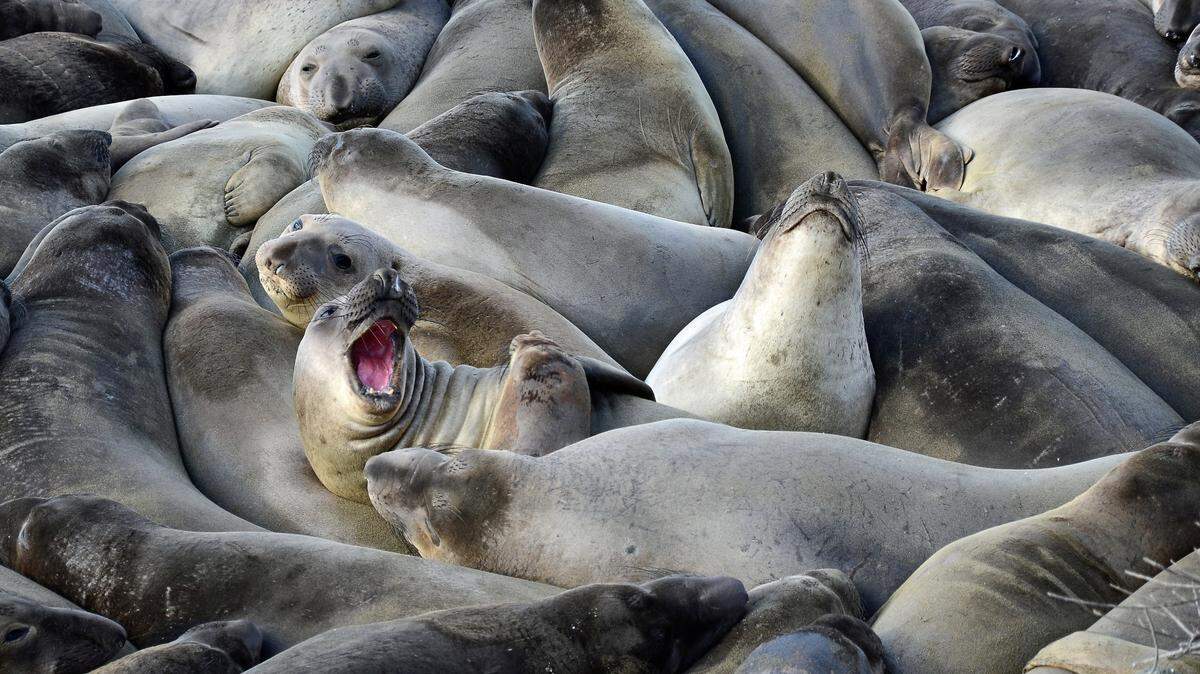
Our family, including my sister Michelle from Santa Rosa and her two daughters, Abigail, who attends Chico State, and Madeline, who will graduate from Cal Poly this month, visited the Piedras Blancas Rookery to view the northern elephant seals. It is located seven miles north of San Simeon on Highway 1.
Many of these fantastic pinnipeds are currently on the beach, molting their old skin and coat. You can easily see shaded bits and pieces of the old tan, dark-brown skin, revealing the new grayish-silvery skin and hair underneath.
However, we noticed a few elephant seals with numerous cookie-shaped open sores or scars between 1 and 2 inches in diameter. It looked like a massive great white shark or orca had attacked them.
It turns out the scars are from a shark, but one that, on average, is only 15 to 22 inches long.
This small shark is called a Cookiecutter and gained its name by the way they strike their prey by violently spinning as they dig their razor-sharp teeth into the bodies of their victims, removing hunks of flesh and leaving behind a crater wound.
According to the Shark Research Institute, a multi-disciplinary nonprofit founded in 1991 in Princeton, New Jersey, Cookiecutter sharks are poor swimmers and are generally only caught at night.
They are an ectoparasite on large fish and cetaceans, which are possibly lured to the shark by its bioluminescent light organs.
They have been reported to have attack rubber sonar domes on nuclear submarines, and there is a case in which a long-distance swimmer was bitten by a Cookiecutter shark.
In other words, this is a vivid description of your worst nightmares if you venture to the ocean. I am a little surprised that someone has not produced a suspense-horror film, like “Piranhas,” about these small flesh-eating cigar-shaped fish.
Thankfully, they favor deep offshore waters and are thus seldom encountered by humans.
That’s bad news for elephant seals, who spend up to 80 percent of their lives in the ocean and often dive to a depth of between 1,000 and 3,000 feet and as deep as over 5,000 feet to feed on squid, fishes, and crustaceans such as shrimp, prawns, and crabs. They can remain underwater for up to two hours.
It’s been hypothesized that the seals also are enticed by the bioluminescence lights of the Cookiecutter sharks in the dark water of the ocean depths and, in turn, become the hunted as they swoop in to eat them.
When you watch these massive seals casually sunning themselves on the beaches of the Central Coast, it’s interesting to know the trials and tribulations they went through to reach the shoreline.
PG&E safety message
Love soars, wildlife dies, power fails on the trail of an errant metallic balloon.
California’s graduation season has begun, and it’s essential that all celebrants understand the public safety risks associated with helium-filled metallic balloons. Unweighted balloons can float away and contact overhead power lines, causing power outages.
In the first four months of 2022, metallic balloons striking electric lines have caused nearly 152 power outages in PG&E’s service area alone, disrupting service to more than 56,000 customers.
To significantly reduce the number of balloon-caused outages and to safely enjoy graduations, PG&E asks customers to follow these important safety tips for metallic balloons:
- Buy latex or rubber balloons instead of metallic.
- ”Look Up and Live!” Use caution and avoid celebrating with metallic balloons near overhead electric lines.
- Make sure helium-filled metallic balloons are securely tied to a weight that is heavy enough to prevent them from floating away.
- Never remove the weight.
- When possible, keep metallic balloons indoors.
- Never permit metallic balloons to be released outside, for everyone’s safety.
- Do not bundle metallic balloons together.
- Never attempt to retrieve any type of balloon, kite, drone or toy that becomes caught in a power line. Leave it alone, and immediately call PG&E at 1-800-743-5000 to report the problem.
- Never go near a power line that has fallen to the ground or is dangling in the air. Always assume downed electric lines are energized and extremely dangerous. Stay far away, keep others away and immediately call 911 to alert the police and fire departments.