Off-highway vehicle commission casts doubt on Oceano Dunes dust science. Is it right?
A state commission is attempting to cast doubt on research looking at levels of dust pollution at the Oceano Dunes, according to a letter sent to the San Luis Obispo County Air Pollution Control District (APCD) earlier this month.
The Off-Highway Motor Vehicle Recreation Commission, a body within California State Parks, also said in the letter that it wants the APCD to buck state and federal air quality standards and only mitigate certain types of particles emitted from Oceano Dunes State Vehicular Recreation Area.
The letter was penned to county Air Pollution Control Officer Gary Willey, State Parks Director Armando Quintero and the APCD hearing board on May 13.
In it, the commission disputes a computer model that shows the Oceano Dunes in southern San Luis Obispo County emitted high levels of pollution in certain areas in 2013.
The state off-road riding commission wrongly attributes the computer model to the Scientific Advisory Group — a group of scientists created to guide the APCD and State Parks in dust pollution mitigation efforts at the Oceano Dunes.
Instead, the computer model was created by the Desert Research Institute in Nevada under a contract with State Parks.
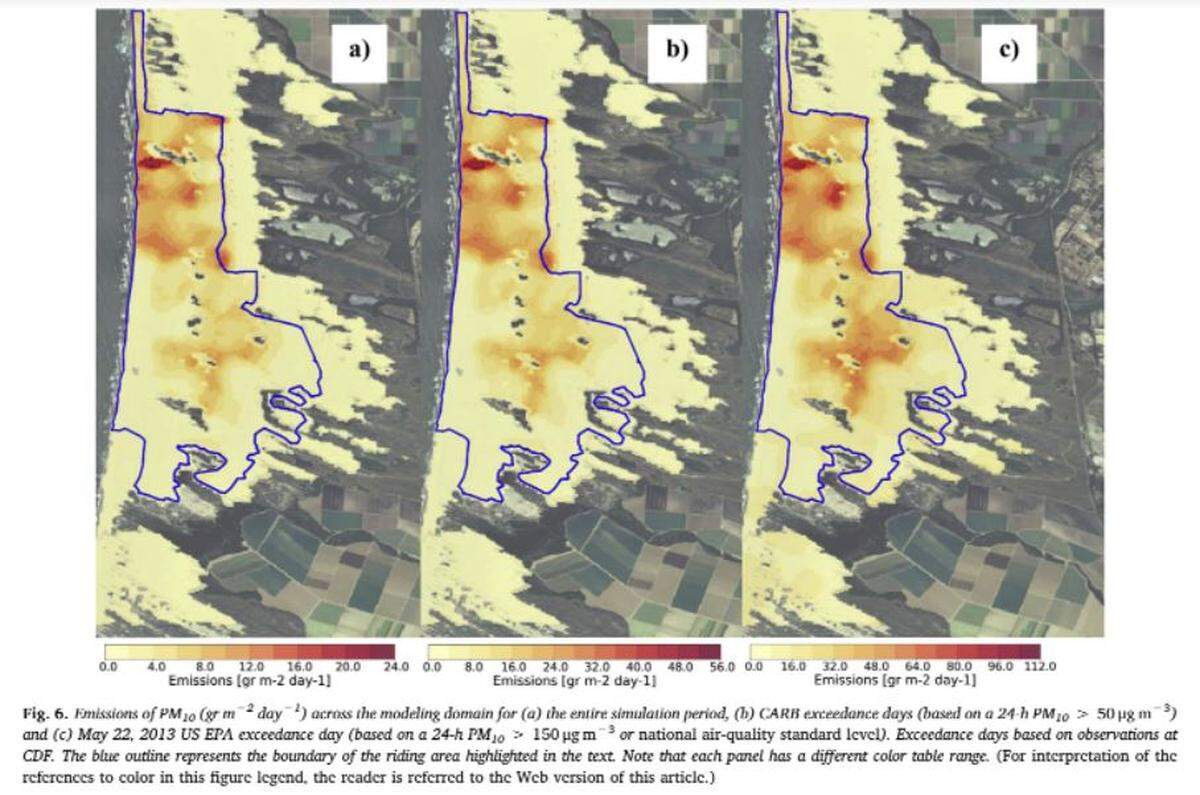
The computer model essentially shows how much fine particle pollution, known as particulate matter 10 (PM10), was emitted from the dunes over 10 windy days in 2013.
Using measurements captured from dozens of locations within the park, Desert Research Institute scientists were able to create what is essentially a heat map that shows where the dustiest areas are at the dunes.
This guides State Parks as it attempts to reduce the amount of dust pollution emitted from the dunes and has led the agency to place many dust mitigation measures where the map was “hot,” or, showed the most pollution.
These measures have helped. Dust pollution from the dunes is estimated to have declined by about 22% compared to those 2013 baseline levels, according to State Parks.
The computer model does not assume that the PM10 is made entirely of “mineral dust,” contrary to what the state commission claims in its letter, according to Jack Gillies, one of the scientists who created the computer model.
Instead, the model looks at PM10 as a whole and does not distinguish exactly what each particle may be, Gillies said.
“Keep in mind, however, under these set meteorological conditions (of 2013), there are essentially no other sources that would be making any significant contribution to the PM10,” Gillies wrote in an email to The Tribune. “The sources of PM between the monitoring locations ... are constrained to be dust and some sea salt.”
Commission: Only measure mineral dust pollution from Oceano Dunes
The computer model’s approach aligns with state and federal PM10 air quality standards, which regulate total PM10 and not the individual constituents in the air.
Regardless, the state commission asks in its letter that State Parks and the APCD buck these standards to instead focus solely on mineral dust pollution coming from the Oceano Dunes.
The commission’s letter further requests that the APCD revise the stipulated order of abatement — which mandates State Parks cut PM10 pollution from the dunes by 50% by 2023, compared to those 2013 baseline levels in the computer model — to only mandate cutting mineral dust pollution.
That stipulated order of abatement is up for revision in an APCD meeting on June 17. The Scientific Advisory Group has suggested the target be shifted from a 50% reduction in PM10 levels to a 40.7% reduction compared to those 2013 baseline levels.
Consistently monitoring pollution from the dunes for only mineral dust is possible, said Karl Tupper, a senior air quality scientist at the APCD.
But it would be expensive and time-intensive, he notes.
“These instruments require some maintenance,” Tupper said. “Our technicians are out there regularly, keeping them going. But they pretty much run themselves.” He noted that the PM10 data is sent to the APCD digitally.
A “manual method” is required to only monitor specifically for mineral dust, Tupper said. “So every sample needs to be started by a human being and then collected by human beings, and then sent to a lab.”
State Parks pays for the operation and maintenance of the instruments that monitor the particulate matter coming from the dunes. Those costs have totaled = about $770,000 since 2013, according to financial documents obtained by The Tribune.
In its letter to the APCD, the state commission also expressed concern about other possible sources of pollution that could be causing PM10 levels downwind of the Oceano Dunes to be higher than in other areas of San Luis Obispo County.
Commissioners requested that the APCD identify and quantify how much construction and agriculture contribute to poor air quality.
Tupper said the APCD could not substantiate past claims that other sources aside from the dunes were the main contributors to the unhealthy levels of pollution on the Nipomo Mesa.
Do dust mitigation measures belong in off-road riding areas?
In addition to taking issue with the computer model, the state commission voiced its concerns about dust mitigation measures at the Oceano Dunes.
“We feel that any further dust mitigation features in the dunes, if they are needed at all, should be located outside of the SVRA riding areas, and the cost of such mitigation should not be borne by the OHV Trust Fund,” the commission wrote in its letter.
About 413 acres of dust mitigation measures have been installed at the Oceano Dunes. These are fenced off areas with no access to vehicles.
About 850 acres at the Oceano Dunes are open to off-road riding, according to a recent State Parks report.
The dust mitigation measures are placed within the riding areas of the dunes because those are the areas determined through the 2013 study and subsequent studies to emit the most dust.
When the Oceano Dunes closed to vehicle traffic in 2020 due to the COVID-19 pandemic, dust emissions dropped by about 50%, according to a study done by the Desert Research Institute.
Jon O’Brien, the environmental program manager for State Parks’ Off-Highway Motor Vehicle Recreation Division, told the commission during its Feb. 17 meeting why the dust mitigation measures needed to be placed in the riding area of the park.
“What we’ve been targeting are those more emissive areas within the park in order to get the most bang for our buck, so to speak,” O’Brien said then. “So it does make a difference where we put the projects. If we pick some other area that isn’t as emissive, we’re not going to get as much of the mass emissions reductions as we’d like.”
The state commission concludes its letter to the APCD by demanding that State Parks withdraw completely from the stipulated order of abatement if its claims regarding the computer model, other sources of pollution and locations for dust mitigation measures cannot be resolved.
The letter will likely be discussed in the APCD’s June 17 hearing board meeting where the stipulated order of abatement revision is on the table.
This story was originally published May 26, 2022 at 9:00 AM.