Oceano Dunes dust decreased by 50% during off-road riding ban, new study shows
Banning off-road riding and camping at Oceano Dunes State Vehicular Recreation Area cuts dust emissions in half in the most heavily trafficked areas, according to a new study.
That study was included in California State Parks’ draft annual dust control program report and work plan for the Oceano Dunes, published Aug. 2.
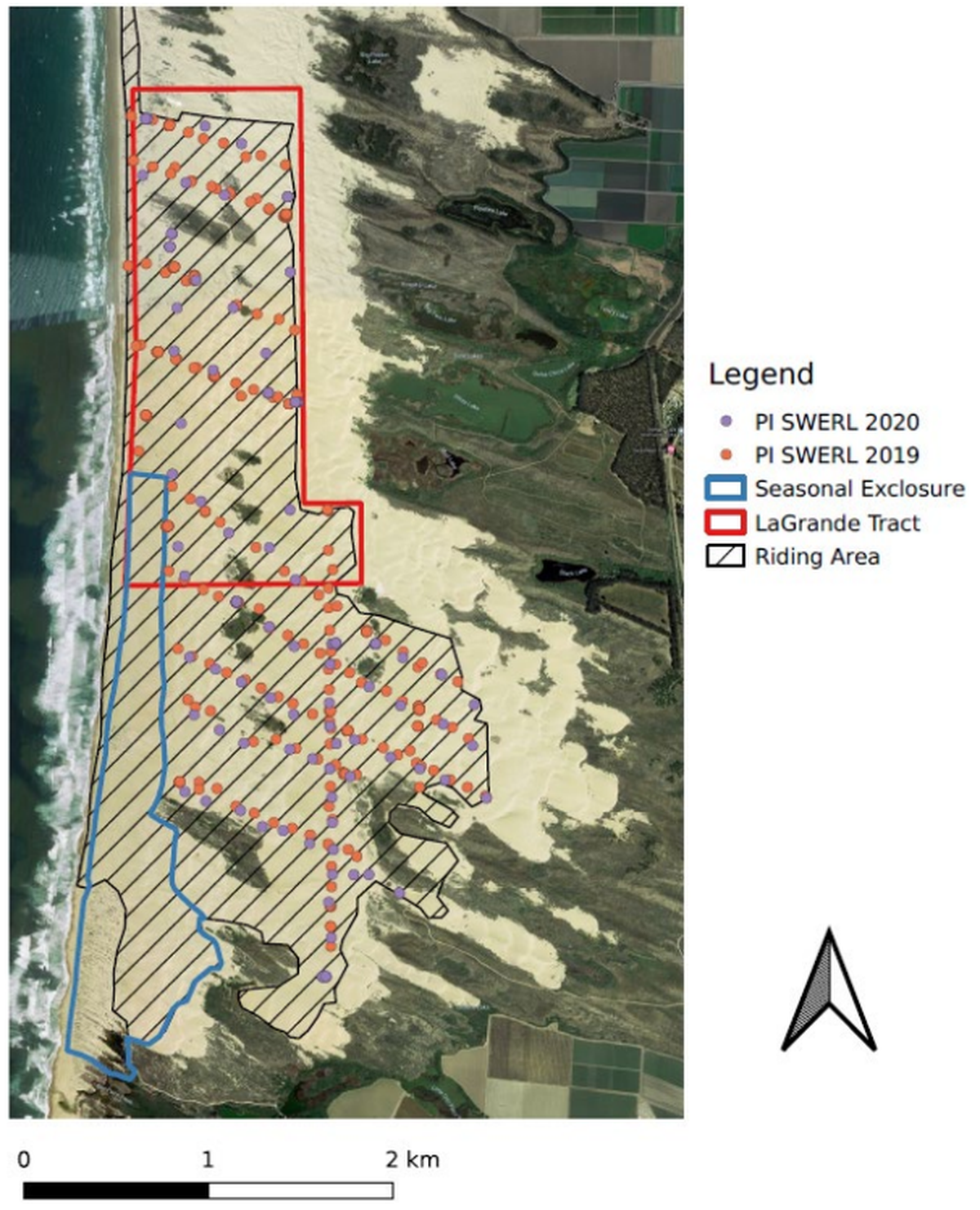
The Desert Research Institute based out of Nevada studied dust emissions at the Oceano Dunes from March through October 2020, when all camping and off-highway vehicles (OHVs) were prohibited in the park due to the COVID-19 pandemic.
The Oceano Dunes, located along the southern coast of San Luis Obispo County, have long emitted dangerously unhealthy levels of dust into Oceano, Nipomo and other communities.
In 2018, State Parks was tasked by the San Luis Obispo County Air Pollution Control District to find ways to reduce emissions from 2013 baseline figures by 50% by 2023.
So far, with millions of dollars spent on dust mitigation efforts including growing new foredunes, re-vegetating areas and installing wind fencing, State Parks has been able to reduce emissions by 21%, according to the report.
It’s an incredible improvement, according to officials and scientists who have studied the dunes’ emissions over the years.
To potentially further curb dust emissions coming from the park, State Parks’ report proposes adding 90 acres of additional dust mitigation measures in Oceano Dunes State Vehicular Recreation Area in 2022 — bringing the total acreage blocked off to OHV use to 413 acres within the 3,600-acre park.
The Desert Research Institute’s study shows that simply closing off the entire park to off-road riding causes conditions to drastically change over a few months.
“It appears that the cessation of OHV activity in 2020 had a demonstrable effect on the emissivity of the dune surfaces in the riding area,” the study says.
Dust emissions reduced significantly in the La Grande Tract, an area in the park where much of the camping and off-roading takes place. There, dust emissions dropped by about 50% by September 2020 from 2019 values, according to the study.
“The (air quality monitoring) station data from 2020 suggest that the removal of OHV activity in April allowed the dune system to move to a different emissive state that was approximately 50% lower following the passage of four months of time,” the study says.
Comparatively, in 2019, air quality monitoring station data indicates that particulate matter levels in the air increased in that same time period, according to the study.
That means that the amount of PM10 — particles such as dust, pollen, smoke and mold with a diameter of 10 micrometers and smaller — in the air increased throughout summer 2019, whereas it decreased in 2020, according to the study.
The longer OHVs were off the dunes in 2020, the less emissive the dunes became.
The Desert Research Institute studied other riding areas of the park only during May 2020, when the park had been closed for a little more than two months.
At that time, dust emissions had reduced from 2019 levels by about 20% during windy days, according to the study.
The study confirms what had previously been speculated: that completely removing OHVs from the Oceano Dunes significantly reduces dust emissions.
Karl Tupper, a senior air quality specialist from the county Air Pollution Control District, said the drop in emissions shown in the Desert Research Institute’s study is “exciting” and shows that the goal of 50% reduction in dust emissions by 2023 is obtainable — with one big caveat.
“But now they’ve reopened the park to riding, so that 50% reduction in emissions that they saw in the La Grande Tract, presumably that’s gone away,” Tupper said.
Whether Oceano Dunes stay open to OHV use may be decided in court
The California Coastal Commission voted in March that State Parks must prohibit OHV use at the Oceano Dunes by 2024, a year after State Parks is supposed to meet its dust emissions reduction goal.
That vote is being challenged in San Luis Obispo County Superior Court in two lawsuits by the Friends of Oceano Dunes. One of those lawsuits alleges the vote overstepped the Coastal Commission and State Parks’ authorities.
The second lawsuit requests a judge grant a quiet title for the land, or determine what the use of the dunes will be for the future.
Friends of Oceano Dunes, a nonprofit group, alleges that the Oceano Dunes have an “implied dedication” to be lawfully set aside for OHV use.
If the group wins, the lawsuit would essentially require that the Oceano Dunes be used solely for OHV use, meaning even land set aside for dust mitigation efforts could be used for off-road riding.
Jim Suty, president of Friends of Oceano Dunes, said in a YouTube video posted on Aug. 2 that the nonprofit’s legal costs have, on average, totaled about $30,000 each month since the fight began in April.
Attorneys for the county Air Pollution Control District and State Parks generally denied all of the allegations in the quiet title lawsuit in separate filings received by the court on July 14 and 16, respectively.
Attorneys for the Coastal Commission and the state of California filed a demurrer in the case. That means the attorneys may not dispute the facts but argue that there is no valid legal claim.
“Friends (of Oceano Dunes) seek, in effect, to adversely possess the public’s property for specific recreational uses,” the demurrer says. “This they simply cannot do.”
A hearing is set for Jan. 5 in Superior Court, during which Judge Tana Coates may decide to sustain the demurrer, meaning Friends of Oceano Dunes may be able to revise their case.
If Coates decides to overrule the demurrer, then the case will be allowed to proceed as is.
State Parks report suggests adding 90 additional acres of dust mitigation
Also detailed in State Parks’ draft annual report and work plan is the agency’s proposal to set aside 90 additional acres at the Oceano Dunes for temporary dust control measures.
About 1,500 acres of the 3,600-acre park are currently open to off-road riding, while 323 acres in total are blocked off to OHV use for dust mitigation measures.
Adding 90 acres of dust mitigation area would bring that total to 413 acres.
What those dust mitigation measures will look like has yet to be identified by State Parks, according to its report.
However, State Parks has proposed two options: the first would “maximize PM10 mass emission and concentration reductions,” and the other would “consider Park operation and resource protection needs better.”
The draft annual report and work plan is currently under review by the Scientific Advisory Group, which was formed in 2018 to assist State Parks and the county Air Pollution Control District in creating and implementing successful dust mitigation efforts at the Oceano Dunes.
The air pollution control district is also reviewing the report.
Once those reviews are complete, the proposed new dust mitigation measures — with any revisions proposed by the Scientific Advisory Group or the air pollution control district — will go to the Coastal Commission for review and possible approval.
State Parks indicates in its report that it hopes to gain approval from the Coastal Commission for the new dust mitigation efforts no later than February 2022, though that is subject to change.
This story was originally published August 6, 2021 at 10:46 AM.