
State approves removal of oil pier from Central Coast beach. What’s next?
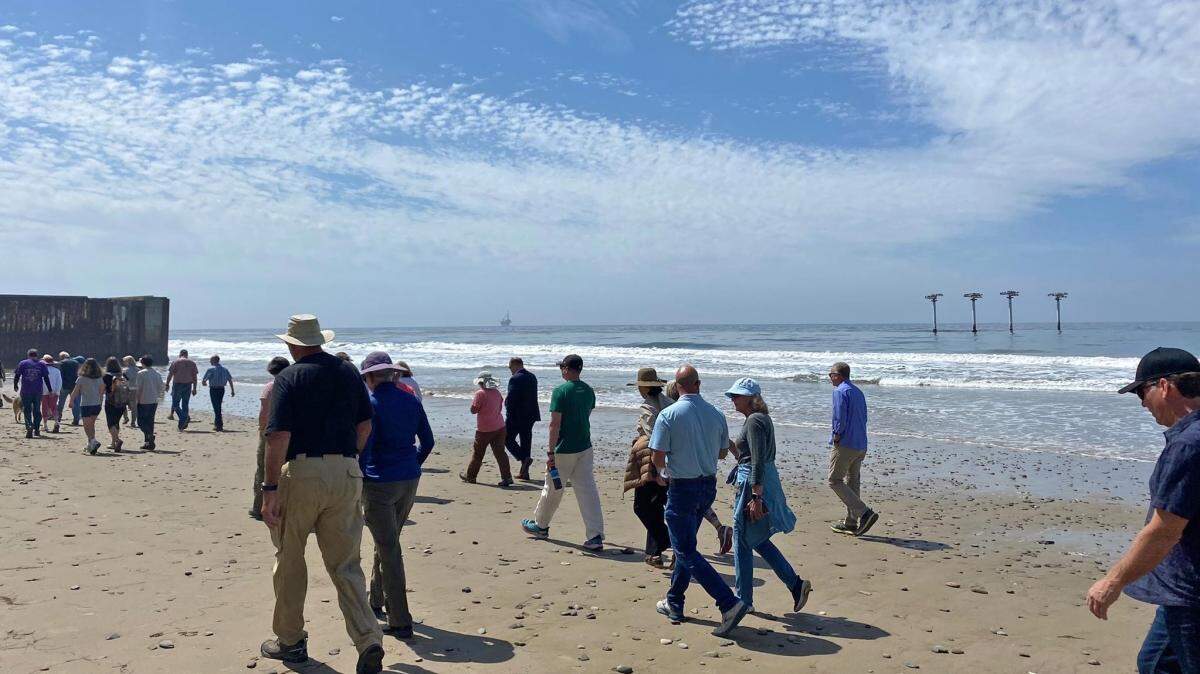
The State Lands Commission approved the first part of a decommissioning project that will remove the oil pier infrastructure at Haskell’s Beach in Goleta, and staff hosted a tour of the site for local residents.
The Commission approved the first component of the project at an April 26 meeting: removing the caisson and pier structures in the tidal zone.
Energy company ExxonMobil is responsible for paying for this portion of the project on public land and will be selecting a contractor to start work later this year, said Joe Fabel, a SLC attorney.
The second part of the project, which would remove an access road to the piers and underground pipelines, is unfunded and involves private land owned by the Sandpiper Golf Club.
The SLC’s certified environmental impact report analyzed the entire decommissioning project.
Peter Imhof, Goleta’s director of Planning and Environmental Review, voiced concerns that the commission was only approving the first part of the pier decommissioning project.
Goleta would not be able to handle funding the road and pipeline removal on its own, he said.
“Removal of this infrastructure is a shared problem and a shared responsibility. The SLC cannot just wash its hands of the upland area infrastructure,” he said during the April 26 meeting, which was held at Goleta City Hall’s City Council Chamber.
“Without a plan to remove component 2, wave action will gradually erode and expose component 2, potentially creating beach hazards and resulting in environmental contamination.”
State Controller Betty Yee, who chairs the SLC, said in her closing comments that she can assure Goleta the state will not turn its back on the issue.
“Our action here today is by no means the end of the Commission’s involvement,” she said.
Local residents visited Haskell’s Beach on April 26 before the meeting for the SLC’s public field trip to the Piers 421 Decommissioning Project Site.
Participants met at the Cliff Drysdale Tennis Club and walked a mile along the beach to two piers and caissons — Pier 421-1 and Pier 421-2. The decommissioning project will remove both wells and pier infrastructure with work starting as early as August.
Nearly 40 Goleta and Santa Barbara residents showed up to Haskell’s, eager to ask questions of the Commission’s representatives, including Fabel. Field trip participants were curious about how the land would be changing.
“We’ve lived out here forever and we’re just interested in what happens in our environment, and to watch the process,” said Lisa Potter, a 20-year Goleta resident and interim executive director at the Native Historical Society.
According to State Lands Mineral Resource Inspector Ernie Guerra, the Piers 421 field trip is the first field trip held by the state in the past four years and the first for the PRC 421 project.
The caissons being removed are 70- to 80-year-old structures that hold soil and substructures, and the main concern is to safely remove the hydrocarbon-contaminated soil inside as well, Fabel said.
“Everything here down to the bedrock,” Fabel said. “It’s about 13 feet at its deepest.”
According to Fabel, the project will be conducted during low tide cycles when the project won’t be hindered by the ocean and will take between six and eight months to complete.
After Venoco declared bankruptcy and quitclaimed its offshore oil leases to the state, the SLC has overseen work to plug and abandon the 30 wells on Platform Holly, which will be completed by the end of the year, and removing the pier infrastructure on Haskell’s Beach.
The SLC plans to hire a consultant to analyze options for decommissioning Platform Holly, which could include keeping the physical structure in place, removing part of it, or completely removing it.
ExxonMobil is required to and has agreed to pay for the full cost of decommissioning Platform Holly, according to SLC staff. This offshore oil production platform is the first one to be commissioned in the state since several Chevron platforms in the 1990s.
Venoco’s bankruptcy came after the 2015 Refugio Oil Spill, in which a crude oil transmission line operated by Plains All American Pipeline ruptured and spilled an estimated 123,228 gallons of oil onto the shoreline and into the ocean on the Gaviota Coast of southern Santa Barbara County.
The pipeline has been shut down since the spill.
Other oil companies with offshore production facilities in the county have halted production since 2015. County supervisors recently denied ExxonMobil’s request to truck crude oil from its processing facility on the Gaviota Coast to refineries.
A proposal to build a replacement Plains oil pipeline is undergoing environmental review.
This story was originally published May 2, 2022 at 9:09 AM.