Take a picture of a monarch butterfly and you could win a $50 gift card to REI
See a western monarch butterfly fluttering around your yard, while on a hike or even walking around the city?
Take a picture and send it to a team of researchers and you might just win a $50 REI gift card.
The annual Western Monarch Butterfly Mystery Challenge organized by researchers from Washington State University, Tufts University, UC Santa Cruz and the Xerces Society for Invertebrate Conservation begins on Feb. 14, Valentine’s Day, and runs through April 22, Earth Day.
It’s the third year of the challenge and has helped the team better understand what the monarch butterflies do after they leave California overwintering sites such as the grove at Pismo State Beach.
The timing of the challenge is key as it corresponds directly with the beginning of the monarch’s typical mating period. Plus, the dates are easy to remember.
“Historically, Valentine’s Day is when you saw lots and lots of mating monarchs,” said Cheryl Schultz, a professor at Washington State University who helps run the challenge. “So, the monarch biology is they overwinter, and then at the end of the historical overwintering period you would see all this pairing in the overwintering sites before they would start migrating. And so there was a lot of mating behaviors observed pretty much around the middle of February.”
By the end of April, around Earth Day, researchers think the monarchs have dispersed into other habitats — but not much more than that is known.
“This year, because we’ve got so many butterflies in the overwintering sites, it’s just this incredible opportunity to learn about early spring,” Schultz said. “Because when those butterflies eventually leave the overwintering sites, we have a huge potential to see where they’re going this year. It’s really exciting.”
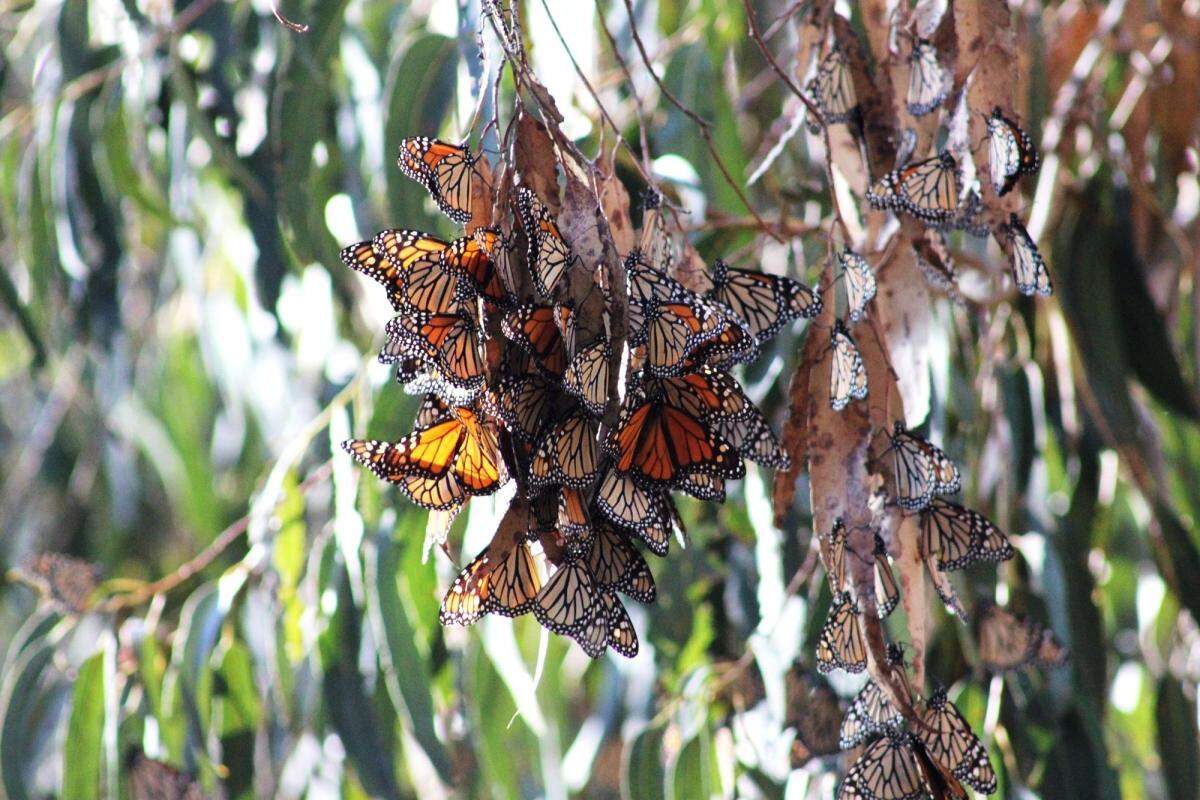
Monarch butterflies saw huge population jump, but still minuscule compared to historical size
California saw a more than hundred-fold increase in the number of overwintering western monarch butterflies this year.
During the annual western monarch Thanksgiving count, volunteers with the Xerces Society counted 247,237 monarchs at various sites across the state — up from 1,899 last year.
Researchers were elated to see the massive jump in the butterfly’s population, and still aren’t quite sure what exactly caused it. But they are also quick to temper their joy by putting the numbers into historical context.
Western monarch butterflies have experienced a drastic decline in population size since counting began in the 1990s. The U.S. Fish and Wildlife Service has estimated that there is a 96% to 100% probability that the western monarch population will collapse within 50 years.
Loss of milkweed and other flowering plants across monarch butterflies’ habitat range, as well as wildfires, climate change, the widespread use of pesticides and the degradation and loss of overwintering groves in coastal California and Mexico have contributed all to the decline of the monarch population, according to the Xerces Society.
Even so, the U.S. Fish and Wildlife Service announced in December 2020 that the species will have to wait for federal protection under the Endangered Species Act — a move researchers worried would surely doom the insects and make protection far more difficult.
However, when President Joe Biden signed the $1 trillion Infrastructure Investment and Jobs Act into law in mid-November 2021, it established a $2-million-per-fiscal-year federal grant program available to Native American tribes, the federal land management agency and state departments of transportation to carry out pollinator-friendly practices on roadways and highway rights-of-way.
Another bill reintroduced by U.S. Rep. Salud Carbajal, D-Santa Barbara, Rep. Jimmy Panetta, D-Carmel Valley, and Sen. Jeff Merkley, D-Oregon — the Monarch Action, Recovery and Conservation of Habitat (MONARCH) Act — is still being considered in the House.
As it was proposed, the MONARCH Act would set aside $62.5 million to implement a massive western monarch butterfly conservation plan prepared by the Western Association of Fish and Wildlife Agencies in January 2019, and another $62.5 million for any eligible entities that implement a monarch conservation project.
Those pieces of legislation only add to the conservation and habitat restoration work the Xerces Society and many other organizations around the West are funding.
In early November, for example, the Xerces Society distributed tens of thousands of free, pollinator-friendly native and drought-resistant plants to landowners around California. The recipients of the plants used them to restore areas of cropland that were not productive, or bring a barren patch of their property back to life.
How to participate in the western monarch mystery challenge
Here’s how you can help researchers better understand the iconic monarch butterflies’ springtime behavior:
- If you see a monarch butterfly outside of an overwintering grove, take a picture! (Don’t worry, it can be far away and blurry).
- Report it through the following options and be sure to include date and location:
- iNaturalist (the app is free),
- Western Monarch Milkweed Mapper OR
- Email it to MonarchMystery@wsu.edu.
You’ll be entered to win a prize every week you report a sighting.