SLO County rains improve local drought conditions. Here’s where our lakes stand now
Just a few months ago, San Luis Obispo County was suffering from weeklong heatwaves after a dry 2020-21 rain season, causing reservoirs to shrivel up.
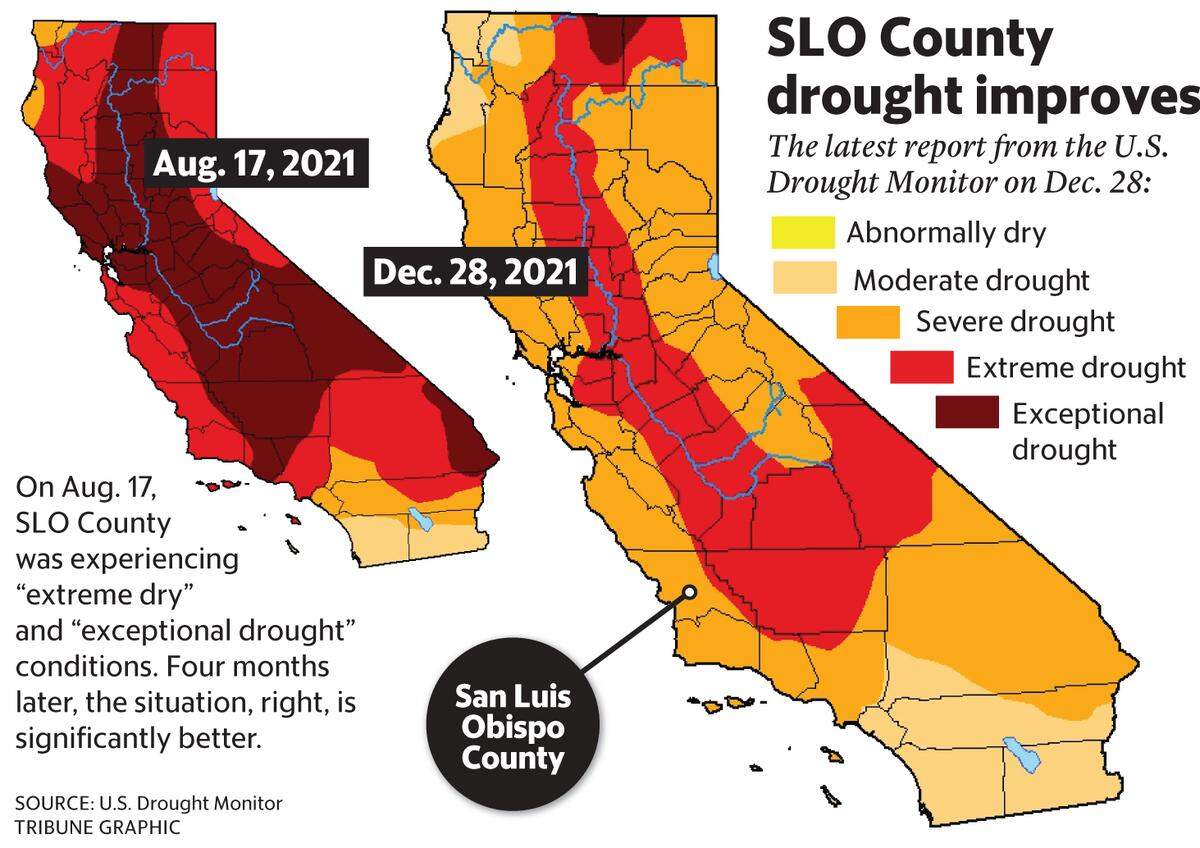
Until recently, most of the county was experiencing what the U.S. Drought Monitor labels as “extreme” and “exceptional” drought conditions, the two most severe categories on the five-level scale.
But a stream of recent rain storms has halted that decline and begun to improve drought conditions locally, giving hope to wary water managers.
As of Dec. 28, most of the county is now in a “severe” drought, according to the U.S. Drought Monitor, which compiles data through a partnership between the National Drought Mitigation Center at the University of Nebraska-Lincoln, the United States Department of Agriculture and the National Oceanic and Atmospheric Administration.
The most eastern edge of the county is experiencing “extreme” drought conditions, a less severe category than it was in before, the U.S. Drought Monitor reported.
It’s a notable improvement brought on by the 4 to nearly 20 inches of rain that fell in San Luis Obispo County in December — and which may ease fears that this year’s drought would balloon into the situation California faced from 2014 to 2016.
“It’s a good sign; it’s a good start,” said Shane Taylor, Arroyo Grande’s water utilities manager. “And we hope this rain continues.”
While the recent rains have been an unexpected boon, they are far from enough to end the drought or reverse conservation efforts.
When drought conditions began to worsen in the summer and peaked in the fall, city and county officials imposed water use restrictions on residents in an effort to save the dwindling reservoirs from becoming depleted.
Most of those will remain in place, despite the recent rains.
Taylor noted it’s largely because the reservoir levels have so-far only marginally improved.
Reservoir levels in SLO County begin to rise
Reservoirs in San Luis Obispo County typically rise significantly only after the rainy season’s first few rains have saturated the soils. Once soils are moist and plants have taken up their fair share of water, more of the precipitation will run off and begin to fill the reservoirs to a greater extent.
Nowhere else in the county is that more evident that at Lake Nacimiento, the dragon-shaped lake in the North County that benefits from 165 miles of shoreline and a massive watershed fed by the surrounding Santa Lucia Range.
Nacimiento is a recreation hub and provides drinking water to cities such as Paso Robles, San Luis Obispo, Templeton and Atascadero.
On Dec. 13, Lake Nacimiento was at 9% capacity, before the heaviest December rains hit the area.
Only 10 days later, on Dec. 23, however, the lake measured at 15% capacity, the Monterey County Water Resources Agency reported.
The next measurement, accounting for the rest of the December rains and continued runoff, will show further improvement.
Lake Nacimiento Resort, in a hopeful Facebook post on Friday, even predicted that the additional rains already have filled the reservoir to 30% capacity.
Lopez Lake — which provides drinking water to the Five Cities community of Arroyo Grande, Avila Beach, Grover Beach, Oceano and Pismo Beach — has gone from 28.5% capacity on Dec. 13 to 30.1% capacity as of Dec. 30, according to the San Luis Obispo County Department of Public Works.
That’s a rise of 834.1 acre-feet of water, Public Works reported.
And Santa Margarita Lake, which serves as the main drinking water source for the city of San Luis Obispo, was at 62.3% as of Dec. 30, up from 55.2% reported by Public Works on Dec. 13. That’s a gain of 1,680.7 acre-feet of water.
Water use restrictions likely to stay in place for most communities
Communities that rely on those reservoirs for drinking water will likely see continued water use restrictions until more rain comes.
For example, San Luis Obispo County put its low reservoir response plan for Lopez Lake into effect in late September after the lake dipped below 20,000 acre-feet. Because the lake now sits at 14,885 acre-feet, the municipalities that take water from it have their diversions reduced by 20%, according to Public Works.
“The rains did help but not enough yet,” wrote David Spiegel, the county’s supervising engineer for the utilities division, in an email to The Tribune.
However, not all communities in the county rely on reservoir water.
Some, such as Cambria, get most of their water from wells.
John Weigold, the community’s general manager, told The Tribune that he believes the wells “are largely recharged” due to the recent rains.
In early July, the Cambria Community Services District Board of Directors declared a stage four water shortage emergency and called upon residents to reduce water consumption by up to 40%. But a recharge of the wells may mean the community could enter a less restrictive water conservation stage, should the board of directors declare so in its next meeting on Jan. 13.
Whether local drought conditions will continue to improve or may worsen depends largely on what precipitation falls in the next few months.
John Lindsey, a meteorologist for PG&E, said the models currently predict a relatively dry start to 2022, although that could change.
This story was originally published December 31, 2021 at 1:21 PM.