State Parks wants to block off more of Oceano Dunes for dust mitigation. Here’s where
The San Luis Obispo County Air Pollution Control District hearing board on Thursday discussed a California State Parks plan to set aside more of Oceano Dunes State Vehicular Recreation Area for dust mitigation measures.
The additional measures are another step State Parks must take to cut dust pollution from the dunes in half as part of the 2018 stipulated order of abatement issued by the Air Pollution Control District.
But the hearing board took no action on State Parks’ plan.
Denial or approval of the plan is left up to Air Pollution Control Officer Gary Willey. If he approves it, State Parks can then send the plan to the California Coastal Commission for their review.
State Parks has proposed to set aside an additional 90 acres of the popular park in southern San Luis Obispo County for dust mitigation, according to a draft annual report and work plan sent to the air pollution control district in August.
About 56 of the 90 acres would be permanently set aside for new vegetation plantings, while about 26 acres would be converted to temporary straw treatment areas and 7.5 acres would be sprayed with a soil stabilizer treatment, according to State Parks’ plan.
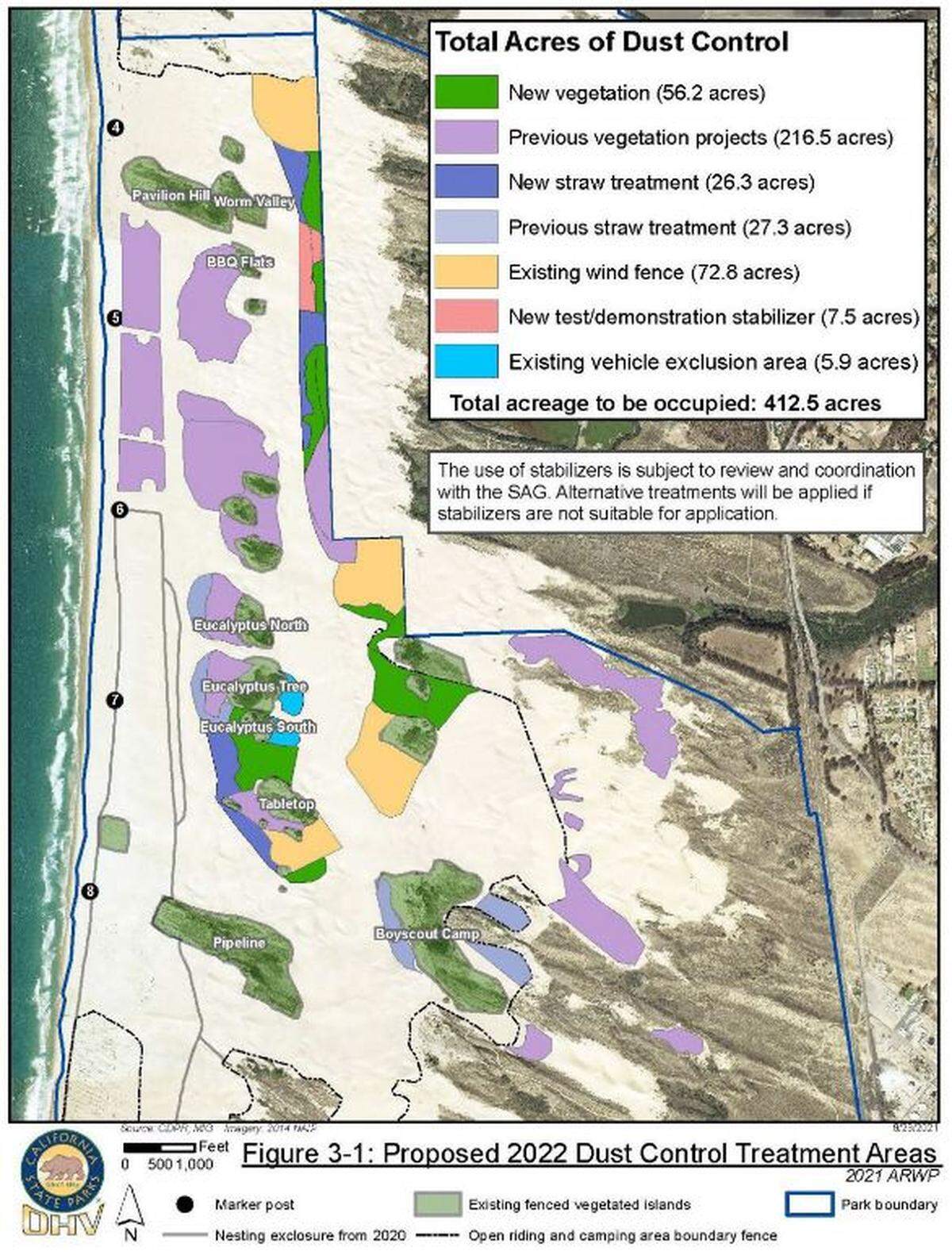
Currently, about 1,500 acres of the 3,600-acre park are open to off-road riding, and 323 acres in total are blocked off to vehicle use for dust mitigation measures.
Should the additional dust mitigation acreage proposed by State Parks be implemented, a total of 413 acres at the park would be off limits to vehicles starting in 2022.
More than 30 people submitted written comments to the Air Pollution Control District hearing board earlier this week regarding the plan, and another handful spoke during Thursday’s virtual hearing.
Public comment appeared weighted toward support of the additional dust mitigation measures, with many speakers saying they wanted the measures to go farther.
“We’ve got to remember this is a public health issue and I still don’t see that level of urgency that would require us to get to this goal,” local resident Chris Sorenson said during public comment. “Just pushing for 90 to 100 acres by the end of 2023 doesn’t seem to be enough.”
Before and after public comment, Willey commented on the speed of the district’s ongoing dust control measures, and the likelihood of reaching its goal of reducing dunes emissions by 50% by 2023 — likening it to a game of whack-a-mole.
“You control something over here, you shift patterns over there,” he said. “So, you know, it’s really exciting that we’re making progress. You know we are disappointed that we’re not there yet. And we’re continuing to strive towards doing that.”
Oceano Dunes dust mitigation efforts are working
State Parks’ draft annual report and work plan detail how the existing dust mitigation measures appear to be working.
Dust mitigation efforts have caused dust emissions at the Oceano Dunes to drop by an estimated 20.6% when compared to baseline conditions in 2013, according to analysis by the Desert Research Institute in Nevada.
That’s still shy of the 50% dust emissions reduction the park must reach by 2023 as part of the stipulated order of abatement by the Air Pollution Control District.
However, a study conducted in some areas of the Oceano Dunes showed that when off-road riding was banned at the park in 2020 due to the COVID-19 pandemic shutdown, dust emissions dropped by 50% from 2019 values.
The study, conducted by the Desert Research Institute, focused on the La Grande Tract, an area where much of the camping and off-highway vehicle (OHV) use in the park takes place.
“The (air quality monitoring) station data from 2020 suggest that the removal of OHV activity in April allowed the dune system to move to a different emissive state that was approximately 50% lower following the passage of four months of time,” the study says.
The study confirms what had previously been speculated: that completely removing vehicles from the Oceano Dunes significantly reduces dust emissions.
Coastal Commission vote to ban OHVs challenged in court
The California Coastal Commission voted in March that State Parks must prohibit off-highway vehicle use at the Oceano Dunes by 2024, a year after State Parks is supposed to meet its dust emissions reduction goal.
That vote is being challenged in San Luis Obispo County Superior Court in three lawsuits by Friends of Oceano Dunes, an off-roading advocacy group.
One of those lawsuits alleges the vote overstepped the Coastal Commission and State Parks’ authorities. The second lawsuit requests a judge grant a quiet title for the land, or determine what the use of the dunes will be for the future.
And the third, filed on Sept. 24, alleges the Coastal Commission “exceeded the agency’s authority” by adopting a revised staff report that detailed the March action taken by the commissioners, according to the complaint.
Attorneys for the county Air Pollution Control District and State Parks generally denied all of the allegations in the quiet title lawsuit in separate filings received by the court on July 14 and 16, respectively.
Attorneys for the Coastal Commission and the state of California filed a demurrer in the case. That means the attorneys may not dispute the facts but argue that there is no valid legal claim.
“Friends (of Oceano Dunes) seek, in effect, to adversely possess the public’s property for specific recreational uses,” the demurrer says. “This they simply cannot do.”
A hearing is set for Jan. 5 in Superior Court.
During that hearing, Superior Court Judge Tana Coates may decide to sustain the demurrer, meaning Friends of Oceano Dunes may be able to revise their case.
If Coates decides to overrule the demurrer, then the case will be allowed to proceed as is.
This story was originally published October 14, 2021 at 5:45 PM.