
A dozen California condors have died so far this year. ‘It’s a hard pill to swallow’
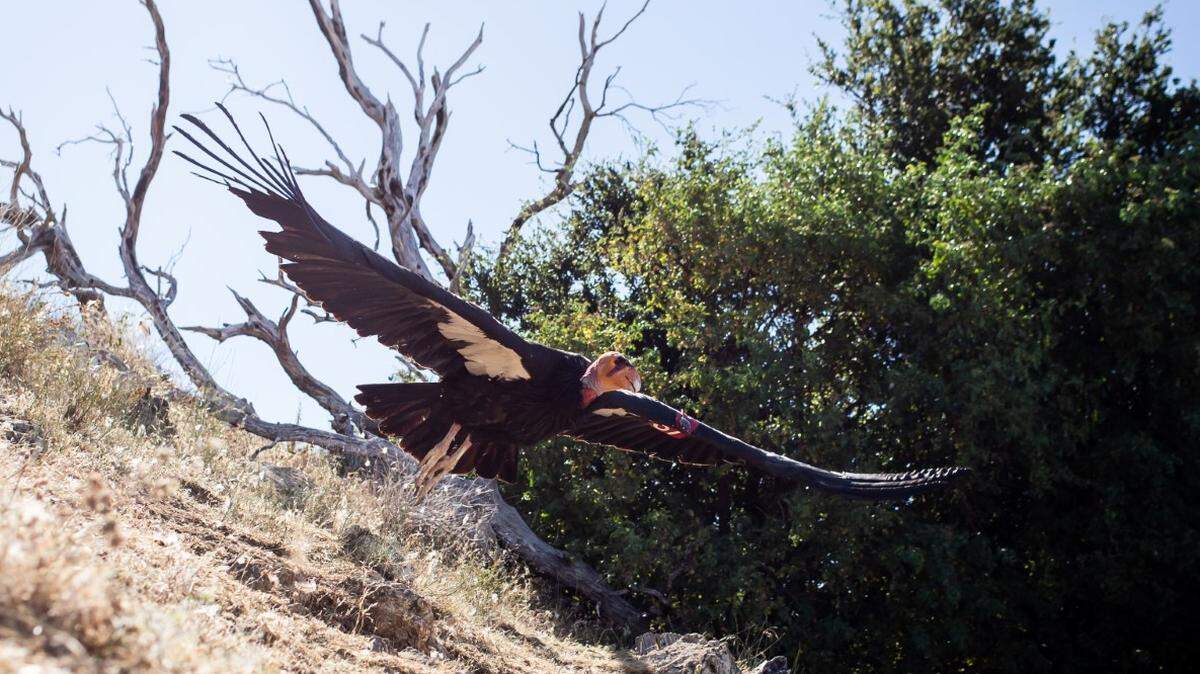
Wildlife biologists are profoundly concerned about the recent shrinking of the California condor population in the central California region.
While 102 giant birds with 9 ½-foot wingspans could be found flying free in Big Sur, Pinnacles and San Simeon in December, researchers counted just 82 in the region in August. That means mortality has now caught up with a dozen condors in 2021.
“It’s tough. It’s a tough pill to swallow,” said Joe Burnett, Ventana Wildlife Society’s lead condor biologist.
Three of the critically endangered condors — the largest land birds in North America — were reported lost in July.
The three giant birds that perished were a male, Kodiak (No. 974), a female (No. 438) and another female, Loner (No. 311).
Lead poisoning suspected in California condor deaths
Two-year-old Kodiak was released from the mountains above San Simeon on Dec. 12.
In the time he was flying free, “He did great. He had become a part of the flock,” Burnett reported.
But on June 10, Burnett explained, “We got a ‘stillness alert’ from our database. The alert lets us know when a bird isn’t moving normally – staying still way more than it should be.”
Using GPS, the VWS staff found Kodak alive near King City in mid-June. On June 25, he flew 50 miles back to his original release site, in San Simeon.
There, VWS staff observed Kodak on a video camera and found he appeared sluggish. Later attempts to capture him to test him for lead poisoning failed.
He was found dead on July 6.
“We suspect it might be lead poisoning. The tell-tale signs were there,” Burnett said. “But we’ll wait for the necropsy results to come back. Still, No. 974 will be missed.”
Losing No. 438 was “a real heartbreaker,” Burnett said during a VWS Zoom chat on July 29.
At 14 years old, the condor was considered “in her prime,” Burnett explained. “Condors live 50 to 60 years in the wild, and 14 years is way too young.
“She had just hit her stride as a breeder. She sired two offspring, and her mate, condor No. 663, is doing just fine raising her second chick (2-month old No. 1007) in a really remote nest site in the Big Sur back country.”
Condor No. 663 is a “pretty high-ranking male,” so Burnett said he is keeping his “fingers crossed” that the male bird can successfully raise his chick solo.
“Another big heartbreaker was losing No. 311,” the biologist said.
Loner was found dead on July 24. The 18-year-old bird “was a really experienced female” who sired three chicks, Burnett said.
“She wasn’t even half way through her life span,” he continued.
Indeed, Loner’s life was touched by tragedy. She lost her nest in the August 2020 Dolan fire, and she also lost her mate, who died due to complications from that devastating wildfire and from lead poisoning.
“Her contribution was huge, when you think about what she gave to this flock in her 18 years,” Burnett said of Loner.
While lead poisoning is suspected of leading to these three condors’ deaths, VWS must wait for the official necropsy report.
Healthy chicks ready to fledge in a few months
In the meantime, “We have to focus on the positive future,” Burnett emphasized. That future is optimistic in part because there are six healthy chicks being raised and are expected to fledge in a few months.
Chick No 1077 is being nurtured by male Junipero (No. 663) in Big Sur.
Chick No. 1078 is being raised in Pinnacles, and chick No. 1089, which is about 3 ½ months old, is a Big Sur bird.
Another chick, No. 1095, is doing well in Big Sur at 3 months old.
Chick No. 1096 is being reared in Pinnacles. And chick No. 1104, which is about 4 months old, is growing steadily in Big Sur.
This autumn, Ventana Wildlife Society plans to send five more juvenile condors into the wild from the huge release pen in the remote mountains above San Simeon.
Along with that cohort of five, juveniles Iniko and Eva will be brought up from their temporary home in the Los Angeles Zoo and released later in the fall.
Iniko’s father was killed in the fast-moving Dolan Fire, and Iniko was force-fledged from the nest when an intruding male condor attacked her mother, Redwood Queen.
Iniko was injured in the fall, but was rescued by VWS and moved to the Los Angeles Zoo for treatment and care.
Eva, a chick who was evacuated before the Dolan Fire could torch her nest, is now a healthy juvenile as well.
For more information on California condors, lead poisoning and Ventana Wildlife Society, visit ventanaws.org.
This story was originally published August 3, 2021 at 7:00 AM.