SLO County is now in ‘extreme’ or ‘exceptional’ drought. What happens now?
.jpg "Lopez Lake is at 35.5% and may need to close its boat launch in August.")
Drought conditions continue to worsen in San Luis Obispo County as heatwaves hit the area and reservoir levels sink.
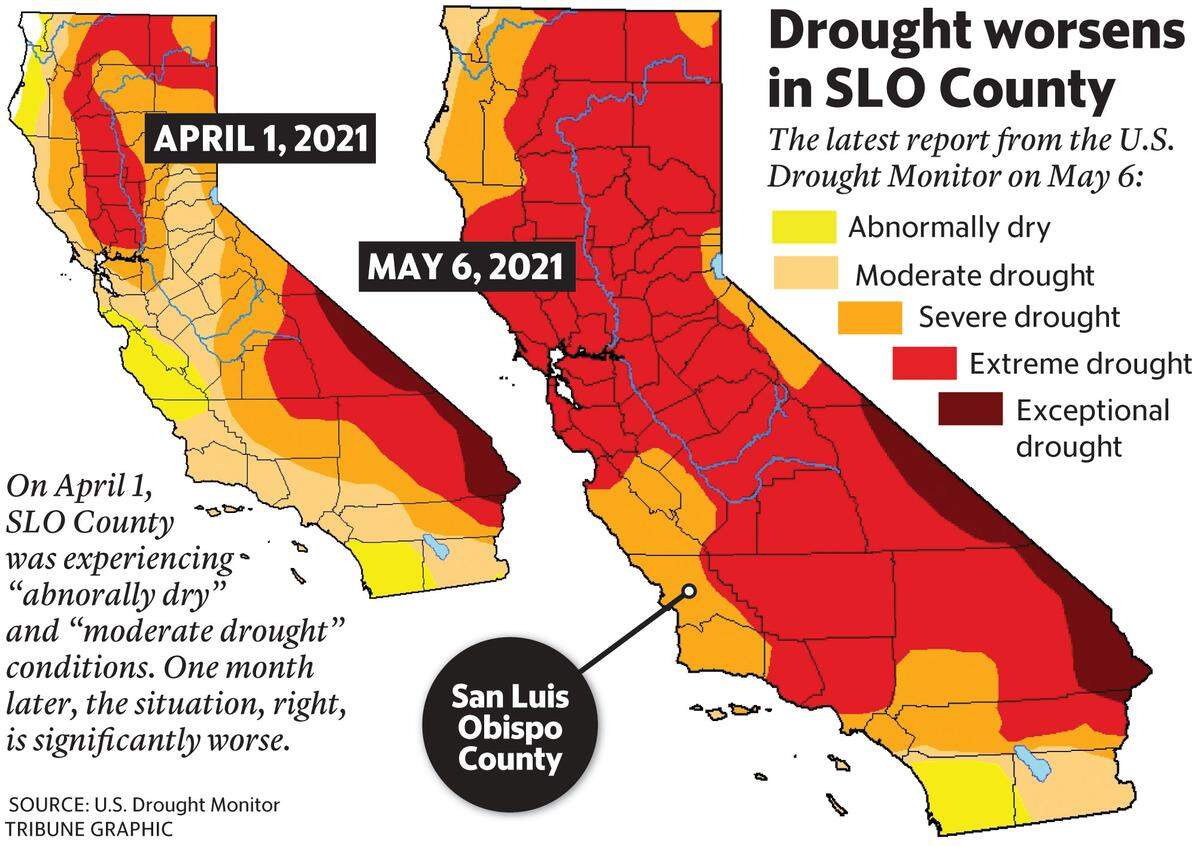
The county is now in what the U.S. Drought Monitor labels as “extreme drought” in the majority of the county and “exceptional drought” in the easternmost area. “Exceptional drought” is the most severe in the five-level scale.
At the beginning of this month, most of the county was in the less severe category of “severe drought,” according to the U.S. Drought Monitor, which compiles data through a partnership between the National Drought Mitigation Center at the University of Nebraska-Lincoln, the United States Department of Agriculture and the National Oceanic and Atmospheric Administration.
The drought has hit the entire state of California — with the worst conditions experienced in the north central and eastern parts of the state. One-third of California is experiencing “exceptional drought” conditions, according to the U.S. Drought Monitor.
So what exactly does it mean that San Luis Obispo County is now in an “extreme” or “exceptional” drought?
What may be the most obvious impact to residents is water-use restrictions. These are already in place in cities such as Grover Beach, Pismo Beach and Arroyo Grande.
Those cities prohibit any excessive water waste, prohibit outdoor irrigation from 10 a.m. to 4 p.m. and are asking residents to conserve water wherever possible.
More cities may also impose water-use restrictions as drought conditions persist in San Luis Obispo County. Communities that receive water from the state via the State Water Project — such as Morro Bay, Avila Beach and Oceano — may see restrictions as well.
The local reservoirs that provide much of the drinking water residents receive are seeing large drops in capacity and elevation levels.
Santa Margarita Lake, which serves as the main drinking water source for the city of San Luis Obispo, is at 65.3% capacity, according to the county Public Works Department. This time last year, the lake was at 84% capacity.
Lopez Lake — which provides drinking water to the Five Cities community of Arroyo Grande, Avila Beach, Grover Beach, Oceano and Pismo Beach — is at 35.5% capacity. In July 2020, the lake was sitting at 49.7% capacity.
Lake Nacimiento — which provides drinking water to cities such as Paso Robles, San Luis Obispo, Templeton and Atascadero — is at 24% capacity, or about 730 feet in elevation. This time last year, the lake was sitting at 756.6 feet in elevation, according to the Monterey County Water Resources Agency.
Whale Rock Reservoir, a small reservoir near Cayucos that provides drinking water to San Luis Obispo, Cal Poly and the California Men’s Colony, is sitting at 76.5% capacity, or 199 feet of elevation. The lake was at 203.8 feet in elevation in June 2020, according to the San Luis Obispo City Utilities Department.
Those who manage recreational opportunities at the local reservoirs say that boat ramps may need to close as the water levels continue to drop.
“Launch ramp conditions will become much more challenging due to silting and the built up material on the launch ramp,” read a Facebook announcement by the San Luis Obispo County Parks and Recreation department on Friday about conditions at Lopez Lake. “Launch at your own risk.”
The boat ramp at the South County lake may have to close in August due to the ongoing drought conditions.
That’s similar to the situation at Lake Nacimiento, where if lake levels drop below 19%, the private boat launches will have to close. Should the current release schedule continue, Lake Nacimiento will drop to 17% by August.
Will the drought continue?
Right now, it doesn’t look as though conditions are going to improve anytime soon, according to drought outlooks by NOAA and PG&E meteorologist John Lindsey.
“This year is going to be kind of a spin of the roulette wheel,” Lindsey said. “We just don’t know what rainfall is going to come at this point.”
That’s because the long-term models show that there looks to be neutral conditions developing — meaning that neither El Niño nor La Niña are present. However, NOAA predicts that the chance for La Niña conditions — dry for the Pacific southwest — increase to near 50% by late fall and winter.
Overall, NOAA predicts that the drought will persist through at least the end of September.
Rains could come in August as the monsoon season hits the western United States — but that could also spell trouble.
The North American monsoon typically brings rain and lightning, the latter which started California’s worst-ever fires in 2020. Current models are predicting slightly below average rainfall during the monsoon season, according to the National Weather Service.
“We were really saved this year by that late January atmospheric river that caused that deluge of rain,” Lindsey said. “If that hadn’t occurred, this would have been the driest year ever recorded at the Cal Poly weather station.”