
Cuesta College’s growing Culinary Arts program turning out new generation of chefs
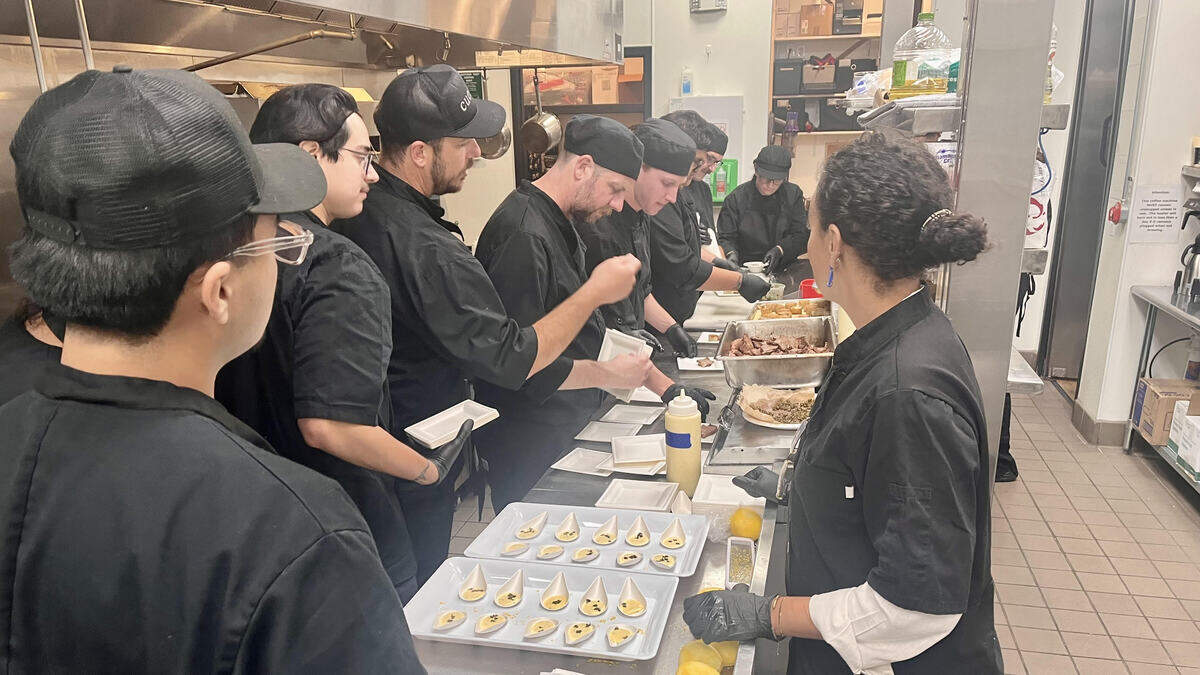
Following a complex past, the Cuesta College Culinary Arts program has been equipping students with the tools of the trade for nearly a decade. Offering classes at both the SLO and North County campuses, the program has gained considerable momentum that the faculty aims to carry forward.
As a sign of its growth, full-time enrollment has increased enough for the program’s first full-time employee. Niki Santisteven was awarded the position and will start as the department lead in fall 2026.
Santisteven, who has years of kitchen experience working with everyone from Ph.D’s to those formerly incarcerated, finds the kitchen to be a unifying space. This is reflected in the program’s seven instructors, who bring diverse real-world experience and work in varied capacities, and in the variety of students who take classes: from high schoolers and full-time students to working professionals and even Cuesta faculty.
Santisteven said she has “definitely noticed an increase in the number of students who really feel they’re putting themselves into the class and into the program.”
However, the path for Culinary Arts at Cuesta has not always been linear.
Culinary Arts program changes
While COVID was difficult for the entire education field, the Culinary Arts program was dealt an especially difficult hand. Online classes meant that students were cooking with limited resources at home and had to source ingredients on their own.
In the academic years from 2020 to 2022, as in-person classes resumed, student success in the program remained relatively low.
Kate Haisch, who was the department lead at the time, cited family caretaking, burnout from previous online learning, and decreased interest in the restaurant industry as the economy shifted, along with myriad other issues created by the pandemic.
Comparing the Culinary Arts program to the rest of Cuesta, Haisch found these issues to be across the board. “I definitely think Culinary was not unique in that area,” she said.
However, the program’s student success rate has steadily recovered from the pandemic and is approaching its pre-COVID level. Further, enrollment has steadily increased, reaching over 900 students in the 2023-25 school years, triple the number from 2020-21.
Part of this increase has been thanks to the program’s strong dual enrollment.
With five participating high schools in the area, culinary classes are aligned to meet Cuesta’s requirements. Students who pass the class and the final exam can earn college credits in the culinary field while staying on their high school campus.
“I think 18 is really young to ask people to decide what they want to do with their lives. But sometimes you get somebody at 14 who’s like, ‘No I’m doing this.’ And so it’s kind of cool, they can jump in and play around with stuff,” Santisteven said.
A diligent and driven high school student who supplements their courses with summer classes can earn a two-year degree before they even physically attend college.
The Cuesta program has also expanded its course offerings with a new Advanced Pastry class, as well as Food Production Baking and Food Production Savory.
Santisteven and another instructor also rehauled the Cuisines of the World class. Originally focused on “Blue Zones” — latitudes with the highest life longevity — the new class has taken a more global and cultural perspective, with South Spanish, North African, North American Indigenous, Immigrant Fusion and Southern Cajun Creole Soul cuisine added. “It was a lot of fun designing that, and it’s been a great course,” Santisteven said.
Further, the program started the Culinary Arts Society Club in fall 2025, offering students a group to meet with for extracurricular activities. The club is still in its infancy and looking to grow.
The program has had a direct impact on the local community, as some of Santisteven’s former students have gone on to work in the industry. For example, a previous baking student of hers got hired as a pastry assistant at Breda, a dessert bakery in downtown SLO. The program has also seen students go on to work at restaurants in SLO Ranch, which Santisteven said is “amazing.”
Santisteven finds that students in the program are more proactive about finding and accepting jobs in the local community, which she attributes to their feeling more confident in their skills and their ability to step into the industry.
“The community is looking for people to hire, and the students wouldn’t always jump on those chances, and I’m seeing more of them contact those employers and get the interviews and get the jobs, which is awesome,” she said.
What the Cuesta program offers
The program offers a handful of different certificates and degree options, including a Culinary Arts Foundation Certificate of Specialization, Culinary Arts Studies Certificate of Achievement, Baking Certificate of Specialization, and an Associate of Science in Culinary Arts.
The program awarded 45 degrees and certificates in 2025, which was consistent with 2024. With 38 of 45 awards being Certificates of Specialization in 2025, Santisteven has been focusing on getting students to “level up” to higher awards.
She often finds students are only a few classes away and urges them to take the final steps. “The nice thing about the AA is once you have it, it’s a savepoint; they can’t take it away from you,” she tells her students.
These awards are backed by a rigorous program that aims to train students to industry standards and prepare them for future employment.
“The goal is to get them industry-ready before they leave the program,” Santisteven said.
“The program, it’s not for the weak. Some chefs will go hard on you. … But they do it just so you advance ahead in the future,” said Samuel Arevalo, the president of the Culinary Arts Society and second-year student. “They care about their students.”
Arevalo is working toward his Associate of Science in Culinary Arts and has goals of opening a restaurant or bakery in Europe, perhaps Germany.
Santisteven said she wants her students to be “able to walk into any kind of kitchen and belong.” This mentality is reflected not just in the variety and rigor of courses, but also in the industry skills and hands-on experience the students acquire in the program.
Sophia Bradbeer, a first-year student who transferred from the nursing program and now wants to be a private chef, found the Food Production Baking class to be beneficial beyond just the cooking skills.
“It’s really great, even if you aren’t sure that baking or cooking is what you’re going to want to do for the rest of your life,” she said. “It’s a really good class to take. It teaches you a lot.”
This focus on holistic, applicable skills is reflected by the fact that the program often prepares food for campus events. For example, a baking class provided hundreds of cookies for a Student Life and Leadership Cougar Social Hour.
“So much of what you need professionally is from actually working in the industry,” Santisteven said, as she aims to simulate that experience in her classes.
Zelle Reyes, a first-year student aspiring to work in a cafe or bakery, said he enjoys the extra work beyond just cooking. The health, safety and sanitation plans “make it feel a little professional,” he said.
In this professional spirit, one of the program’s final projects was a “Jazz Night,” with students serving a full-course meal, from appetizers through dessert, hosted in downtown SLO with musical accompaniment by the Cuesta Jazz Studies Program.
Bradbeer also noted the team-building aspect, as different roles are rotated among the students, and they all learn to communicate and work together.
“I’ve always done stuff alone, and so being in something like this, it teaches you how to share different parts of cooking,” she said. “And you can use that in the outside world too with anything, any job in general.”
Cuesta provides cooking classes to CMC inmates
The Culinary Arts Program’s reach also extends off Cuesta’s campuses to the local California Men’s Colony through Rising Scholars. As part of a statewide program for incarcerated students to attend community college, Cuesta has been offering a full culinary program since 2017.
Offered three times a year at an accelerated pace, the program allows incarcerated students to earn 10 college credits in five courses. At the end of a 10-week time-intensive schedule, students will earn a Culinary Arts Foundation Certificate of Specialization along with directly applicable job training.
This experience is solidified by their final class, where students are pulling 12-hour days for 12 days to feed CMC’s fire camp. Operating out of a mobile kitchen unit, hundreds of workers are fed each day in the field.
Nearly 300 students have gone through the program, and Devin Kutil, the program coordinator overseeing the CMC Education Program, said, “It’s a very highly respected program.” Its reputation often precedes itself as its cooking is known to be high quality among the Cal Fire crews they serve.
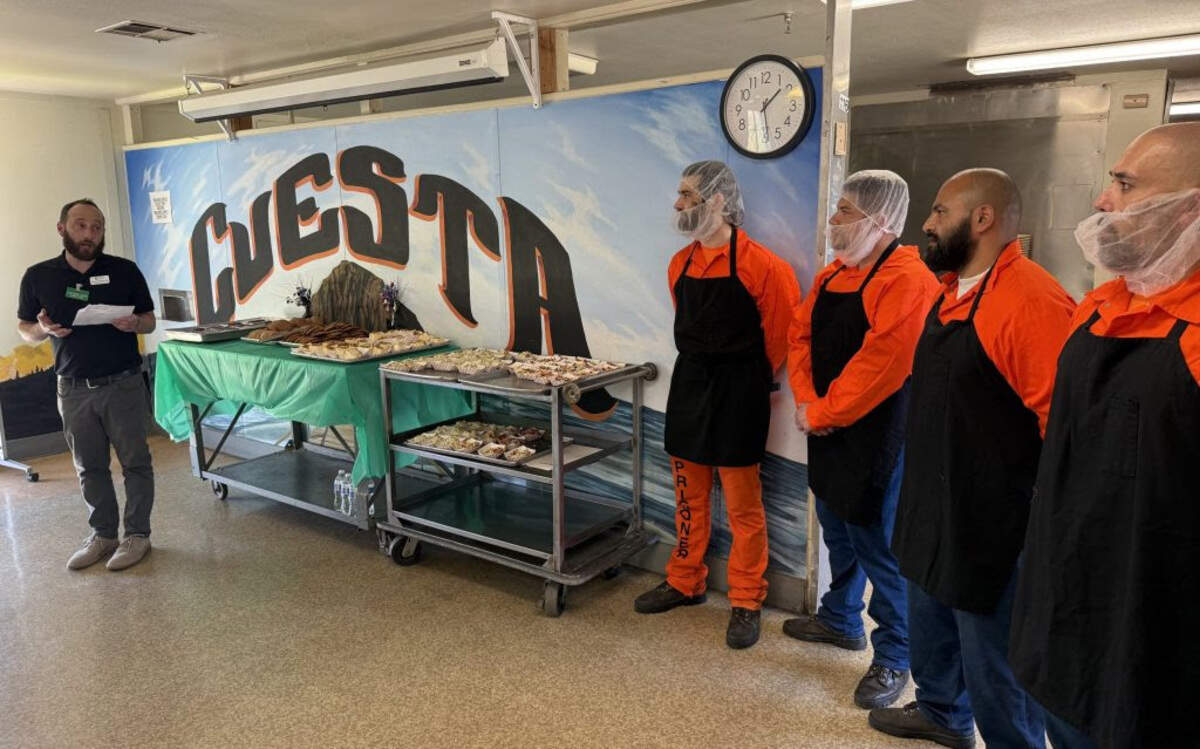
In a strict prison environment, Roseanne Feild, the Culinary Arts Program’s CMC lead, finds these classes to be beneficial for inmates.
“It’s an outlet, it’s an escape,” she said.
And while the classes still follow prison rules — all items are strictly inventoried, knives are chained to the tables and trash, sugar, and tinfoil are heavily monitored — Santisteven has found the students to be mild-mannered, of minimal issue, and the program to be a positive part of their lives.
Beyond teaching basic cooking skills, the program’s main focus is to give incarcerated students the skills to rehabilitate, parole and reduce recidivism.
“You’re taking in that negative and you’re turning it into a net positive,” Kutil said.
While creating that initial positive can be difficult, Kutil finds that such work ripples across communities and has an exponential positive effect. For example, the Culinary program had an incarcerated student parole who now works as a restaurant manager on the Central Coast.
The Rising Scholars culinary program’s 23rd cohort graduated in March 2026, with a class of four students. Despite the small cohort size, Feild said they “were some of the best students I’ve ever had.”
The future
While the Cuesta Culinary Arts Program has gained solid momentum after weathering the pandemic, Santisteven sees room for improvement.
She especially wants to continue growing their full-time enrollment and the program’s resources and availability across both campuses. While they have been able to use an industry-standard kitchen at the North County campus, the SLO campus classes need to be held at The Kitchen Terminal by the SLO Airport and the California Conservation Corps’ kitchen down the road from campus.
Further, she would like to see the same courses offered at both campuses. Given the significant distance between SLO and Paso Robles and the lack of frequent public transit, she would like to reduce the amount of travel required of her students.
Another major area she would like to see improved is their connections to local businesses. Many of the instructors have relationships to restaurants and bakeries in the area, but Santisteven would like these connections to be more formalized and established. This would also align with the program’s goal of preparing students for “working interviews,” where an applicant’s skills are assessed by putting them to work in a kitchen.
The Culinary Arts Society Club would also like to keep growing and building its activities. One of its main goals is to organize field trips to explore the cuisine in other areas, such as Las Vegas or San Francisco.
On the CMC side, the culinary program would like to reconnect with Restorative Partners, a local organization that provides incarcerated people with resources and support to rehabilitate and reintegrate into society. While there used to be a relationship, employee turnover on both ends has put the connection on hold.
Some of this is also driven by the prison’s declining Level 1 inmate population, resulting in smaller student cohorts. With fewer low-level inmates available to take classes, enrollment has been down, which has reduced the number of people paroled and in need of Restorative Partners’ work.
Overall, though, Santisteven is pleased with the program’s growth and the opportunities it offers students.
“The restaurant industry is always a place that’s hiring,” she said. “So it’s a great little thing to have in your back pocket.”
The Culinary Arts Program can be followed on Instagram @cuestaculinaryarts and the Culinary Arts Society Club can be followed @culinaryartssociety_cuesta. More information on the program can be found on the website.
This story was produced by The Cuestonian, Cuesta College’s student newspaper, and is published in partnership with the San Luis Obispo Tribune. The partnership is supported by the Center for Community News at the University of Vermont.