
Privacy stalls added to SLO County school’s locker room amid transgender debate
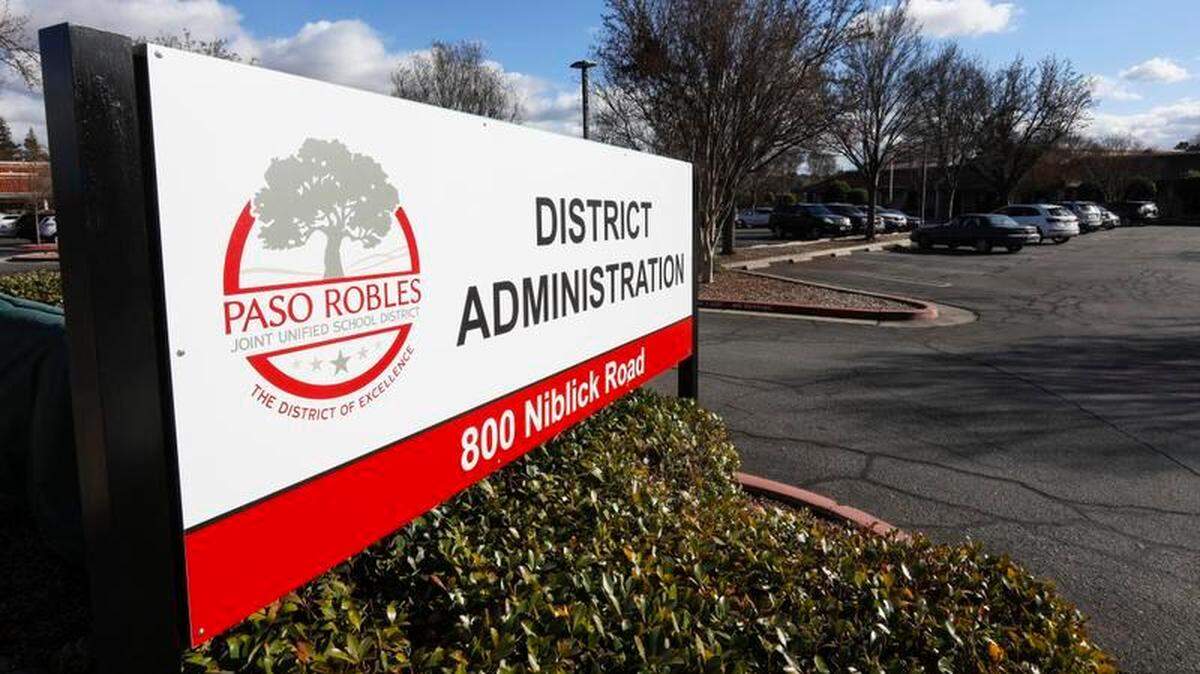
The Paso Robles school district will construct new, private changing spaces in one of its locker rooms as a hopeful solution to community division over the inclusion of transgender girls in girls facilities.
The announcement came during a school board meeting Tuesday night, when the district formally discussed California law regarding transgender athletes and bathroom and locker room use after repetitive requests for action by one trustee and some students and community members.
Board member Kenney Enney has focused on the transgender debate for months, saying in October that he would bring the topic up at all future board meetings after his fellow trustees struck down his suggestion that they pass a resolution opposing the inclusion of trans students on sports teams and in locker rooms that align with their gender identities.
At a meeting in January, after months of public comment and repeated requests from Enney, the board decided to bring the topic forward as an information item — meaning no action would be taken — to learn from district staff and legal counsel about what California and federal law say.
That conversation occurred Tuesday night, with Superintendent Jennifer Loftus presenting the law to the board and community members speaking out in support of trans students or raising concerns about student privacy in school facilities.
While the board did not take action on the issue Tuesday night, it was announced that the district is already in the early stages of constructing additional, private changing spaces in the girls locker room as a solution to the issue.
Staff said at the meeting that the first three or four changing stalls would be completed during spring break. The district had already removed some lockers to make room for the new changing spaces. Another three or four stalls were slated to be built during the summer.
The project was not voted on by the board because the cost of the initial phase did not meet the requirement for board approval, district spokesperson Melissa Godsey told The Tribune on Friday.
The money for the first phase will come from the district’s allotted maintenance budget, she said. An exact figure was not immediately available.
The second half of the project could be more costly, but estimates and funding plans were still being developed as of Friday, Godsey said.
What does the law tell schools?
Loftus presented both state and federal law to the board Tuesday night.
She explained that California law allows students to play on the sports teams that align with their gender identities — something she pulled directly from California Education Code, based on a law passed in 2013-14.
“In simple terms, in California, if a student identifies as a girl, she can play on a girls team, and if a student identifies as a boy, he can play on a boys team,” she said.
Loftus also explained CIF rules regarding transgender athletes. She said the organization, which governs high school sports, allows students to compete in sports aligned with their gender identities and has said it will continue to follow state law, despite federal disagreements.
Loftus said there have been some cases where the CIF has made adjustments to try to address concerns about fairness.
In 2025, a transgender track athlete shared medals with her cisgender competitors at the state track championship, after the CIF allowed more girls to qualify for and win events that included a trans athlete, EdSource reported.
Cisgender athletes who were beat by a trans athlete were awarded the medal they would have received had the trans athlete not been competing, EdSource wrote.
Still, the CIF allows trans athletes to compete in sports in line with California law, Loftus said.
In addition to sports, Loftus also explained the rules for bathroom and locker room use in public schools.
Loftus said that by July, schools must provide at least one gender-neutral restroom that is labeled, unlocked and stocked with menstrual products. That bathroom also must have a staff member who is charged with enforcing the rules and acts as a contact person for students or families with questions.
Schools must post a notice at the restroom explaining the policy and including the name and contact of the associated staff member, Loftus said.
Importantly, schools must allow students to choose which restroom they use — meaning districts cannot require transgender students to use gender-neutral facilities, Loftus said.
“The student gets to decide, based on what they feel most comfortable doing,” she added.
Loftus added that as of the 2024-25 school year, schools serving students in grades 3-12 must provide menstrual products in all girls and gender-neutral restrooms and in at least one boys bathroom.
Loftus also touched on the conflict between federal directives and California law.
“As of early 2026, California is at the center of an active and highly contested conflict with the federal government — specifically the U.S. Department of Education’s Office for Civil Rights (OCR) — over how Title IX applies to transgender athletes,” her slideshow read.
The federal agency has alleged that California is in violation of Title IX by allowing transgender athletes to participate in the sports aligned with their gender identities.
Loftus said the federal government demanded that California ban trans athletes from the sports aligned with their gender identities and adopt biology-based definitions of male and female, but California rejected that demand.
California officials have continued to rely on state law, arguing that the federal government’s interpretation of Title IX law is “politically motivated and legally disputed,” Loftus said.
She highlighted federal court decisions that have supported the inclusion of trans athletes, while other decisions at the federal level have signaled the opposite and the issue is actively being litigated in the Supreme Court.
“The law is mixed, evolving and currently unresolved at the national level,” Loftus said.
District to build new private stalls in girls locker room
Loftus touched on possible solutions to privacy concerns in Paso Robles.
Enney had previously suggested the purchase of locker room trailers that would provide external, private changing spaces for students who chose to use them — but Loftus said Tuesday that solution was concerning.
Bringing a trailer onto campus would require space that won’t impede on fire lanes or bus lanes, while also remaining close enough to the locker rooms that it wouldn’t be out of the way. A trailer was estimated to cost between $80,000 and $100,0000.
“We do find this particular option to be problematic,” she said.
However, district staff also looked into the removal of lockers in the existing girls locker room to potentially build new, private changing spaces for girls who would like to use them. Loftus said staff estimated they could add four new changing stalls by removing the unused lockers.
Loftus added that two shower poles could also be removed to make space for more changing areas to match what could be provided by a portable trailer.
Later in the meeting, it was shared that the school was already in the early stages of constructing the new changing spaces, with the first group slated to be completed during spring break, and the second group in the shower area to be completed during the summer.
Loftus said girls have already been using bathroom stalls, private areas behind shower curtains or more secluded parts of the locker room to change.
The new stalls will provide additional spaces for privacy to match the boys locker room, where additional stalls were already built.
Loftus added that the district does put staff in the locker room to monitor students.
As Loftus pointed out previously, the district cannot require transgender students to use the new private changing spaces.
Parents, students divided on Title IX policy
Several students and parents showed up at Tuesday’s meeting in support of transgender students, while others showed up to advocate for privacy for cisgender female students.
Speaker Liz Tashma said she is the parent of the only transgender athlete she knows at the high school.
“I don’t understand why the school board continues to bring this topic and talk about transgender athletes,” Tashma said. “How many transgender athletes are there in Paso Robles High School? I know one, and she’s graduating in June.”
As a counter to the argument that transgender students take opportunities from female athletes, Tashma said her daughter has “never been mistaken for the Hulk.”
“In reality she is 5’5 and 110 pounds,” she said. “The Paso Robles High School girls tennis team is the lowest league in the division. Somehow, even with her superior strength, my daughter only placed fifth in the league. What opportunity is she taking away from other girls?”
Tashma reinforced the fact that California law supports transgender athletes who participate on the teams that align with their gender identities, and said any policy that infringes upon that right would open the district up to legal and financial consequences.
“I’m asking this board to stop turning our schools into a political battleground,” Tashma said. “Please focus on the real work: supporting teachers, improving academics and keeping every student safe.”
Student Chloe Breese, who has also spoken at previous school board meetings, spoke Tuesday once again in support of change.
“The concerns I have raised previously about ... girls privacy and Title IX have not gone away, and neither have the voices of students and families who are asking to be heard,” Breese said.
Breese said the inclusion of transgender girls, who she referred to as “biological males,” in locker rooms makes other girls uncomfortable.
“Not because we hate anyone, but because privacy matters,” she said.
Another female student described the school board’s process as “painfully slow,” and said the district’s solution of providing private changing stalls wasn’t good enough because transgender students would still be allowed in the girls locker rooms.
Trevor Norcross, a Gala Pride and Diversity Center board member and the parent of a trans athlete who has been the target of similar debates in the Lucia Mar school district, suggested the board host a town hall where the community could get to know trans students and discuss the topic at hand.
Norcross said he had observed “a distrust of transgender students in spaces because of a lack of empathy and understanding.”
“What I hear is a desire to pre-judge and separate transgender students before there is any evidence of wrongdoing,” Norcross said. “If you really get to know these kids, you may learn they are not threats they are made out to be. They just want to live their truth.”
Board members support new stall construction
Most board members appeared to support the construction of the new stalls to provide additional privacy for students.
Several trustees also said they toured the locker rooms prior to the meeting to get a better understanding of the layout and options for students.
Enney said he was surprised to find during that tour that privacy stalls had already been built in the boys locker room years prior, and signaled that he hoped future Supreme Court or other decisions could change the legal landscape of the issue.
“It’s a good solution,” he said of the new construction. “I’m hoping it’s temporary.”
Trustee Sondra Williams questioned whether eight stalls would be enough to provide all students with access to a privacy, and reinforced the fact that the district can’t require trans students to use a certain changing area.
Board member Jim Cogan thanked the audience for the respectful conversation, and said he supported the construction of new privacy areas — but he took issue with some verbiage used by those who advocated for girls’ privacy.
“I would like us to remove the word safe from our vernacular,” he said, “because it presumes that students that are in a bathroom with a trans student are somehow unsafe, and that is not true, and it’s not fair.”
This story was originally published March 2, 2026 at 5:00 AM.
.JPG)