COVID spike hits Cal Poly with 2-hour testing lines, shortage of isolation space
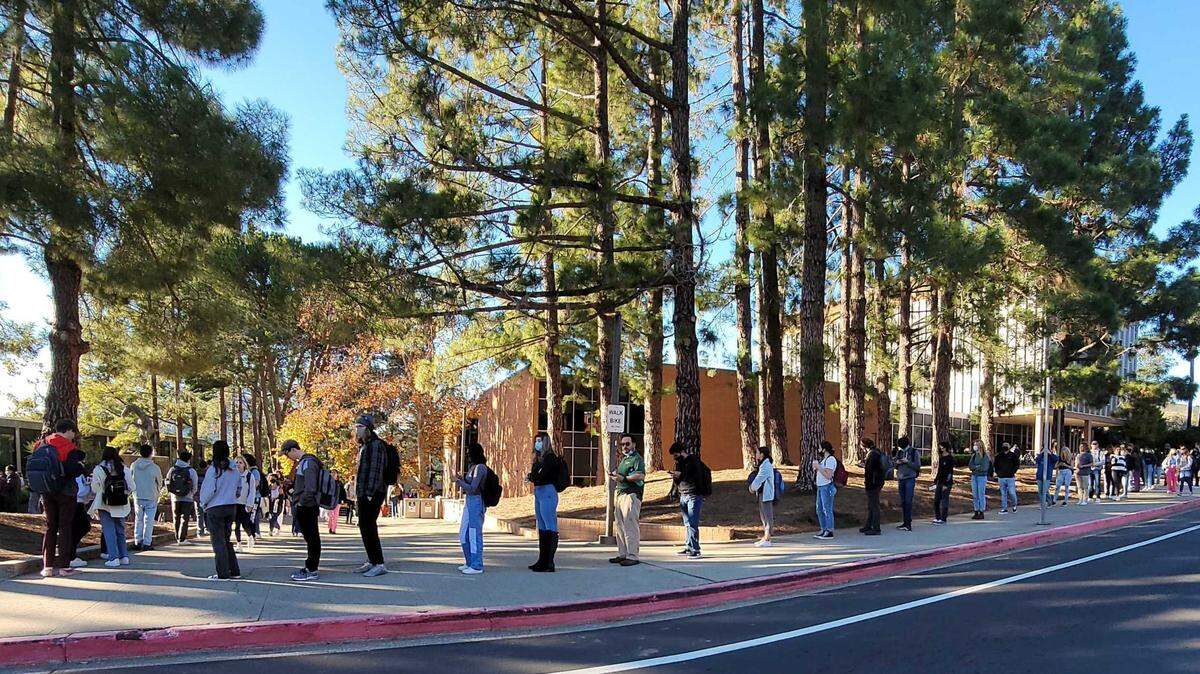
Many Cal Poly students have felt the fresh excitement of being back on campus with their friends quickly fade as COVID-19 cases skyrocket and overwhelmed isolation and testing measures create confusion and anxiety.
The university has reported about 680 positive COVID-19 tests since many students started moving back to campus on Sunday, the day before the winter quarter began. That’s according to preliminary data released by the university Thursday morning and makes it the biggest surge in the entirety of the pandemic.
The spike in positive test results has created long lines of students seeking tests and quickly filled the university’s isolation space, to the point it’s once again housing sick students in San Luis Obispo hotel rooms.
“It’s obviously pretty stressful, and I expected the campus to do a little bit more for students to feel safe,” said first-year graphic communication student Jackie Bostock. “I don’t feel safe right now.”
Students and university employees accessing campus are required to be fully vaccinated against COVID-19 — which includes receiving a booster shot by Jan. 20. Everyone on campus must wear face masks while indoors, according to university policy.
Some of Cal Poly’s classes are currently held in person, although hundreds of faculty have temporarily transitioned to a virtual teaching format due to the virus’ spread as the omicron variant causes widespread spikes in infections.
The situation at Cal Poly mimics the spike occurring across the county, with the San Luis Obispo County Public Health Department reporting more than 1,500 new cases in the five days covered by its latest update.
How Cal Poly is handling COVID testing
Students at Cal Poly are required to be tested for COVID-19 once during the first week of classes. However, they may still attend in-person classes before getting tested. Unvaccinated students must test for the virus every three days.
The university did not require a negative pre-campus-arrival COVID-19 test as it had in previous quarters. This is because many testing centers were likely closed during the New Year’s holiday and therefore a negative test taken within 72 hours of arrival on campus would not have been possible, university spokesperson Matt Lazier told The Tribune.
The massive influx of students needing COVID-19 tests during the first week of the winter quarter — and then some of those receiving positive tests — has created dismay and confusion on campus.
Students have told The Tribune they waited in line for more than two hours to receive a test. Others said they were exposed to the virus on Monday or Tuesday but could not make an appointment to get tested until the weekend — leaving them to wait several days wondering whether to self-quarantine or if they could possibly expose others.
Meanwhile, the university quickly ran out of on-campus isolation beds for those who received a positive test result and has recently begun renting off-campus hotels for sick students. Some COVID-positive students have been forced to isolate in their dorms or apartments with roommates who originally did not test positive for the virus, but then days later started exhibiting symptoms.
In total, the university has 194 isolation beds — 62 of which are on campus and 132 of which are off-campus hotel beds in the San Luis Obispo community.
“The number of on-campus isolation beds was lower at the start of this quarter than it has been in the past,” Lazier told The Tribune. “One reason for this is that our case rates were very low in the fall and the university had multiple requests from students in significant need of housing — and some isolation beds were converted back to standard housing, to accommodate those students’ needs.”
Students who move home to isolate, instead of relying on the university’s isolation measures, are being given a $400 Cal Poly University Store gift card, according to the university’s paper, Mustang News.
“It feels weird because they’re (Cal Poly) not really prepared,” said a second-year child development student who wanted to remain anonymous because they received a positive COVID-19 home rapid test result after feeling symptomatic, but then violated CDC isolation measures because they had to go to campus to get an official Cal Poly test to comply with the university’s requirement.
How Cal Poly compares to other California universities
Cal Poly’s approach to the beginning of the winter quarter is unique from other California State University and University of California campuses. It is the only university on the quarter system starting the new year off with in-person classes — others have chosen to hold virtual classes for the first one to three weeks of the term, or their terms start later in January.
On Thursday, the Los Angeles Times reported some campuses were pushing back in-person classes even further, to the end of the month or even into February.
According to Lazier, Cal Poly has comprehensive plans to deal with the ongoing surge of COVID-19 cases.
“With the omicron variant surging throughout the state, nation and world, we did anticipate an uptick in the number of cases within the campus community,” Lazier said. “We empathize with everyone who is being affected by this surge, whether it be dealing with a positive diagnosis or facing additional challenges to maintain their studies or do their jobs while looking after their health and safety.
“By testing all of our students, we are able to identify early those with infection and separate them from those uninfected, creating a safer environment for our students. This mass testing and early identification of those positive essentially compresses and pulls forward the infection curve, allowing the university to minimize its peak and the spread of infection.”
Recent spike is worst of the pandemic on campus
The influx of COVID-19 cases at Cal Poly is unprecedented.
During previous virus spikes on campus, the university at most reported 52 positive test results in one day. That was on Nov. 13, 2020, according to university data.
On Jan. 2, the university reported 81 new positive COVID-19 test results. On the third, 179 new positive results were reported, on Jan. 4, 239 were reported and on Jan. 5, 181 positive tests were reported, the university’s online COVID-19 case dashboard shows.
In total, 680 positive COVID-19 tests have been reported out of 9,075 tests performed on campus, according to the university’s data. As of Wednesday, the university had a test positivity rate of 7.66%.
Bostock, the Cal Poly freshman, said she and her on-campus roommate both got tested for COVID-19 at the university on Monday. The same day, the university contacted Bostock’s roommate to inform her that she had an inconclusive result.
After retesting, Bostock’s roommate received a positive COVID-19 test result at about 6 p.m. on Tuesday. Both students are fully vaccinated, Bostock said.
“I was freaking out because I didn’t have a positive test and I’d been in the room with her all day, so I was pretty much exposing myself,” Bostock said. “So then we just waited for the email from the isolation team because once you test positive you’re supposed to be moved because we share a bathroom with 10 other girls and there’s a lot of common spaces.
“But she wasn’t moved and we had to sleep in the same room ... so we both slept with our N-95 masks on.”
On Wednesday evening, about 24 hours after she received a positive COVID-19 test result, Bostock’s roommate was moved to an isolation room on campus.
By Thursday morning, Bostock said she was feeling “all the textbook symptoms of COVID”: a fever, sore throat, body aches and nausea.
“A lot of people are anti-online classes, and I am too — I hate my online classes,” Bostock said. “But I feel like sh-t right now. I’d rather be sitting in online lectures instead of putting ice cubes on my forehead so I don’t overheat.”
Beyond just feeling sick, however, Bostock said she’s worried about missing her classes that remain in person. She said she went to a San Luis Obispo County Public Health COVID-19 testing site on Wednesday to get a test, which she can then send to the university to satisfy the first-week testing requirement.
Should those results come back positive, she’ll have to begin 10-day isolation and miss the classes that faculty have not voluntarily transitioned online.
Cal Poly faculty critical of administration
The California Faculty Association Cal Poly San Luis Obispo chapter said in a recent news release that university President Jeffrey Armstrong “seemed disconnected from faculty, staff and student concerns about COVID exposure on campus (after) saying (in a recent campus-wide communication), ‘we have every expectation that the in-person educational experience at Cal Poly will remain one of the safest places and activities you can be a part of throughout next week and all of winter quarter.’ ”
Lazier said that Cal Poly has worked closely with “on- and off-campus health consultants who are on the front lines of the COVID-19 battle” to formulate its campus processes and procedures to handle the virus.
”We know from the past that most of our students would return to San Luis Obispo regardless of class modality. Our on- and off-campus experts agreed that moving to virtual would only delay implementation of our mitigation strategies,” Lazier wrote in an email to The Tribune.
“All indications from health officials are that the omicron variant is milder than previous variants, and with these mitigations that already have proven successful for us, (including vaccine and booster mandates, testing, isolation and quarantine, indoor mask mandate, daily symptom checker, and hygiene and sanitation), we remain confident in our ability to slow the spread of the virus and maintain a mostly in-person living and learning experience for our students,” he said.
This story was originally published January 7, 2022 at 8:00 AM.
CORRECTION: This article was corrected to clarify that the number of COVID-19 positive cases on Cal Poly’s reporting dashboard represent individual COVID-positive test results, not necessarily individual COVID-positive students.