Did you get a COVID exposure notification from school? Here’s what to do next
An email appears in your inbox — or a notification from ParentSquare pops up on your phone screen.
It says that your child was potentially exposed to COVID-19 while at school.
Now what?
“Take a deep breath, and then gather yourself and read that entire notification from beginning to end, and maybe a couple of times,” advised Grace Van Doren, San Luis Coastal Unified School District’s lead nurse. “I know it’s a scary thing because I have received a call regarding my children. And so it is something that induces panic or anxiety, but really, we do ourselves great service when we stay as calm as possible.”
Several San Luis Obispo County parents have told The Tribune that the notification process their school uses following a COVID-19 exposure is confusing and unclear. Some said they weren’t sure when or where their kid was exposed to the virus and added that the school’s quarantine process was not explained well.
As of Sept. 13, a total of 441 students in local public schools had reportedly tested positive for COVID-19, according to data gathered by The Tribune. That’s up from 289 reported the week before.
An additional 57 school employees have tested positive for the virus, according to Tribune data.
San Luis Obispo County schools have looked to local and state public health departments along with the U.S. Centers for Disease Control and Prevention and American Academy of Pediatrics for advice on how to handle the COVID-19 pandemic while still educating students.
“Everything we do is guided by the state and local health departments,” said Anna-Liza Pacaoan, district nurse for the Lucia Mar Unified School District.
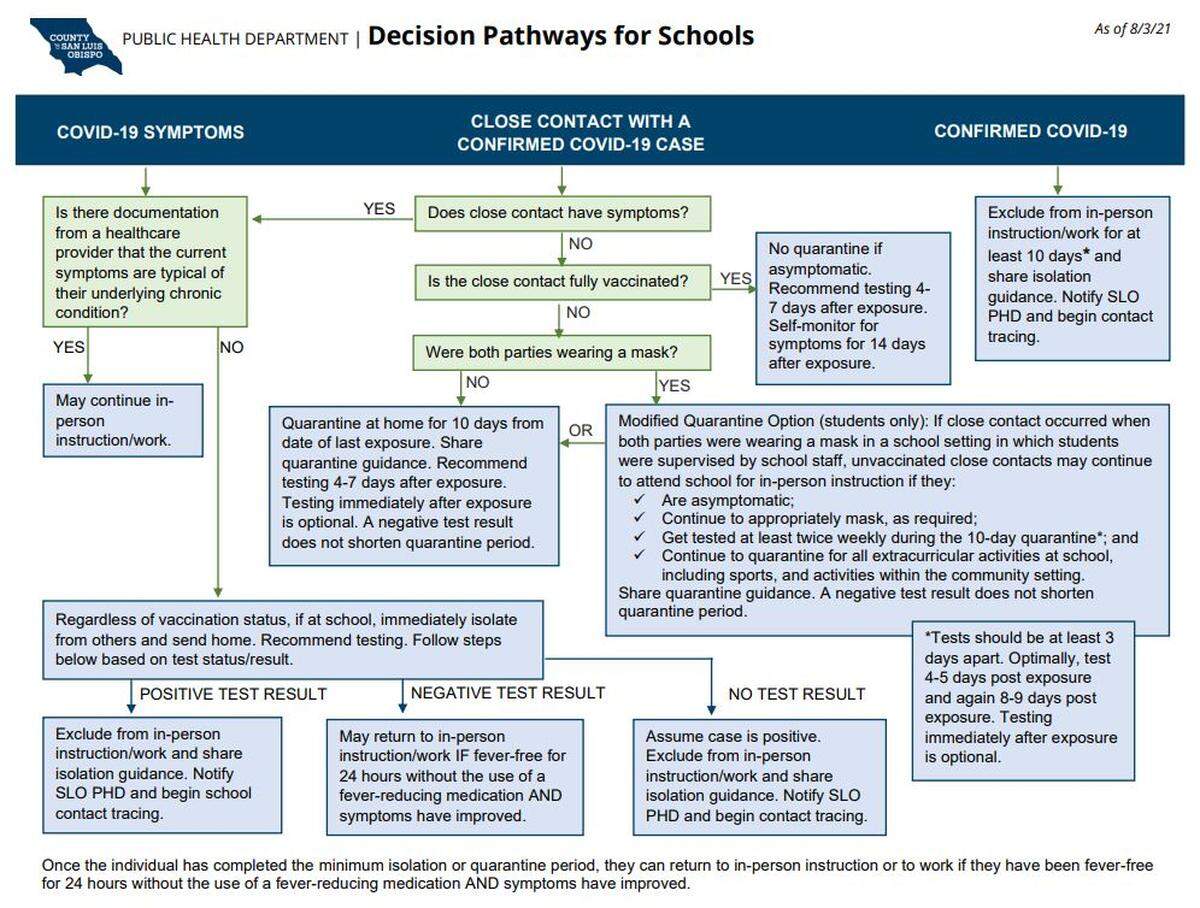
Responding to the COVID-19 pandemic in schools creates several “if this, then that” situations. And there’s no one-size-fits-all solution to when someone tests positive for the virus or a student comes to school with coronavirus symptoms.
The Tribune spoke to Pacaoan and Van Doren, as well as Dr. Laura Hutchison, a pediatrician at Patterson and Tedford Pediatrics in Atascadero, about how parents can and should respond when they get a COVID-19 exposure notification.
The medical experts also discussed what the different quarantine processes are like and when to keep a kid home from school if they’re exhibiting coronavirus-like symptoms.
I got a COVID-19 exposure notification. What does that really mean?
Once you’ve thoroughly read that COVID-19 exposure notification, you should have a clearer idea of what’s going on. And there are some key parts of that message you should pay attention to, Van Doren said.
Was your child “in the proximity of” a child who tested positive for the virus, or were they a “close contact?”
If that specific language isn’t in the notification you receive, look for phrases such as “a student in your student’s classroom has tested positive,” “there was a potential exposure in your students’ classroom” or “someone in your child’s class has or had COVID-19.”
Schools will send out exposure notifications to entire classes when a student tests positive.
For example, if John in second period mathematics tests positive, every kid in that math class and the other classes John attended during the time he was infectious will get a COVID-19 exposure notification.
The school will then work with the San Luis Obispo County Public Health Department to determine which students qualify as “close contacts” by looking at classroom seating charts, bus routes, lunch schedules and more.
A “close contact” is a child who was within six feet of the infectious student for 15 minutes or more over a 24-hour period. That could mean five minutes per day for three days, or one hour-long class period.
You may get an additional notice from public health officials or the school if your kid is determined to be a close contact with the infected student.
How does quarantine work? Can I send my child to school?
This is where things get a bit confusing.
“There are two types of notifications regarding close contacts that we send out to parents,” Pacaoan said.
Those involve regular and modified quarantine options, she explained, and only apply to unvaccinated students.
If one or both of the unvaccinated students were not wearing masks at the time of the potential exposure, then the student must participate in a regular quarantine.
A regular quarantine means that a student cannot go to school at all. During this time, their teachers may send homework packets home or the student can partake in a short independent study option to ensure they do not fall behind.
An unvaccinated student is eligible for modified quarantine — meaning that they can still attend classes in person but can’t participate in sports or extracurricular activities — if both students were wearing masks at the time of the potential exposure.
“The modified quarantine allows them to attend school but quarantine from all other activities,” Pacaoan explained.
What happens if my child is vaccinated against COVID-19?
Many students — particularly those under the age of 12 — are not or cannot be vaccinated against COVID-19 yet.
However, if your child is vaccinated against the novel coronavirus, they do not need to quarantine at all, according to the district nurses. This is following guidance from the San Luis Obispo County Public Health Department.
“When a student who is vaccinated has been exposed to a COVID-positive person and is not symptomatic, it would be business as usual,” Van Doren said. “They can go to school normally, do their extracurriculars.”
This is because the COVID-19 vaccine is effective at greatly reducing the transmission of the virus. Therefore, it’s unlikely your child contracted the virus if they are vaccinated.
“We push for vaccination because we don’t want people to get sick and have a terrible outcome,” Hutchison said. “But we also push for vaccination because we want the kids to stay in school and we want people to be able to continue to go to work.”
How long does quarantine for unvaccinated students last? Does my child need to get tested?
Both of the quarantines — modified or regular — last 10 days.
The school will then recommend a student get tested for COVID-19 to ensure they did not contract it.
“If they’re going to be in the regular quarantine, testing is recommended with the Delta variant between day four and seven,” Pacaoan said. “In modified quarantine, they will undergo testing twice during the quarantine period and that is offered at school as an option. And that’s with parent consent.”
If you are going to test your child for COVID-19, the school nurses suggest you bring them to a San Luis Obispo County testing site where polymerase chain reaction (PCR) testing — also known as nasal swab testing — is available.
Schools will not accept at-home or over-the-counter COVID-19 tests as proof of negative tests as those are less reliable than the PCR tests.
Testing is recommended because, if a student contracts COVID-19, then they may need to stay out of school longer to ensure they’re not infectious when they return.
If a student tests negative for coronavirus and they’ve completed the required 10 days of quarantine, then they can go back to school and extracurricular activities as usual, the school nurses said.
What happens if my child develops symptoms of COVID-19?
It used to be common for parents to tell kids to “tough it out” and go to school even if they were feeling a little under the weather.
The COVID-19 pandemic has changed that.
Schools encourage parents to make plans to keep their kids at home if they’re exhibiting symptoms such as headache, fever, nausea, persistent cough, runny nose, sore throat, fatigue, diarrhea, difficulty breathing, a new loss of taste or smell or muscle or body aches.
“In kids, since it is milder, sometimes COVID looks like a cold,” Hutchison said. “So we’re generally recommending that they get tested just so that you can rule it out.”
“The common symptoms that we’re actually seeing for COVID are congestion, sore throat, fever, fatigue, body aches and then sometimes a loss of taste or smell,” Hutchison continued. “And, of course, sometimes they don’t have all of those symptoms at the same time necessarily.
“Also, if adult family members are getting sick, there is a higher chance it’s eventually COVID, certainly if they’re unvaccinated. Whereas, you know, a lot of adults don’t catch every cold their kid gets.”
Schools have a lot to balance when a kid comes in with coronavirus-like symptoms.
“So we try to be really reasonable, and yet very cautious and careful,” Pacaoan said. “And so we determine the level of risk.”
School nurses will first look at whether a student has a certain underlying medical condition — such as asthma or allergies — that could be causing the symptoms.
“We also look at, what are the symptoms? Is it just a runny nose? Is it just a stomachache?” she added. “And that doesn’t go to say that that doesn’t become a COVID case down the line. But we definitely look at what our potential is to monitor the case and if they improve.”
The school may also ask the student or their parents if they’ve been around other sick people recently and if there was a potential they were exposed, Pacaoan said.
If they have concerns that the student is coronavirus-positive, the school will ask parents to pick them up and take them home. The school will also ask that the student get tested for COVID-19 and quarantine until they get PCR test results back.
Students can also get a doctor’s note certifying that they do not have COVID-19, Van Doren said.
If a parent cannot pick up a student from school due to work or other constraints, the school will reach out to an emergency contact and release the kid to that individual with proper identification. While the student is waiting to be picked up, they will wait in an isolation area at the school, the school nurses said.
“We recognize that they’re going to miss a couple of days of school, whereas in the pre-COVID era, the kid that did not have a fever that just had a runny nose and felt OK, would probably go to school,” Hutchison said. “Kids are going to miss a little bit more school. But two days and then back in school after getting that negative (PCR COVID test) result is probably not so bad in order to not infect your whole classroom.”
My kid tested positive for COVID-19. What now?
If a student tests positive for COVID-19, “They’re looking at a 10-day quarantine. They’re gonna stay home,” Hutchison said. “And there’s kind of no way around that one.”
Parents should notify a school as soon as possible after they receive a positive COVID-19 test result.
Working alongside school nurses, the county Public Health Department will then reach out to conduct contact tracing to identify individuals with whom that student was in close contact in and out of school.
Students in quarantine or isolation will be given class materials or can participate in a shortened version of each school district’s independent study programs.
After day 10 of quarantine, if a student does not have a fever or any symptoms of COVID-19, then they can return to school.
If the student continues to exhibit symptoms, they must stay home until at least 10 days after the symptoms began, at least 24 hours have passed since the fever has gone away without fever-reducing medications and after all other symptoms have improved.
If your child tests positive for COVID-19 and plays sports, they must get a physical test from a pediatrician to determine it’s safe for them to return to physical activity. This is because COVID-19 can cause side effects such as myocarditis, or, inflammation of the heart, that could turn deadly should they return to sports.
If you still have questions about what to do in your kid’s specific case, call your school and pediatrician for advice.
“We get it,” Hutchison said. “We try to have some grace with our families by understanding that this is not easy. We try to find a path forward to what our goal is: to keep kids safe, but also keep them in school.”
Have more questions?
Have more questions? Reach out to education reporter Mackenzie Shuman at mshuman@thetribunenews.com, and she will work to find answers. You can also reach out to your local pediatrician or school nurse.
This story was originally published September 14, 2021 at 9:00 AM.