Divest from fossil fuels, Cal Poly students tell university: ‘It’s wrong to wreck the planet’
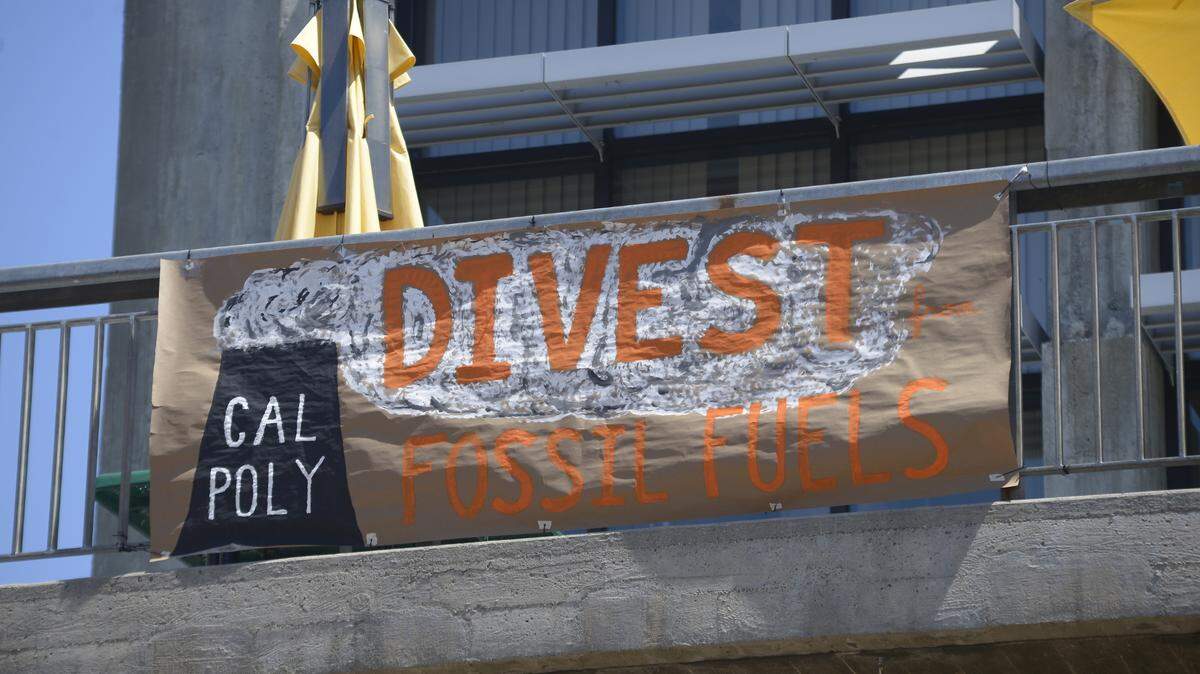
Cal Poly student Nick Trautman isn’t sure he wants to donate any money to his soon-to-be alma mater when he graduates.
Most alumni of colleges and universities receive annual letters and emails asking for donations to help the school boost its endowment — which, in turn, helps students there receive an education.
But Trautman and others at Cal Poly and other California State University campuses are concerned about how money they might donate is invested.
“When I graduate in the fall and somewhere down the line Cal Poly says, ‘Hey, you want to donate to us?’ (I’ll respond with) you divested yet?” Trautman said. “I think that’s going to be my first question. And I think if people are aware of the fact that Cal Poly has these oil, gas and coal investments, that may make them less inclined to donate to Cal Poly in the future, as I currently am.”
Trautman is part of a statewide campaign that is requesting most of the CSU campuses to divest their endowments and corporation investments from fossil fuel companies.
The reason: Students say they see fossil fuels as a primary driver of human-caused climate change, and they want their money to stop going to those companies.
“Given that we’re investing in fossil fuel companies that are actively contributing to climate change, to other forms of pollution .... we are making some money for Cal Poly students by investing in those companies but are also contributing to the demise of the world that we and other students are going to inhabit for the rest of our lives,” Trautman said.
CSU Chancellor Joseph Castro announced on May 18 that the largest public university system in the nation would “carefully analyze” the system’s investments in fossil fuels. Then, he said the CSU would make a “prudent, fiscally sound investment-based decision” on whether to stay committed to those investments while also upholding and pursuing sustainability goals.
The CSU’s Investment Advisory Committee is tasked with reviewing the system’s investments and policies and will report any findings back to the Board of Trustees at its November meeting.
The CSU holds about $4.5 billion in assets in its largest financial portfolios, with $155 million in shares of fossil fuel companies — which include more than $80 million in Chevron and ExxonMobil bonds.
Cal Poly, on the other hand, said it has no intention of changing its investment portfolio to meet the demands of the student campaign.
“At this time, we do not see merit in changing the current portfolio,” the university’s Media Relations Director Matt Lazier wrote in an email to The Tribune.
“Our Foundation Board and Investment Committee are made up of dedicated, committed professionals who take their responsibilities very seriously, who do not act in haste or without strong data, and who critically review our portfolio once every quarter,” Lazier wrote. “They are focused on assisting in raising money and meeting the wishes and agreements of our donors — and are fiduciary in the sense of preserving our donors’ gifts in order to support programs on into the future.”
The Cal Poly Corp. has about $1.24 million invested in fossil fuels — about 1% of its investment portfolio.
The Cal Poly Foundation has about $5.6 million, or 2.1% of the overall value of the endowment, invested in “the energy sector,” although that is in both renewable energy sources and fossil fuels. The university was unable to provide a more concise breakdown of the investments, according to Lazier.
Both the Cal Poly Academic Senate — the university’s faculty governing body that represents more than 1,300 faculty members — and Cal Poly Associated Students Inc. — which serves as the official voice of university students — passed resolutions in recent months urging Cal Poly and the larger CSU to divest from fossil fuels.
Additionally, the CSU system-wide faculty union, the California Faculty Association, and the Cal State Student Association passed similar resolutions.
Students argue it makes financial sense to divest
Lisa Swartz, a graduate of Cal Poly and one of the campaign leaders, said it is too risky to continue investing in fossil fuel companies.
“If you told me that, like, let’s take blueberries — no one would ever purchase as many blueberries ever again due to a global crisis associated with blueberries, that peak blueberry production was in 2019, I would not be investing in blueberries,” she said.
Same goes with fossil fuels, she said.
“Coal, oil and gas must all decline in the next 10 years,” she said. “There can be no increases if we are to have a chance of meeting our climate goals that prevent the worst destruction possible. So why still invest in those fossil fuel companies?”
An August 2020 study by researchers in the Netherlands found that divesting from fossil fuels does not hurt an investor’s portfolio performance.
The study found that fossil fuel stocks aren’t exposed to any unique risks but are more exposed to common risks faced by many firms. That means that investing in fossil fuels isn’t necessarily a better investment, just a riskier one, according to the study.
When the market crashed in 2020 due to the COVID-19 pandemic, the value of the S&P 500 recovered and then grew by the end of the year, according to the Yale Climate Connections.
However, Chevron, Shell, ExxonMobil and Peabody Energy’s stocks have not fully recovered from the crash. Data show that those fossil fuel companies’ stocks peaked in value between 2018 and 2019.
“Shares of ExxonMobil have lost 47% of their value in the past five years,” Karin Kirk of Yale Climate Connections wrote in a January article. “Over that same time span the S&P 500 has gained 84%. These crippling losses once seemed unthinkable for this titan of industry, but in 2020 alone, the company’s market value withered from $300 billion to $176 billion.”
Swartz noted that as renewable energy sources become more cost-effective and as federal, state and local governments turn their energy portfolios away from fossil fuels, the case for divesting becomes even more financially smart.
Additionally, Swartz said it should be in the university’s best intentions to divest in fossil fuels to protect students who benefit from strong endowments.
“That is a lot of risk for smart, conservative investors like Cal Poly to take on,” she said. “And since we are depending on a decrease in fossil fuels for our planet, for all of our futures, it just doesn’t make sense for us to be losing money. When these companies lose money, students and faculty who benefit from the funds in the endowment should be protected from these losses.”
UC system, other universities already divested from fossil fuels
Other universities around the nation have already divested from fossil fuels.
In May 2020, the University of California system formally announced that its investment portfolios were free of fossil fuels after it sold more than $1 billion in assets from its pension, endowment and working capital pools.
“Today’s announcements on our investment strategy underscore our hopeful view of the future,” said Richard Sherman, chair of the UC Board of Regents’ Investments Committee, in a press release about the divestment. “As long-term investors, we believe the university and its stakeholders are much better served by investing in promising opportunities in the alternative energy field rather than gambling on oil and gas.”
Chico State University was the first CSU campus to fully divest from fossil fuels. It committed to a four-year transition away from fossil fuel investments in 2014.
Institutions such as Rutgers University, American University, Brown University, Columbia University, Georgetown University, Middlebury College, the University of Southern California and the University of Cambridge have all announced that they would divest from fossil fuels.
That’s on top of about 1,300 institutions that have pledged to divest from fossil fuels, according to gofossilfree.org, a website that keeps a running tally of how many companies, churches, governments, healthcare institutions and others have divested.
For Swartz, Trautman and the others involved in the CSU divest campaign, they’re working on gathering student signatures, speaking with university investment teams and putting the pressure on university administrations to make the move away from investing in fossil fuels.
“There is growing consensus that money talks, and we are ready for our money to speak for us, to speak for our futures and to speak for the planet,” Swartz said. “So now we are really focusing our pressure on President (Jeffrey) Armstrong. As the public face of Cal Poly, he needs to know that it’s wrong to wreck the planet. It’s wrong for Cal Poly to try to profit from that.”
This story was originally published June 28, 2021 at 5:00 AM.