Paso Robles school board to discuss banning critical race theory from classrooms
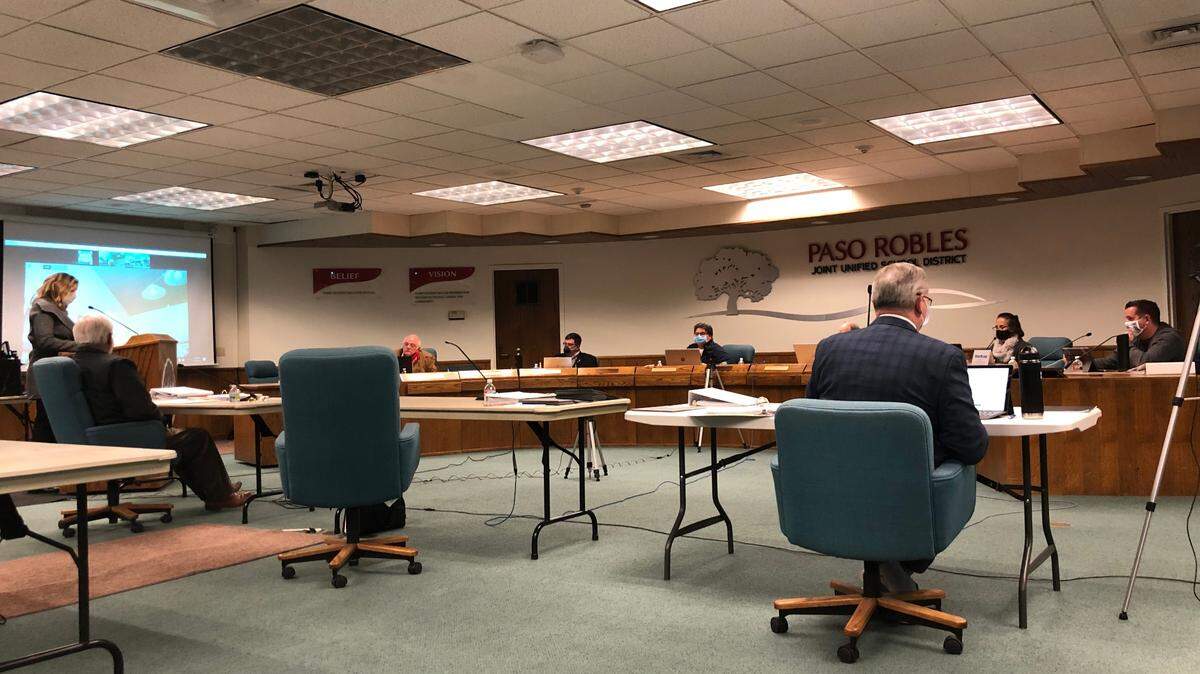
The Paso Robles Joint Unified School District board of trustees will discuss a draft resolution at its meeting Tuesday that would effectively ban the teaching of critical race theory in the district’s classrooms.
Board members will also discuss how critical race theory pertains to current board policy and administrative regulations that regulate and guide how teachers talk about controversial subjects with students.
The board will not take any action on the proposed resolution in Tuesday’s board meeting. Rather, the resolution will be discussed, and if a majority of the board would like to vote on approval of the resolution, it may be brought to the board’s next meeting on July 13.
Some states have already banned teaching critical race theory in classrooms through legislation, while others are proposing to do the same.
No such bill has been brought before the California Legislature, although the state Department of Education approved a new ethnic studies model curriculum for schools. A bill currently making its way through the California State Senate proposes to make that curriculum mandatory in public schools.
Paso Robles High School will have its first ethnic studies course in the fall. The curriculum was heavily debated by the Paso Robles school board in March but was ultimately approved.
In the statewide ethnics studies curriculum, teachers are encouraged to “familiarize themselves with current scholarly research around ethnic studies instruction, such as critically and culturally/community relevant and responsive pedagogies, critical race theory and intersectionality, which are key theoretical frameworks and pedagogies that can be used in ethnic studies research and instruction.”
Critical race theory was developed in the 1970s and ’80s when scholars took a deeper look into how racial inequities persisted even after landmark civil rights and anti-discrimination laws were passed.
In an interview with the Texas Tribune, Daniel HoSang, a professor of ethnicity, race and migration and American studies at Yale University, described critical race theory not as “content,” or a “set of beliefs,” but rather an approach that “encourage(s) us to move past the superficial explanations that are given about equality, and suffering, and to ask for new kinds of explanations.”
A main concept of critical race theory is that racism must be addressed by shifting structures and policies.
“So (critical race theory) actually says, ‘No, we shouldn’t be preoccupied with trying to discern “Who is the racist here,” because that moves the attention away from the structures,’ ” HoSang told the Texas Tribune.
Paso Robles school board policy, regulations to be discussed
In their recommendation to the school board, the school district’s administrators suggested that critical race theory “should be debated or discussed in a class solely as a controversial issue not presented in any way as fact.”
Their recommendation also suggests that the board focus on the school district’s Administrative Regulation 6144, which outlines the constraints in which controversial topics may be discussed in the classroom.
The administrative regulation outlines eight factors that restrict the teaching of controversial issues in the classroom:
District staff is most concerned about whether discussing critical race theory in the classroom would “reflect adversely upon persons because of their race, sex, color, creed, national origin, ancestry, handicap or occupation.”
The Paso Robles school board’s policy will also be discussed during Tuesday’s board meeting in terms of how it may limit teachers’ ability to discuss critical race theory in the classroom. The policy says that “it is necessary to encourage open inquiry and the free examination of ideas that will allow our society to grow and develop.”
The policy notes that “academic freedom is defined as the right and responsibility to study, investigate, present, interpret and discuss all the relevant facts and ideas within a field of study.”
Furthermore, the board’s policy says that students need to study controversial issues.
“Students need to study issues upon which there is disagreement and to recognize that differing viewpoints are valuable and normal,” the policy states.
According to the board policy, studying controversial issues helps students to recognize that reasonable compromise is often needed in the democratic decision-making process, develops their ability to use “rational methods” in researching significant issues and aids their ability to “study relevant problems.”
It also teaches students how to analyze and evaluate sources of information for propaganda, half-truths and bias, and instructs them on “the need to respect the opinions of others,” the board policy says.
Resolution would largely ban teaching of critical race theory
After discussing the board policy and administrative regulation on Tuesday, the Paso Robles school board may talk over a draft resolution to largely prohibit teaching critical race theory in classrooms.
The ending paragraph of the resolution notes that it would not impose a complete ban on teaching critical race theory. Instead, it would allow teachers to discuss the topic as long as they avoid certain elements of and “doctrines derived” from critical race theory.
Instruction around critical race theory in social science courses would need to play “only a subordinate role in the overall course” and must focus on the “flaws in critical race theory,” the resolution says.
One important thing to note is that critical race theory is not taught in Paso Robles school classrooms, nor has it been proposed to be taught.
“As a teacher of 23 years at the high school, I’ve never known my colleagues or myself to teach critical race theory or any element of critical race theory,” said Geoffrey Land, a social science teacher at Paso Robles High School who will be teaching the school’s new ethnic studies course starting in the fall. “It’s not on our radar. It’s not been a part of our instruction. It’s not a part of the ethnic studies class.”
Land said critical race theory is a high-level academic theory that is taught at colleges and universities but seldom tackled at schools instructing students in kindergarten through 12th grade.
Board member Nathan Williams, who spoke to The Tribune on his own behalf and not for the board as a whole, agreed with Land’s statement.
“Critical race theory is not a foundation of any of our classes in our curriculum, nor is it a part of any foundation of any proposed curriculum,” he said.
Additionally, the proposed resolution in front of the board may cross the line of what board members can do.
“I don’t even like getting into what critical race theory is because there are such different interpretations of it,” Williams said. “It’s a topic of discussion that should be allowed to be had as long as it’s done so in an appropriate and respectful way.”
Williams noted that the policies and regulations already in place at the board and school district provide clear guidance and safeguards on how teachers can go about discussing controversial subjects in the classroom. The proposed resolution may overstep the board’s roles, he said.
“We’re supposed to hover. We’re not supposed to be down on the ground ... dictating what happens with every little thing,” he said. “That’s why we have an administration. That’s why we have a superintendent. That’s why we have all these teachers that have college degrees. It’s not our job to be there, dictating how it’s supposed to go. And I think it’s really important that we try to stick to that.”
How to attend Paso Robles district board meeting
Tuesday’s Paso Robles school board meeting will be held virtually and in-person. Closed session begins at 5 p.m. and open session is expected to start at 6 p.m.
To attend the meeting virtually, visit the district’s YouTube page at bit.ly/PRJUSDmeeting.
The meeting will be held in-person at the district administration office at 800 Niblick Road in Paso Robles. According to the school board’s agenda website and state guidance, people who are vaccinated against COVID-19 are not required to wear face coverings and those who are not vaccinated must wear masks while attending the meeting.
If you would like to provide public comment during the meeting, you may use the Zoom link for the meeting, which can be found at pasoschools-org.zoom.us/j/85393319050 or call in at 805-608-4230.
Spanish interpretation is available via the Zoom meeting link.
The discussion regarding critical race theory is near the very end of the agenda and is expected to start around 9 p.m., according to the school board’s agenda website.
This story was originally published June 22, 2021 at 3:17 PM.