‘The hardest thing we’ve ever done.’ SLO County parents fear learning at home will leave kids behind
Every day, Vianna Mongeur wakes up at 5 a.m. to go to work in Paso Robles — in the afternoon, she starts her second job as a homeschool teacher to her two daughters.
“My mind is done by the end of work,” she said. “I don’t have the energy to be a teacher for another eight hours.”
Mongeur and thousands of other San Luis Obispo County parents are nearly two months into unexpectedly becoming their children’s educators after the coronavirus pandemic closed all K-12 campuses.
The situation is easier for some parents, who can work from home while their children video chat with teachers and classmates on their Chromebooks.
But distance learning is an almost insurmountable challenge for parents who must leave home to work, who are already juggling their own studies with work and who have children with learning disabilities and other special needs. Schools provide their children with resources that are simply impossible to replicate in a home environment.
These parents all feel their best isn’t enough — that their children won’t be able to keep up with their work and will start the next school year unprepared.
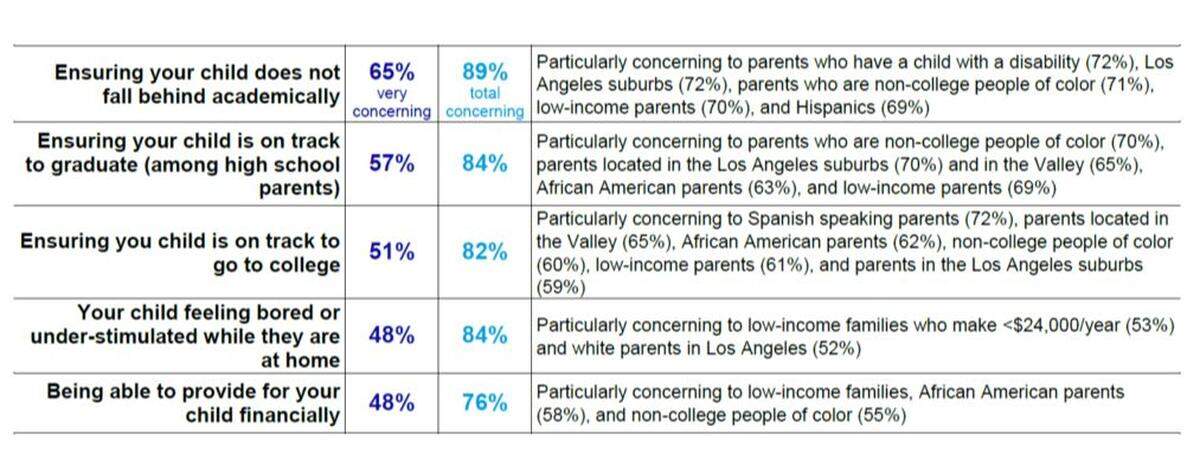
Most California parents surveyed in a poll conducted in late March and early April by Education Trust-West — which advocates for and conducts research into education equity issues — expressed concern about their children falling behind academically due to the coronavirus school closures.
Eighty-nine percent of parents surveyed said ensuring their children don’t fall behind academically is concerning. That includes 70% of low-income parents and 72% of students who have a child with a disability.
With about a month of school left, these concerns are still very much at the top of local parents’ minds.
“I don’t think anyone’s having a super easy time with the distance learning,” Mongeur said. “I think it’s a lot.”
Parents working from home find a routine
After schools closed, Curtis Nemetz and his wife began working from their San Luis Obispo home and educating their kids at the same time.
Initially, things didn’t go very well, to say the least.
“People are losing their jobs. People are worried about getting sick,” Nemetz said. “All of a sudden, we have to become homeschool teachers, which we know nothing about.”
The Nemetzes, who work in real estate coaching and marketing, felt like they weren’t doing a good job with work or teaching their four kids, who attend Sinsheimer Elementary and Laguna Middle schools.
Their second-grader would interrupt one parent’s work, and they suspected one of their sons spent the first week of distance learning watching YouTube videos instead of focusing on school.
Eventually, they decided one parent would work in the morning, while the other supervises the children. Then, they switch later in the day.
They also helped their kids find spaces throughout the house where they work best, Nemetz said: “They’ve all found their little zones.”
Although it’s tough to keep track of all their children’s work, finding a routine has been enormously helpful, he said. In spite of the struggles, the family feels fortunate to be in their current position.
“We’re kind of getting into the groove, the routine of it,” Nemetz said.
Working single parents balance jobs with distance learning
Mongeur, the Paso Robles mom, is a single parent to a first-grader at Kermit King Elementary School and a seventh-grader at Daniel Lewis Middle School.
When Mongeur goes to work as a county employment resource specialist, her daughters help each other out at home.
Her seventh-grader is mostly self-directed, but her younger daughter has a tough time doing schoolwork on her own. Sometimes, the first-grader is supposed to watch videos or do things online while Mongeur is at work.
Her older sister has to set things up, and Mongeur feels bad giving her older daughter that responsibility. Teachers have helped by checking in when the first-grader hasn’t logged into class activities, but it’s a tough situation for Mongeur to manage.
She’s stressed, and her daughter sometimes says she wants to go back to kindergarten so she doesn’t have to complete the homework packets.
“If she doesn’t want to do it, I can’t really argue with her,” Mongeur said.
She checks in with her daughters frequently during the day and comes home during her lunch break. She shifted her schedule earlier so she could come home earlier to be with the girls, who used to go to the Boys and Girls Club of North San Luis Obispo County after school.
After work, Mongeur tries to give them fun activities to do, like making bath bombs, to keep them occupied.
“When I come home, I still have everything else I have to do in a regular day,” she said. “On top of that, I have to be a homeschool teacher.”
Working parent-students suddenly become teachers
Kiah Goranson never imagined she’d suddenly become her daughter’s teacher while she was still a student, herself.
Every evening, Goranson — who’s taking pre-nursing classes at Cuesta College — comes home from work in Atascadero and hits the books while also helping her fifth-grader tackle distance learning.
“It’s just trying to juggle a heck of a lot more than we thought we would,” she said.
Goranson — who works in the human resources department of a water meter reading company — called suddenly taking on her daughter’s education “truly the hardest thing we have ever done.”
Her daughter’s father can sometimes work from home and help the 11-year-old with her schoolwork. But sometimes, “she’s essentially almost teaching herself,” Goranson said.
Although Goranson is trying her best, that doesn’t make her feel good as a parent.
“I don’t think she’s getting as good of an education as before,” she said of her daughter. “Her dad and I are not teachers.”
Parents struggle to help children with learning disabilities
This school year, Heather Lynch finally felt like her teenage son had a plan to help him cope with his learning disabilities — then the coronavirus outbreak closed Paso Robles schools.
“It’s really tragic that all of this is happening at this point,” Lynch said.
Every day, Lynch goes to work as an X-ray technician at an orthopedic surgeon’s office. In the evening, she comes home and helps her son, a sophomore at Paso Robles High School, with his schoolwork for at least three hours.
Without the normal help he gets at school during the day, it’s hard to get her son to complete his assignments. Lynch tries to get him to go to work with his dad, who has a job in construction, to keep him occupied.
She sent her daughter, a sixth-grader at Daniel Lewis Middle School, to stay with her grandmother in Arizona.
Lynch misses her terribly, but she didn’t think she could effectively help both her children at the same time. She suspects her daughter was also having learning problems, but the schools closed before she could be properly assessed.
“She’s going to be upside-down without any of the assessments going into seventh grade,” Lynch said.
Lynch is frustrated by the situation and thinks her daughter’s teachers have been overly harsh when she’s fallen behind on distance learning work.
“I think our kids are definitely falling behind and falling by the wayside,” she said.
Lynch feels like there are a lot of unanswered questions about what lies ahead for her kids’ education.
“I just want to see a light at the end of the tunnel,” she said. “I just want to see a solid game plan.”
This story was originally published May 10, 2020 at 5:00 AM.