How do you learn remotely with no internet? SLO County families struggle to connect
How is distance learning going for you or your child? What questions do you have? Let us know by filling out this form.
For Nishca Cross, every day she can’t get internet at home is another day her sixth-grade son loses ground in his education.
The San Miguel mother has been struggling to get connected amid the coronavirus shelter-at-home order, but appointments are so backed up, her provider won’t make it out for another two weeks.
“He already struggles with certain classes,” Cross said of her son. “For him to fall further behind — it’s scary.”
Cross’s story is not an uncommon one for rural and low-income families who are trying to learn remotely without the internet access needed to complete assignments, stream classes and email teachers.
While many San Luis Obispo County students have been attending classes online for more than a month, others are lacking critical connectivity that isn’t readily available in certain areas and that some parents can’t afford.
Tony Thurmond, the state’s superintendent of public instruction, estimated that nearly 200,000 students across the state do not have access to the internet based on an ongoing survey conducted by the California Department of Education.
A new task force, which had its first meeting on Monday, will try to close persistent gaps in internet access that could undermine the education of California’s most isolated students. The state Department of Education said the group of lawmakers, industry and education leaders will focus on getting internet access and devices in the hands of students who need it.
“We see this as an opportunity to go even further, to say that once and for all we will close this digital divide that has separated our students between those who have and those that do not,” Thurmond said. “We have to let (the) internet flow like electricity and make sure students throughout our state have access.”
A Sacramento Bee analysis of Federal Communications Commissions and U.S. Census Bureau data shows nearly 500 census tracts throughout California with fewer than 600 internet connections for every 1,000 households, including areas in San Luis Obispo County.
The analysis included only places with populations greater than 1,000 people, so some smaller areas with connectivity issues may not appear on the map.
SLO County internet haves and have-nots
A data analysis from Education Trust-West — which advocates for and conducts research into education equity issues — indicates students in the poorest and most remote districts likely struggled with internet access more than their peers in wealthier and more populous areas even before the coronavirus outbreak.
San Luis Coastal Unified School District serves more than 7,600 students, about 36% of whom are socioeconomically disadvantaged and about 11% of whom are English language-learners, according to California Department of Education data.
Education Trust-West data indicates about 9% of San Luis Coastal students of color lacked access to internet, as did 15% of low-income students.
In comparison, Shandon Joint Unified School District educates nearly 300 students in the northeast region of the county, 83% of whom are socioeconomically disadvantaged and 42% of whom are English language-learners.
About 25% of Shandon students of color lacked access to internet, as did 36% of low-income students, according to Education Trust-West data.
Dr. James Brescia, county superintendent of schools, said his office has been working with districts to fill gaps related to device distribution and internet access. He said students’ socioeconomic status and location play a big role in whether they’re able to connect to the internet.
In addition to Shandon, students also struggle to connect on the Carrizo Plain, in Creston, at Lake Nacimiento and in San Simeon, Brescia said.
That’s something teachers and administrators can control when students are receiving instruction in classrooms. But when students are learning at home, inequities have a concerning impact, Brescia said.
“I think what you’re going to see is the disparities in access are going to be glaring,” he said.
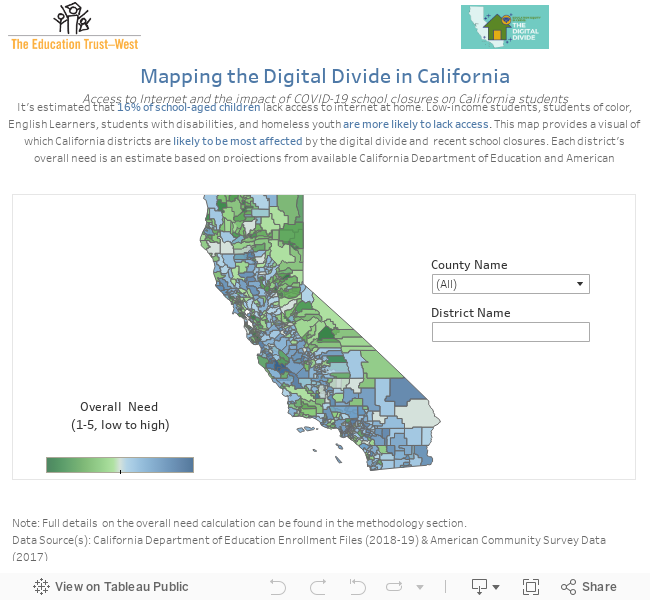
Districts in more populous areas with fewer low-income families have greater resources to devote to ensuring students have internet at home, now that distance learning is the only way students can attend school.
But smaller districts in more remote areas have had to rely on internet companies to provide hook-ups for students who couldn’t previously get online at home and relied on school site internet access to complete assignments.
San Luis Coastal has given out internet hotspots to families to use for distance learning during the coronavirus closures.
Officials estimate about 600 families are currently using hotspots to connect to the internet, and the district has another 80 to 100 devices in reserve, said Eric Prater, superintendent.
“We have conducted parent surveys over the past several years trying to determine who has access to the internet in their homes,” Prater told The Tribune in an email.
“We don’t have the exact numbers; however, we recognized that some families use their personal cell phones for internet access. We committed to technology, access to all, and to build district capacity for distance learning several years ago through board strategic initiatives. This is why we have been able to get our students connected without too much disruption.”
Half of Shandon students didn’t have internet before coronavirus
In Shandon, administrators estimate about half of all students didn’t have internet at home before the coronavirus outbreak, said Superintendent Kristina Benson.
The community’s remoteness and the cost of internet service are the two main factors that have prevented students from getting online in the past, Benson said.
“They’re working on taking care of their families,” she said of some parents in her district. “Internet is not something they can make a priority.”
Before campuses closed, students would take advantage of library hours before and after classes to complete homework, Benson said. Schools also held special nights when parents and their children could come fill out college financial aid application forms.
“I think a lot of the families have relied on the access provided by the schools,” Benson said.
After the coronavirus outbreak shut down Shandon campuses, administrators began working immediately to find a way to get students online.
Ranch WiFi — a Central Coast internet company that primarily serves customers in rural areas — is providing families with free wired internet, which means computers must remain plugged into an ethernet cable.
But only one computer can be connected to the cable at a time, so if a family has multiple students, they have to take turns getting online. Families can also get free wireless internet, but they have to pay for a $25 router.
Some students are also going to their friends’ houses to get internet access, Benson said.
Following district efforts to get Shandon students online, Benson estimates only about 10% of district families still aren’t connected to the internet.
Families without access find distance learning ‘difficult and scary’
A handful of families in San Miguel Joint Union School District — a K-8 district that serves 615 students on the northernmost border of the county — are also struggling to get online.
About 80% of San Miguel students are socioeconomically disadvantaged, and 37% are English language-learners. The district didn’t start distance learning until April 13, implementing online classes for third-graders and up, while distributing paper homework packets for students in kindergarten through second grade.
Some parents who stopped by Lillian Larsen Elementary School on April 15 to pick up free sack lunches for their children told The Tribune they still don’t have internet access in their homes.
Cross, the mother of the sixth-grade son, said she’s been struggling to get internet through Ranch WiFi. The company initially told her she’d have to pay a $99 installation fee, although school staff assured her that’s been waived for district families.
“It’s difficult and it’s scary,” she said.
Ranch WiFi is also backed up with installation appointments, so Cross is currently waiting until May 2 to get connected. She plans to borrow a router to get wireless internet.
Dulce Cruz, a mother to four children, said she cannot afford to pay for internet because she lost her job when the shelter-at-home order went into place. Cruz told The Tribune in Spanish that she has two kids in high school, one in middle school and a younger child. This is their first week of distance learning.
She said the school told her about free internet resources, and she is planning to call and look into it.
Raul Leon is also grappling with getting internet access for his kids. He has three children who attend Lillian Larsen — a 6-year-old in transitional kindergarten, an 8-year-old in second grade and an 11-year-old in fourth grade.
“It’s not the same as learning with the teacher right there,” Leon said in Spanish. “It’s not so easy.”
Leon said while he would like to provide internet for his family, he lives in rural San Miguel and their home is outside of most internet providers’ service range.
While picking up lunches, Leon was informed about Ranch WiFi, and he said he would give them a call. In the meantime, he’s been trying to make sure his kids aren’t falling behind by helping them with homework.
“It’s super important for my kids to learn how to use the internet,” Leon said. “It really affects us not having internet. They can’t communicate with the teachers easily with this situation.”
How to get connected
Spectrum — which provides internet in more populated areas of San Luis Obispo County — is offering 60 days of free internet access for K-12 and college students who don’t currently have service.
For more information, visit spectrum.net/support/internet/covid-19-internet-offer-students or call 855-243-8892.
Spectrum also offers reduced-price internet for low income families who qualify for free or reduced-price lunches. For more information, visit spectrum.com/browse/content/spectrum-internet-assist.
The provider has also opened up public hotspots throughout the county for public use. To find one near you, visit spectrum.com/wifi-hotspots.
Ranch WiFi provides internet for many rural areas of the county and is offering free connection options for students who attend certain school districts.
For more information, call 805-995-4181.