Should SLO County DA be allowed to try Tianna Arata case? Here’s what appeals court justices said
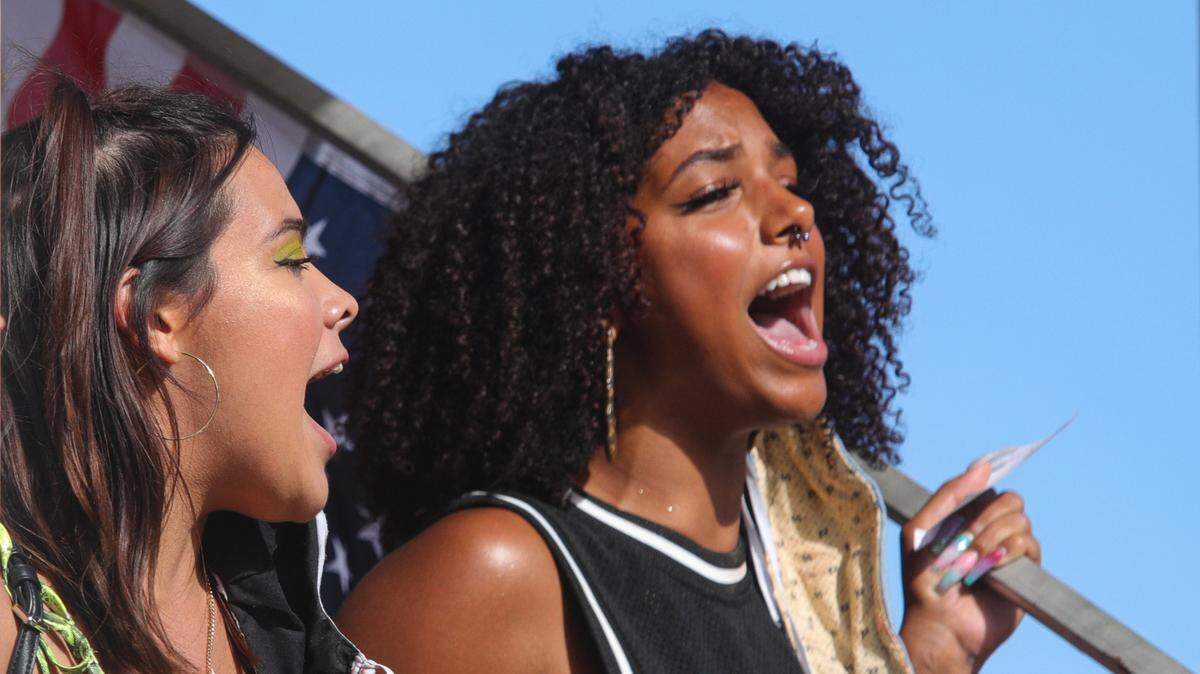
Oral arguments were heard in the California Court of Appeal on Thursday regarding whether the San Luis Obispo County District Attorney’s Office should be allowed to prosecute Tianna Arata and six other Black Lives Matter activists.
Arata, Robert Lastra, Samuel Grocott, Jerad Hill, Marcus Montgomery, Amman Asfaw and Joshua Powell were all charged with multiple crimes following a July 21, 2020, rally during which protesters marched onto Highway 101 and clashed with motorists.
Arata faces 13 misdemeanors related to the protest — including counts of false imprisonment, obstructing a public thoroughfare and resisting arrest.
Shortly after the District Attorney’s Office filed charges against Arata, the wife of District Attorney Dan Dow sent a fundraising email to his supporters paid for by his re-election campaign
In the email, Wendy Dow wrote that her husband was “leading the fight” against the “wacky defund the police” and social justice movement.
San Luis Obispo Superior Court Judge Matthew Guerrero cited the email sent as a key reason to disqualify the office from prosecuting the case, writing in his December 2020 ruling that it showed a “clear conflict of interest.”
The District Attorney’s Office and the state Attorney General’s Office appealed the decision in January 2021, claiming the ruling was an abuse of discretion. They argued that it would “incentivize defendants to abuse” the law that disqualifies district attorneys from trying certain cases due to their political views, according to court documents obtained by The Tribune.
The appeals case consolidated all seven protest cases into one hearing.
In their reply, lawyers for the protesters asked the Court of Appeal to uphold Guerrero’s decision.
The defense attorneys cited the fundraising email and a post by Dow in the PRotect Paso Facebook group where he explained why he charged the protesters with misdemeanors and not felonies.
The attorneys also claimed Dow’s office participated in unfair treatment regarding charging decisions during the protest, noting that the office did not charge a driver who hit two protesters during the July march.
AG: Disqualifying SLO County DA would be ‘extraordinary step’
The District Attorney’s and Attorney General’s Offices’ main argument hinged on whether the perception of fairness outweighed the reality of fairness.
Deputy Attorney General Christopher Lee began his argument by calling the move of disqualifying the office “an extraordinary step.”
“It’s an extraordinary step in an extraordinary situation,” Court of Appeal Presiding Justice Arthur Gilbert responded.
“When someone is running for office on the basis of going after somebody for doing something wrong, in all probability being elected on that, and then actually doing it — it just seems ... to taint the whole judicial system,” Gilbert told Lee. “This taints the whole process, and it hurts you as a prosecutor, your office, everyone.”
The justice added that, while he hasn’t decided on the case, he will need “some real convincing” to turn around his opinion.
Lee said the disqualification was “based entirely on speculation” and not about whether or not Dow appears fair, but rather about whether he is fair.
He said that Dow made the PRotect Paso Facebook post in response to criticism that he filed misdemeanor charges instead of felonies against Arata.
Dow explained in the post that he can only ethically charge what prosecutors can prove beyond a reasonable doubt, Lee said.
Lee noted that Dow responded similarly to those who criticized him for filing charges at all and accused him of racism. He quoted a statement by Dow saying, “I will never compromise the integrity of this office by using race or public opinion to decide whether or not to file a criminal charge.”
“Do I look at it through the district attorney’s eyes or do I look sort of the eyes of the public who has to have faith in its prosecuting agency?” Gilbert responded. “What I’m hearing you say is, ‘No, you listen to what the D.A. said, he told you what his motives were. That’s enough.’ Is that really what we’re talking about?”
Lee responded yes, and noted again that the case is based off the speculation of bias.
“No reasonable judge could possibly come up with this decision (in the DA’s favor). And I’m at a loss to know how to write that,” Gilbert said.
Gilbert then asked Lee to lay out what he would think would be in an opinion that would be in the DA’s favor.
Lee said the email sent by Dow’s wife was “a generic campaign email” and that it said “in a nutshell” that Dow was fighting hard for public safety.
He said there is not a specific mention of the Black Lives Matter movement, but rather passing references to “crazy protest activity” and the “wacky defund the police movement.”
Lee said there is a logical gap between the facts of what the email said and Guerrero’s ruling that it posed a conflict of interest.
He also noted that Dow’s tweet in support of a speech Candace Owens made where she talked about the Black Lives Matter movement among other topics did not directly indicate his thoughts or feelings about the movement.
While Dow appeared on Tony Perkins’ Christian radio program in August 2020, Dow only discussed COVID-19 policies and restrictions on the program, Lee argued. He said that while Perkins may have written an op-ed criticizing the Black Lives Matter movement, the movement was not discussed with Dow on the program.
Lee added that while the members and posts in the PRotect Paso group criticized the Black Lives Matter movement and the protests, Dow’s post in the group did not indicate that he agreed with the criticism.
“What makes this such an unusual case is the campaign to be DA is premised on on these defendants who are creating havoc and crime,” Gilbert said. “The question is not necessarily his integrity per se, but just the perception of justice being fair in the community. That’s that’s what’s troubling me.”
Lee said he understands but at the end of the day “you can only judge the district attorney’s own words, and his own words say he’s going to follow the law.”
DA’s actions go beyond just perception of unfairness, attorneys say
Gilbert then asked the two attorneys arguing the protesters’ case, Patrick Fisher and Brian Ford, to demonstrate why the DA should be disqualified from the case other than the fact that Dow was running for office on the issue.
Fisher, Arata’s attorney, noted that on Perkins’ show, Dow said he would not prosecute COVID-19 violations in churches, which is “based on his own political and personal views of the law.”
“He made it clear he disagrees with that law. He’s not going to prosecute those violations,” Fisher said.
Fisher noted that Dow, in his PRotect Paso Facebook post, took position of “the law is the law and I just have to enforce the law as it’s written, we have no other choice.”
Even taking out the consideration of Dow’s campaign, Fisher said, there is still evidence of selective prosecution.
He said it’s significant that Dow only reached out to the PRotect Paso group to explain his charging decisions because members of the group also make up his voting base.
“It’s no secret in this small community that Mr. Dow holds very right wing political views. He’s very vocal about them,” Fisher said. “When both sides are upset with Mr. Dow for what he did, who does he reach out to? He only reaches out to PRotect Paso, to plead his case to them. And it speaks volumes.”
Not only did Dow reach out to the group, Fisher said, but his campaign also sent an email asking for donations “in exchange for essentially him going after these Black Lives Mater protesters.”
While the campaign email did not specifically mention the Black Lives Matter movement, Fisher added, the only protests going on at the time in San Luis Obispo County were BLM protests.
According to Fisher, Dow’s voting base was upset with his office filing misdemeanors against Arata, who is Black, so he filed charges against three more Black protesters. Fisher noted that the majority of protesters at the July 2020 protest were white.
Fisher added that the events that occurred in this case by the District Attorney’s Office is more than just a perception of unfairness, but rather the reality.
In his argument to the court, Ford focused on whether the district attorney’s argument met the burden required to prove Guerrero exercised an abuse of of discretion.
He said that while the campaign email showed a clear conflict of interest, the charging decisions in the case show that there was a manifestation of unfairness because of that conflict.
As an example, Ford offered the motorist who hit two protesters with his car during the July 2020 protest.
Video submitted by Ford’s team to the court shows that the driver struck one protester who was stationary on their bike before hitting another protester with such force that the person was launched onto the hood of his car. The attorney added that the video showed the driver narrowly missing three or four more protesters.
The fact that this man wasn’t charged with a crime — and was actually deemed a victim by the District Attorney’s Office — is significant because “even though the pedestrians are unlawfully in the roadway, it does not allow a driver to then engage in open season on pedestrians,” Ford said.
“The problem here is that a driver was not charged, and it’s apparent from the video that some criminal charge must have been there,” Ford said.
Ford noted that a motorcyclist who hit and hurt a Black Lives Matter protester with his vehicle in a separate incident was charged with a misdemeanor, which shows a “stark” disparity.
“If (Dow is) charging the Black Lives Matter demonstrators to the full extent of the law and all he can get to is misdemeanors, why is it that the person driving a motorized vehicle with the potential to kill who does strike a protester, who does injure a person, is only charged with a misdemeanor?” Ford said. “Certainly felony charges could follow in that instance.”
“I think every element of this prosecution has been tainted, and I think every part of it affects the perception of fairness in the community,” Ford said. “I think it makes it hard for the residents of San Luis Obispo County to trust that their prosecutor is actually going to enforce the law.”
He added that unfairness cannot be avoided if the District Attorney’s Office prosecutes the Arata case, and asked the court to uphold Guerrero’s decision.
Are charges against ‘SLO Seven’ a civil rights issue?
Ford told the Tribune that the “SLO Seven,” a term he applied to Arata and her co-defendants, were politicized very early on.
“It doesn’t have the hallmarks of your typical criminal justice case. I think this one looks a lot more like a civil rights case,” Ford said. “Because it’s a civil rights case, I think that has a much larger impact on our society and our democracy.”
Ford said it raises concerns when the public only sees Black protesters being prosecuted.
It’s also concerning that the District Attorney’s Office, which has an outspoken political belief, only chooses to prosecute people of a different political party, he added.
“If you can be prosecuted criminally or the decision to prosecute you is based solely on your political affiliation, that really goes against the core tenets of what it means to be in a free democracy.”
The attorney noted that the protest that led to Arata and her co-defendants getting charged “came about because of civil rights issues that needed to be addressed,” specifically the death of George Floyd in Minneapolis police custody.
In response to a request for comment from The Tribune, Dow thanked the Attorney General’s Office “for their strong advocacy” and said his office looked forward to the court’s decision.
An opinion about the case is expected to be released within 90 days or less.
This story was originally published June 11, 2022 at 9:00 AM.