See the summer flowers brightening up SLO County
I love colorful summer flowers on the Central Coast, where our seasons and their blooms don’t always follow the calendar because Mother Nature rarely plays by our monthly rules.
Sure, autumn colors are lovely, if more restrained here than the ones I grew up with on the East Coast.
Our winter tones are subtle and soothing.
Then there’s that huge emotional uplift from spring’s blaze of glory, when Mother Nature air-sprays wildflowers across our hills and roadsides. Many gardens, even some neglected ones, fill with floral rainbows.
By now, many of spring’s Crayola brights have faded.
Our hills are mostly brown, with patches of green where there’s still water flowing way down beneath them.
Summer flowers bring color to SLO County
Those vivid stained-glass scenes of wild mustard, poppies and wildflowers are gone. You can still see some plants here and there, but the colors have dimmed, as if we’re looking at them through sepia-toned glasses.
Or so I thought. My recent jaunt to San Luis Obispo proved me wrong.
The flowers I saw there offered delight for a weary heart, a trip down memory lane and a huge emotional lift.
In San Luis Obispo, I saw huge masses of royal blue-purple flowers in jacaranda trees towering over streets in many areas of town. There were so many blooms crowded onto the often gnarled, oak tree-like limbs.
Summer is jacaranda’s time to shine on the Central Coast. I’ve loved those beautiful blossoming trees since I was commuting to my copywriting job at two radio stations. Of course, I don’t have to clean up after them …
Once I’d re-tuned my eyes for summer colors, there was much to see.
Bottlebrushes. Magnolia trees. Lavender, jasmine, oleander and masses of bougainvillea. Alstroemeria. Statice. Fuzzy-headed anise and hemlock. Roses. Geraniums.
I’ve seen seen gorgeous flowers everywhere from Pismo Beach to Ragged Point to Santa Maria.
Deer dines on floral buffet
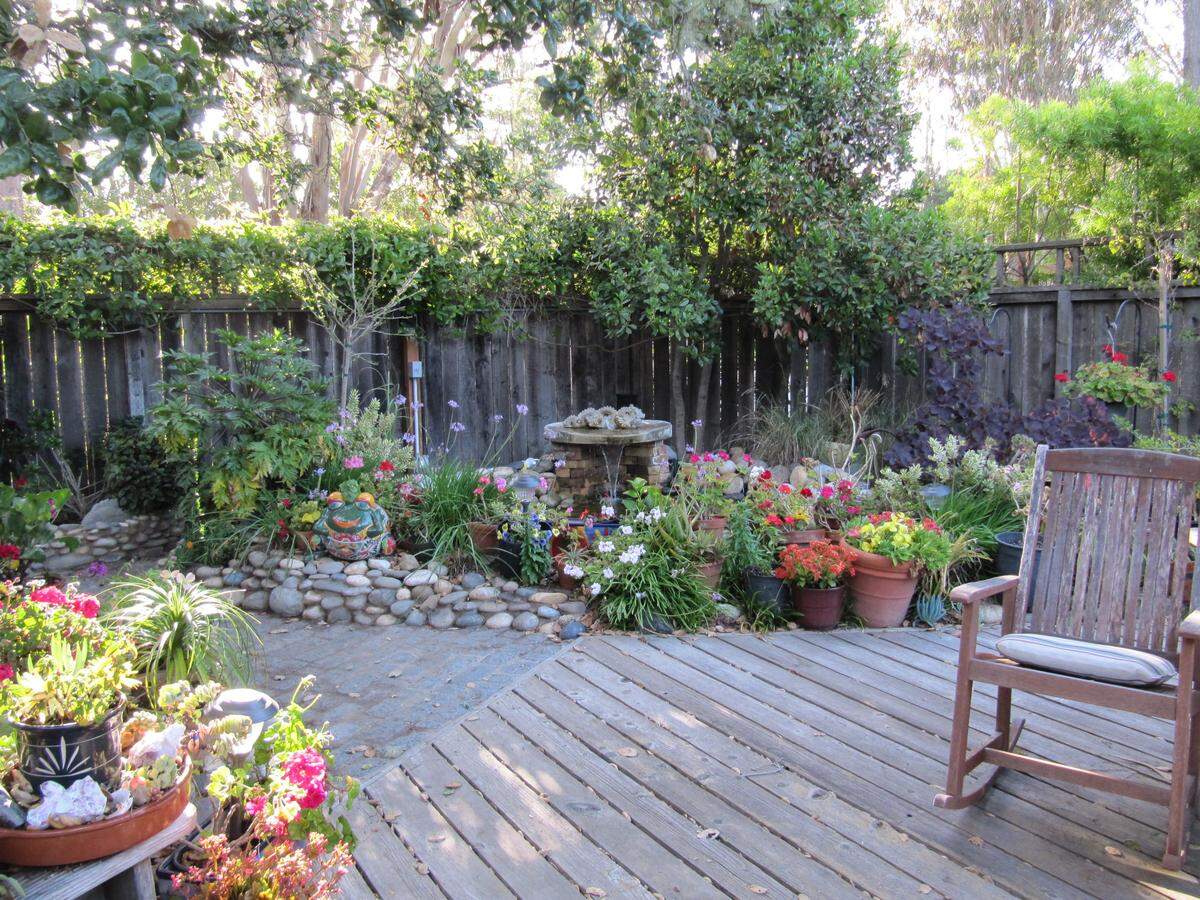
My joy carried over back home in our compact, enclosed Zen garden although through different eyes.
An interloper deer recently squeezed through a smallish hole in the garden’s 7-foot-tall fence, then squiggled past a Japanese maple and rose bush to dine on the floral buffet we’d so kindly provided.
That was the first time it had happened in 12 years.
Fortunately, I spotted the deer before it ate every blossom and plant in the garden.
So I still have one orchid bloom left on a long, stripped-down spike, a random spray of lavender and one rose. Who knows how that one escaped?
The geraniums and pansies were denuded of color, but our hungry guest didn’t pull them up, so they’ll bloom again.
Thank heavens that the pond, big old oak, Japanese maples and bay tree still anchor the peace and quiet that make the area lovely. With or without blooms.
And yes, we’ve blocked the hole in the fence.
Cambria garden club offers help
Surveying the leftovers, I understood again the attraction of belonging to a garden club, of banding together with knowledgeable friends to learn more about creating a place of year-round beauty.
There are quite a few garden clubs in San Luis Obispo County, but Cambria, a village with 6,000 or so residents, has at least three of them.
What happened after the original Cambria club formed in 1967? Was there a struggle for the leadership role, or a personality clash?
Apparently, it was nothing that dramatic, according to memories that longtime member Betty Fiscalini shared years ago with her daughter, Gloria Fiscalini of Cambria.
Betty died in 2013, but Gloria has carried on in what has for many years been referred to as The Garden Club, with a strong emphasis on “The.”
Then, as is often the case now, the club’s meetings were held at someone’s home, with the hostess-of-the-month providing refreshments and gardening enlightenment — and arranging the occasional field trip.
The club’s membership was and still is capped at 25, Gloria explained with a chuckle, “because that’s how many would fit into a family’s living room.”
The group was so popular that it maintained a waiting list of wannabe members.
And joining the club wasn’t automatic when a vacancy occurred.
“A member had to invite you to join,” Gloria said. “They’d always say they were in ‘the’ garden club because it was so hard to get into.”
In fact, she explained, “Somebody would have to move away, drop out for some reason, have health or family issues or die” for a spot to open.
As the decades went by, the club evolved into a monthly social-and-garden gathering, always with an annual overnight bus trip, semi-monthly field trips and the Pinedorado plant booth, she said, but it was always wrapped around the landscaping theme.
Because bus tours were limited to 45 people, the attendee list could expand to include nonmembers, and scoring a seat on that bus was considered to be a coup.
By then, other gardening enthusiasts shut out of “the” club decided it was time to form another group, so one was launched at the Joslyn Adult Recreation Center.
Darlene Wadsworth recalled that, in 1997, “when the Joslyn club dwindled, we went over to the Cambria Newcomers Club.”
Soon, that group — eventually dubbed Garden Club No. 2 — was full. Membership was capped at about 12 people, perhaps because modern houses were getting smaller or organizers preferred smaller groups.
Consuelo Macedo remembers being told in 2000 that Garden Club No. 2 was full, but as soon as five women who wanted to be in a new garden club banded together, they could start it under the Newcomers umbrella.
So they did, and Cambria’s garden clubs continued to flourish.
However, like most other things in the past year and a half, club membership and attendance have been erratic.
The Garden Club is down to 17 members, Gloria said, and each is encouraging like-minded friends to join.
Maybe I should sign up. I wonder if they’d have me?
After all, I’m the gal whose small, protected garden, with its high fence, briefly became a buffet grazing line for deer.